
There is a quiet truth about crypto that most builders eventually learn the hard way. Technology alone doesn’t bring people in. Experience does.
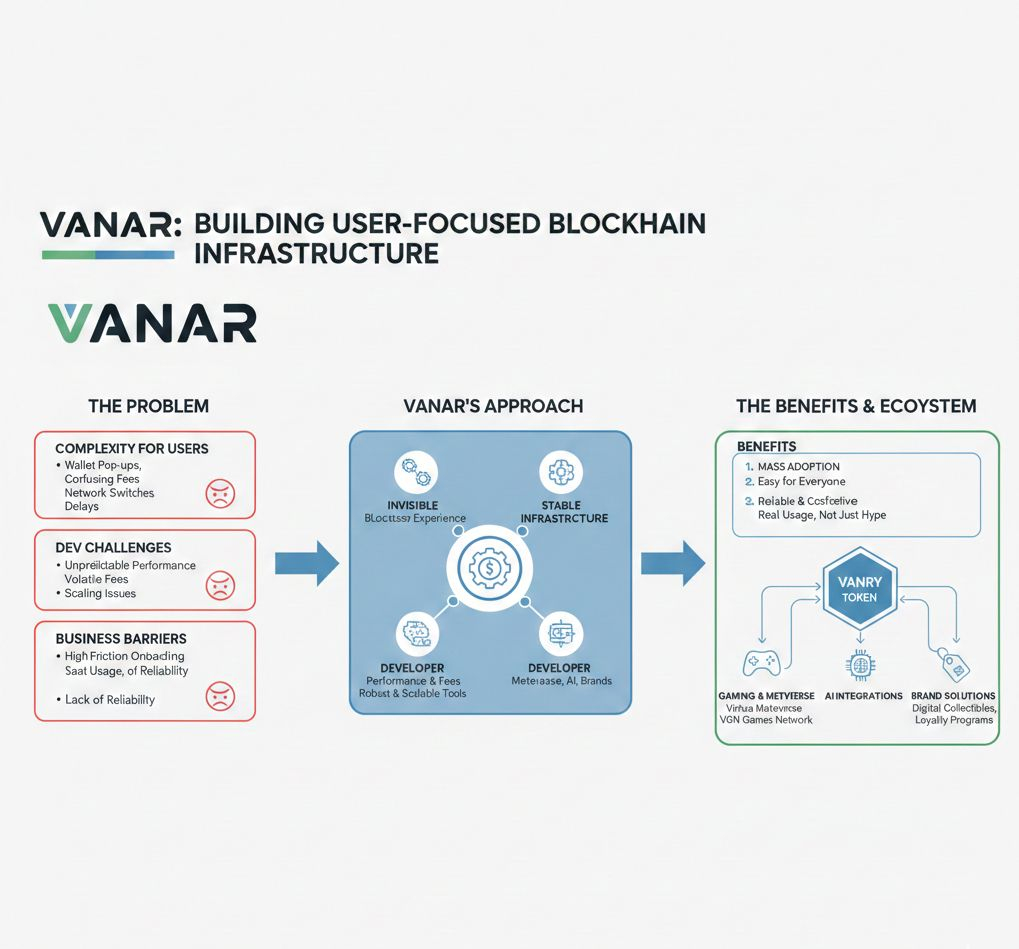
Over the last few cycles, we have seen chains compete over speed, TPS, and technical elegance. Those metrics matter, but they don’t solve the everyday frustration a normal user feels when they try to interact with Web3 for the first time. Wallet pop-ups, confusing fees, network switches, transaction delays — none of that feels intuitive to someone who just wants to play a game, collect a digital item, or interact with a brand they like.
Vanar feels like it understands that gap.
Instead of positioning itself as just another high-performance Layer 1, Vanar is structured around a simple idea: if Web3 is going to reach billions of users, the blockchain layer must feel invisible. It should behave like normal internet infrastructure. It should not demand that users become mini-experts before they can participate.
That mindset is especially relevant in this phase of the market. Retail enthusiasm is more cautious. Liquidity is selective. Hype cycles burn out faster. What survives now is usability. Projects that reduce friction rather than amplify complexity are the ones that quietly compound.
Vanar’s focus on gaming, metaverse environments, AI integrations, eco systems, and brand solutions is not random. These are areas where mainstream users already spend time. People understand games. They understand digital collectibles. They understand brand loyalty programs. What they don’t understand — and shouldn’t need to — is how gas pricing mechanics work under the hood.
From an infrastructure-first perspective, that changes how you design a chain. It means thinking about predictable performance instead of peak theoretical throughput. It means ensuring that fees are stable enough for businesses to plan around. It means giving developers tools that don’t break when usage spikes. A consumer-focused blockchain must behave like dependable product infrastructure, not like an experiment.
That’s where assets like Virtua Metaverse and the VGN games network become important. They aren’t just ecosystem logos. They are real environments where the chain gets tested by actual behavior. When users log in, interact, mint items, or trade assets, the network is under real pressure. Those moments expose weaknesses quickly. If the infrastructure holds steady during those periods, credibility builds naturally.
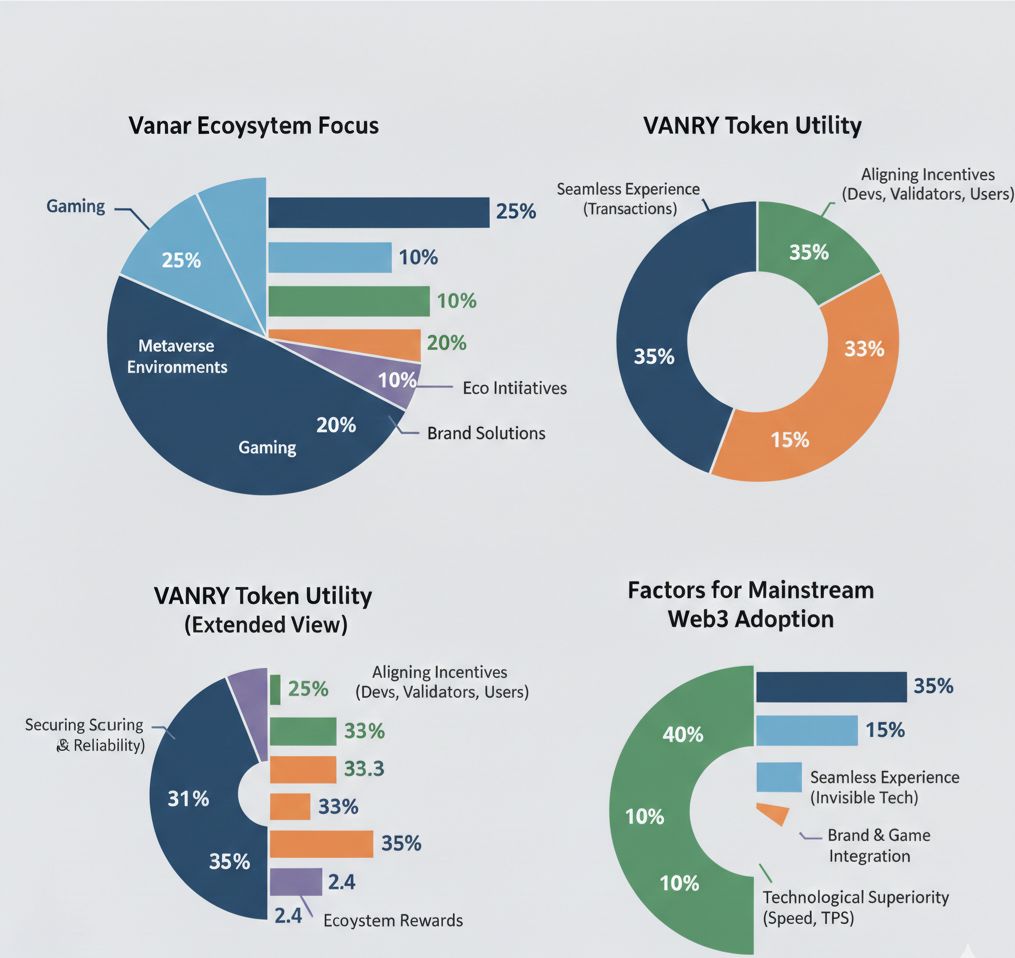
The VANRY token sits at the center of that structure. For a token to feel healthy, it must serve a clear purpose inside the network. It should secure the chain, facilitate transactions, and align incentives between developers, validators, and users. When token design becomes disconnected from usage, speculation overtakes substance. The stronger model is when token demand grows because people are actually using the network.
In this cycle, gaming and metaverse narratives are no longer inflated the way they once were. That’s not a negative. It forces discipline. It forces projects to build working products instead of promising abstract futures. Vanar is competing in a space where players like Immutable, Ronin, and Polygon already have traction. That means execution must be sharp. Partnerships must convert into active usage. Tooling must be stable. Documentation must be clear.
There is also a deeper risk worth acknowledging. Multi-vertical ecosystems can stretch focus. It’s easy to announce integrations across gaming, AI, eco initiatives, and brands. It’s harder to sustain each vertical with equal strength. Consumer adoption requires patience and consistent support. Studios and enterprises do not tolerate unstable infrastructure. They choose reliability.
From a market psychology standpoint, consumer-oriented chains often move differently than DeFi-heavy ecosystems. DeFi can generate fast liquidity spikes. Consumer ecosystems grow more gradually. They rely on retention rather than short-term incentives. That slower growth can feel boring in speculative phases, but it tends to be more durable.
As a trader, that difference changes how you approach positioning. Projects like Vanar are rarely pure momentum plays. They are execution plays. The signals that matter are not only price candles, but ecosystem activity — user retention in games, recurring transactions, developer expansion. Accumulation, for those considering it, usually aligns better with broader market consolidation rather than euphoric surges.
A contrarian thought is that early-stage consumer adoption may prioritize reliability over ideological decentralization. Crypto natives often treat decentralization as the primary feature. Mainstream users prioritize functionality. They want the product to work every time. If a chain can deliver smooth experiences consistently, adoption can precede philosophical alignment. Decentralization layers can deepen over time as the ecosystem matures.
Vanar’s long-term opportunity lies in becoming infrastructure that users don’t consciously think about. When someone earns an in-game item and it just appears instantly. When a brand launches a digital collectible and onboarding feels familiar. When users participate without friction. That is when blockchain begins to feel normal.
Having watched several cycles unfold, one pattern stands out. The loudest projects are not always the ones that endure. The ones that focus on usability, align incentives properly, and keep building during quiet phases often emerge stronger.
Vanar does not need to promise dramatic disruption. It needs to prove consistency.
If it continues building infrastructure that supports real products and real user behavior, credibility will compound over time. And in markets like this, credibility is more powerful than noise.
From a trader’s seat, I don’t look for perfection. I look for steady execution and improving fundamentals. If Vanar continues to strengthen its ecosystem while maintaining disciplined token mechanics, it becomes something worth tracking not because of hype, but because of structure.
And structure, more often than not, is what survives when cycles turn.
