
The other day I tried to send a small trade during a volatile hour and caught myself staring at the confirmation screen, waiting. It wasn’t even a long delay. Maybe a second. But in markets, a second stretches. You feel it. That’s when I started thinking again about this obsession with “the fastest Layer 1.” It sounds technical, almost abstract. Yet it comes from something very ordinary: nobody likes waiting when money is moving.
Speed in blockchains usually gets reduced to numbers. Block time. Finality. Transactions per second. If a chain says it has 40 millisecond block times, that means it can produce 25 blocks every second. On paper, that feels decisive. Fast. Clean. But those numbers don’t trade. People do. And what traders really care about is whether the network feels predictable when things get messy.
Fogo has positioned itself directly in that tension. Not just “we’re fast,” but “we’re built for execution.” That’s slightly different. Execution is about how quickly and reliably a transaction goes from intention to settlement. If latency is low, meaning the delay between submitting and confirming a transaction is tiny, strategies that depend on tight timing become realistic. Market makers, the firms that constantly post buy and sell orders, live in that world. A few milliseconds shaved off round-trip time can change their risk model.
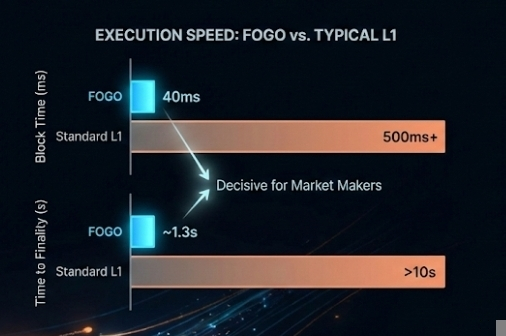
But here’s something that doesn’t get said enough: most users aren’t market makers. If I’m moving assets between wallets, the difference between 500 milliseconds and 40 milliseconds is barely noticeable. It feels instant either way. So when people say Fogo might be “winning the race,” I always pause and ask, winning for whom?
There’s also the matter of throughput. Throughput is simply how many transactions a network can process per second. High throughput matters during peak demand. When markets spike and everyone tries to act at once, weaker systems clog. Fees rise. Transactions fail. If Fogo can maintain stable performance under that stress, that’s meaningful. Stability during chaos is worth more than impressive lab benchmarks.
Still, high performance comes with trade-offs. Validators, the nodes that secure and confirm transactions, often need stronger hardware in ultra-low latency systems. Stronger hardware means higher costs. Higher costs can reduce the number of independent validators willing to participate. And that’s where decentralization quietly starts to thin out. It’s not dramatic. It just shifts, gradually.
I don’t think this makes Fogo flawed. It just means every design choice has a cost somewhere else. We tend to talk about blockchain upgrades like they’re pure improvements. They’re usually rebalancing acts.
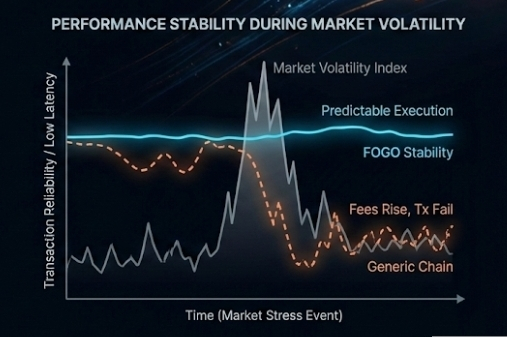
Another layer here is perception. On Binance Square, performance narratives spread quickly. Posts with charts showing 40ms blocks or claims of near-zero friction get amplified if engagement rises. Ranking systems and AI-driven visibility tools reward what people react to. That creates feedback loops. If speed becomes the dominant talking point, it reinforces itself, regardless of whether users have directly felt the difference.
And yet, I can’t dismiss what Fogo is trying to do. Focusing narrowly on execution infrastructure is at least intellectually honest. Many Layer 1 projects describe themselves as “general-purpose,” which often means everything and nothing. Fogo seems to be saying: we care about trading performance first. That clarity helps developers decide whether it fits their needs.
But winning a speed race is strange in this industry. There’s no finish line. Hardware improves. Competitors optimize. What feels cutting-edge today becomes baseline tomorrow. I’ve watched this cycle repeat. First it was seconds. Then sub-second. Now we’re measuring in milliseconds. The bar keeps moving.
The more interesting question might not be whether Fogo is the fastest right now. It might be whether it can turn speed into durable activity. Real activity. On-chain volume that isn’t just speculative bursts. Developers who stay. Liquidity that doesn’t evaporate at the first sign of stress.
Because I’ve seen fast systems before. Some faded once incentives cooled. Others slowed down as complexity grew. Sustaining performance over time is harder than launching with impressive metrics.
If I’m honest, I don’t care about the headline number as much as I care about how a network behaves on a bad day. When volatility spikes. When thousands of users rush in. When something breaks elsewhere in the ecosystem. That’s when infrastructure proves itself.
Maybe Fogo is ahead right now in raw execution speed. It certainly seems focused enough to compete seriously. But the race itself keeps changing shape. Speed attracts attention. Reliability keeps it. And sometimes the chain that feels quietly dependable ends up mattering more than the one that briefly held the stopwatch record.