
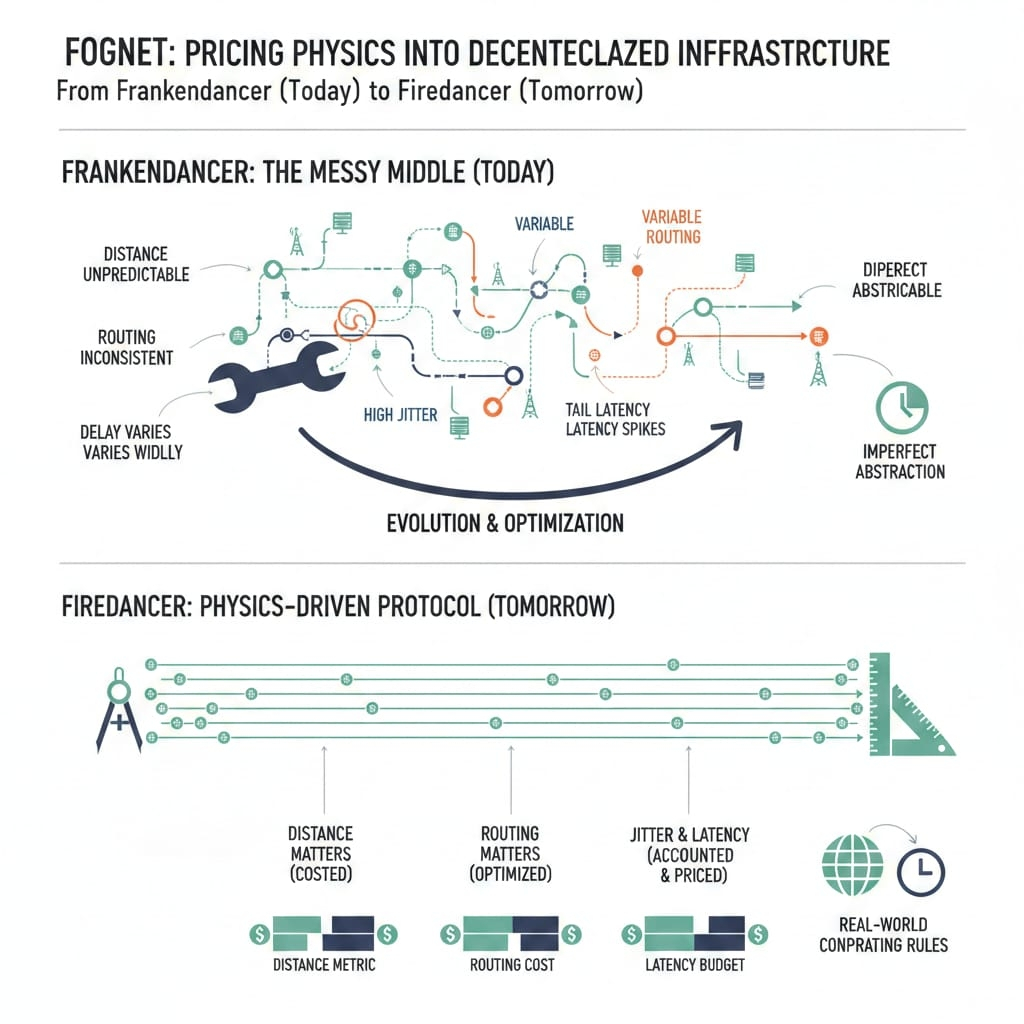
The more time I spend thinking about Fogo, the less it feels like a typical blockchain project and the more it feels like a systems project that happens to live inside crypto, and that difference matters in ways people usually notice too late, because most chains are designed as if the network is an abstract space where messages magically move, while real networks are messy, uneven, and shaped by geography, hardware limits, and human operations that do not care about narratives or token prices.
What stands out to me is that Fogo seems to start from the uncomfortable truth that performance is not only about how fast something can go in ideal conditions, but about how stable it stays when conditions get ugly, and ugly conditions are the default in real infrastructure, not the exception, because congestion, packet loss, uneven validator quality, and sudden spikes in activity are what actually define whether a system can be trusted as part of a larger workflow rather than just admired in benchmarks.
When people hear about zones and co-located validators, they often jump straight to concerns about centralization, and those concerns are real and should not be brushed aside, but there is also a deeper engineering logic underneath that is easy to miss if you only look at decentralization as a count of nodes rather than a question of how the system behaves under stress, because if your validators are scattered across continents, you can optimize software all you want and you will still hit the limits of physics, and once timing starts to affect outcomes in things like settlement flows or liquidation logic, small delays turn into structural risk that no amount of marketing can fix later.
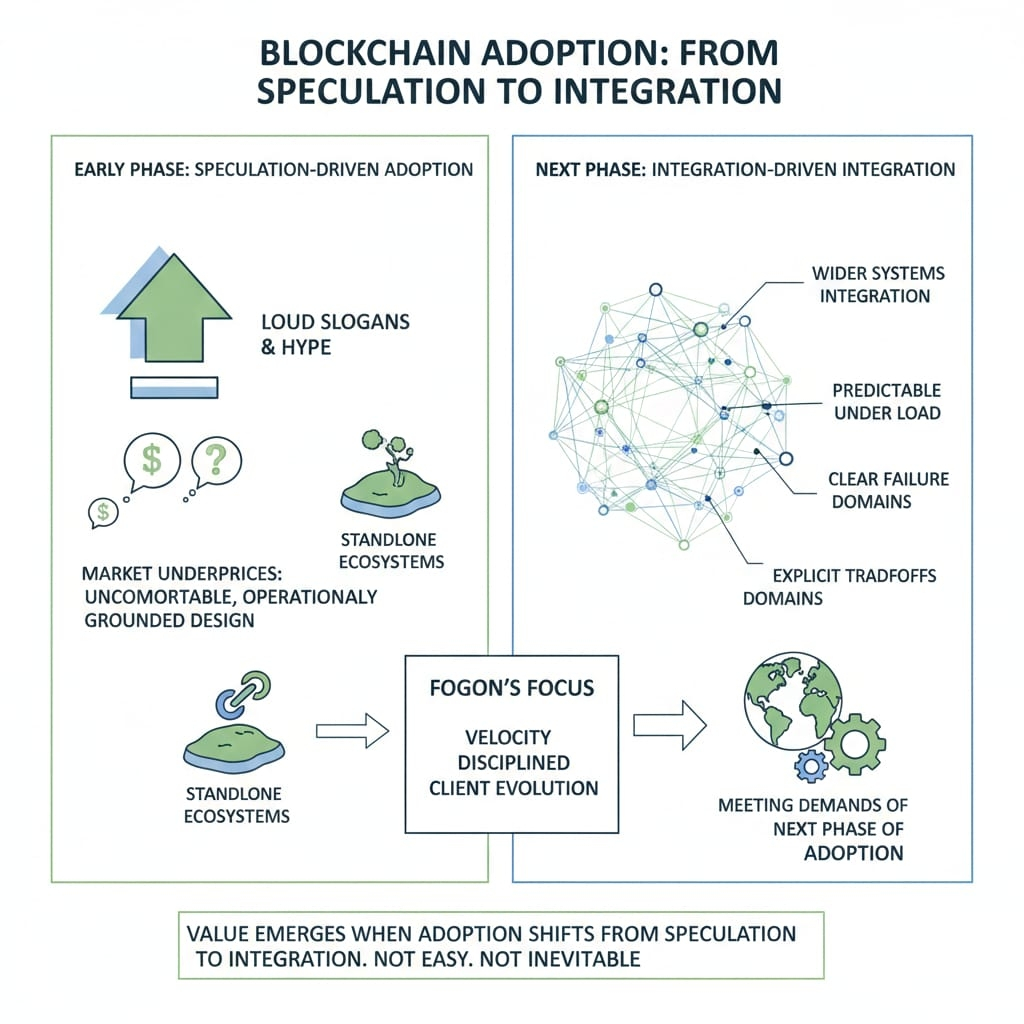
What feels different here is that Fogo is not pretending those tradeoffs do not exist, and that honesty is rare in crypto roadmaps, where everything is usually framed as upside with no cost, because acknowledging tradeoffs means you also accept accountability for them, and curated validators, rotating zones, and staged client transitions are all choices that create new responsibilities for the project over time, not just technical advantages, since the system now has to prove that these mechanisms stay flexible and do not harden into permanent power structures that are impossible to challenge.
The Frankendancer to Firedancer path fits into this same philosophy of being willing to live in the messy middle instead of pretending a clean rewrite is easy, because real infrastructure almost never moves from old to new in one clean step, and the risk is not in admitting that, but in failing to manage the long period where hybrid systems exist and edge cases hide, which is usually where reliability is earned or lost in ways users only notice when something breaks during peak demand.
I think the deeper bet Fogo is making is not on speed itself, but on predictability, because speed without predictability is just a number that looks good in isolation, while predictable behavior under load is what lets other systems build on top of you without constantly defending against worst case scenarios, and once blockchains start being treated as components in larger operational stacks rather than isolated worlds, that difference becomes the line between something that can be integrated into real processes and something that stays mostly speculative.
None of this guarantees that Fogo will win, and in fact the path they are choosing is harder than simply promising more throughput and hoping the details sort themselves out later, because governance around zone rotation can become political, curated validator sets will always face pressure and criticism, and migrating clients in production is where even mature systems have historically stumbled, but the uncomfortable work of making these tradeoffs explicit is often what separates systems that survive early adoption from those that only look impressive before real load arrives.
If the next phase of crypto is less about isolated ecosystems and more about integration into real operational environments, then the projects that quietly design for failure modes, tail behavior, and operational discipline may end up being more important than the ones that win short term attention, and Fogo’s approach feels like a bet on that future, not as a promise of inevitability, but as an attempt to build something that can be judged like infrastructure rather than like a story.