
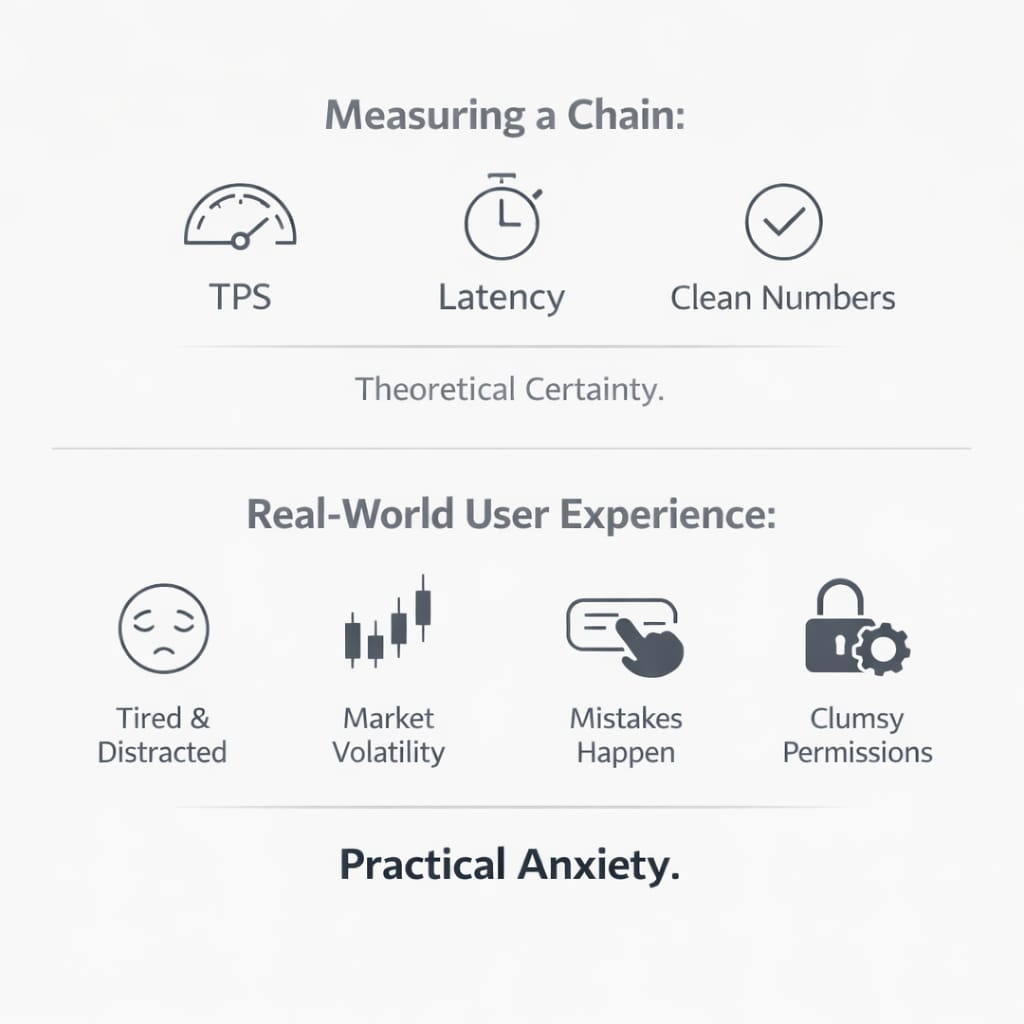
The first mistake is always the same. We measure a chain like we measure a race car on a straight road. TPS. Latency. A clean number that looks like certainty. Then we pretend that certainty is the product.
It isn’t.
In the real world, speed is not the moment the block lands. Speed is what a user has to do to safely get from intention to execution, again and again, when they’re tired, when the market is moving, when their finger slips, when their confidence is already thin. If the chain is fast but the permission model is clumsy, the system still feels slow. Not in milliseconds. In anxiety.
I understand why people start with performance. I did too. Sub-100ms consensus catches your attention. SVM alignment makes builders feel like they’re not starting from scratch. Firedancer roots carry the quiet implication that serious engineers have put their hands on the problem. You notice these signals because they are visible, and because they are easy to repeat in a meeting.
But after a few late nights of watching logs and wallets and users do the same wrong thing for the same reason, the question changes. It stops being “how fast can we confirm?” and becomes “what are we asking people to approve in order to move this fast?”
DeFi has a particular kind of pain that doesn’t show up on chain dashboards. It’s the click pain. The dull, repetitive, guilt-inducing rhythm of approval prompts. Trade. Approve. Modify. Approve. Cancel. Approve. Re-enter. Approve. The system trains the user to stop reading. The user trains themselves to click through discomfort because they want to keep up.
When we criticize that experience, we usually frame it as a nuisance. But it’s more than that. It’s a behavioral lesson. Over time, repeated prompts don’t make people more careful. They make people numb. And numb is a dangerous state when you’re handling real funds.
So users look for the exit. And the exit, too often, is a blanket permission. One approval that makes everything smooth. One approval that quietly turns the wallet into an unlocked room. You feel the relief immediately. You also feel the unease, even if you can’t name it. Because you didn’t grant capability. You surrendered it.
This is where the conversation should have started all along. Not with TPS. With permissions. With the way a chain’s ecosystem teaches people to hold their own keys without turning their day into a sequence of frantic confirmations.
That’s why Fogo Sessions matters more than the usual performance bragging rights, and why it belongs in an operations discussion instead of a marketing one.
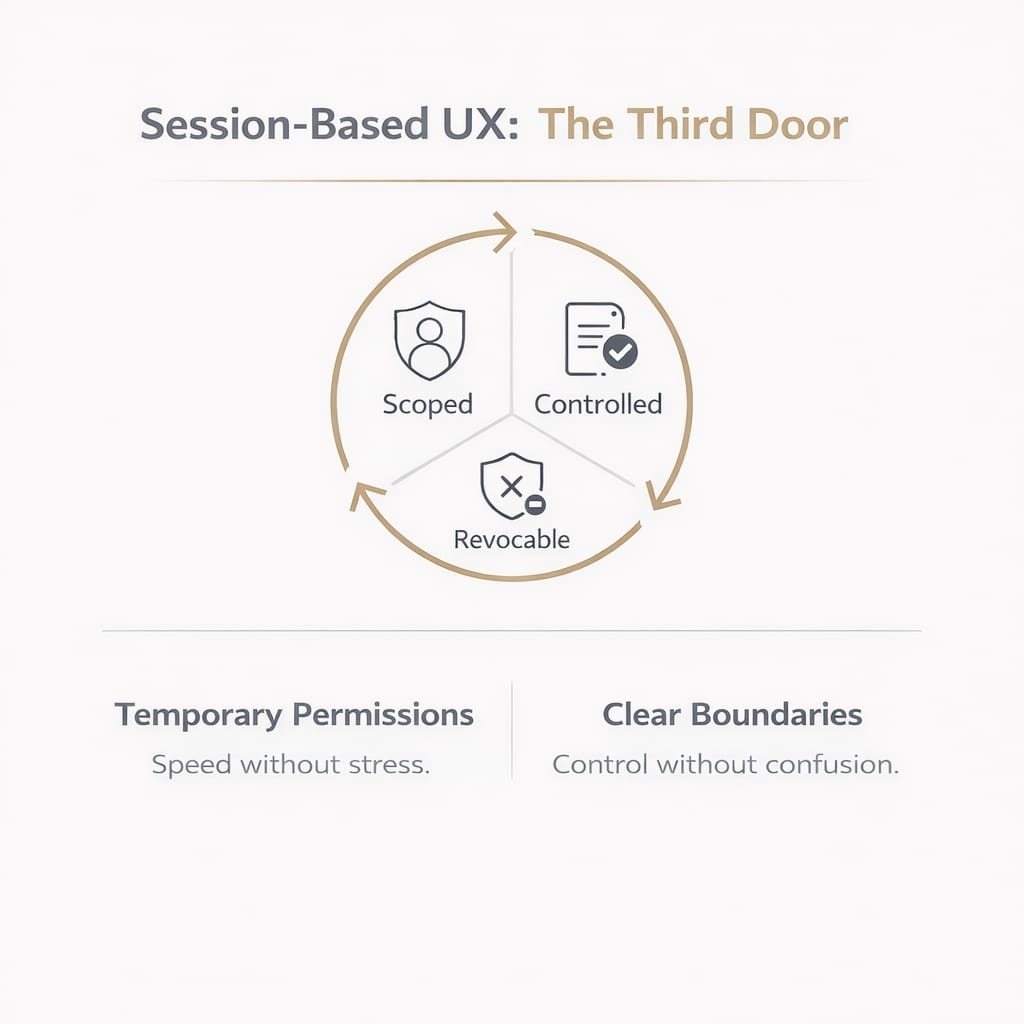
A session is easier to understand if you remove the blockchain vocabulary and think like a person who has used modern apps. A session is a temporary permission card. A temporary access pass. You give an application limited ability to do certain actions for a short time, within boundaries you can explain without a diagram. Then the pass expires. Or it hits a limit and stops. Or it tries to do something outside the allowed scope and fails.
You don’t approve every single action. You also don’t hand over your wallet.
You grant a controlled window of behavior.
This is the thesis, stated plainly because it has to be explicit to be useful: scoped delegation plus fewer signatures is the next wave of on-chain UX.
That sentence sounds simple, and it should. The best operational truths usually do. They’re the kind you can repeat in a risk review without watching people’s eyes glaze over.
The shift Sessions suggests is not cosmetic. It changes the posture of the wallet. Today, the wallet is often either an anxious clerk stamping every page, or an unlocked door because stamping every page was unbearable. Sessions introduces a third posture: a gate with rules. An agreement that looks like this, in human terms.
This app can do these kinds of things. For this long. Up to this amount. From this verified place.
If you’ve ever sat through a compliance call, you recognize that structure immediately. It’s not a technical model. It’s a control model. It’s how adults talk about delegating power without losing oversight.
And it fits trading, because trading is not one action. Trading is a chain of small actions that happen under time pressure. That’s the whole point of a trading interface: to let someone do many small things quickly without losing their place.
A normal trading session is messy. Place. Modify. Cancel. Re-quote. Switch markets when liquidity shifts. Move margin. Rebalance exposure. Add collateral. Withdraw dust. These are not “advanced” features. This is what the day actually looks like when someone is active. If every one of those steps requires a fresh signature, the product becomes a negotiation with the wallet. If the only way out is blanket permission, the product becomes a gamble with the wallet.
Neither outcome is acceptable if you want people to use the system with calm.
And calm is the real scarce resource. Not bandwidth. Not blockspace. Calm.
People like to say adoption is blocked by hacks. Hacks are part of it, but they’re not the whole story. Another part is fear and confusion. The quiet fear of not understanding what you just approved. The confusion of prompts that all look the same when you’re rushing. The creeping suspicion that you’re being asked to authorize something you can’t properly inspect.
You don’t need a breach to lose a user. You only need a moment where they feel stupid, or exposed, or out of control. They stop coming back because the system asked them to behave like an expert when they are just trying to do a simple thing quickly.
Two safety controls make sessions feel like they were designed for ordinary people, not for demos.
The first is spending limits. A hard ceiling. Something you can state out loud. “This app can spend up to this much during this session.” That doesn’t guarantee perfection, but it changes the shape of the risk. It turns unknown exposure into capped exposure. That matters when you’re trying to sleep, or when you’re managing money on behalf of someone else and you need to justify your controls without hiding behind jargon.
The second is domain verification. Most users don’t think in addresses. They think in places. Sites. Apps. A familiar domain is the anchor for their trust, even if they don’t realize it. Domain verification ties the permission to the place the user believes they are interacting with, reducing the chance that a lookalike interface becomes the owner of a powerful approval. That matters not because users are careless, but because adversaries are patient.
This is also where the developer perspective becomes unavoidable. Permission handling cannot be a series of clever one-off hacks per app. When every team invents its own delegation model, the ecosystem fractures. The prompts look different. The limits behave differently. Revocation is buried in different menus. Expiry semantics shift from one product to the next. Users don’t learn. They memorize. And memorization fails the first time they’re stressed.
Consistency is underrated because it is boring. But boring is how trust is built.
The same kind of screen. The same kind of boundaries. The same language. The same expectation that when you grant a temporary pass, it expires, it obeys limits, and it is easy to revoke. Monotony feels unglamorous in a pitch deck. In operations, monotony is relief. It’s the difference between a system people can internalize and a system that constantly asks them to re-interpret danger.
So Sessions shouldn’t just exist. It should be treated as a standard primitive. Something applications can rely on in a common way. Something that comes with SDKs that push sane defaults instead of letting every team find the sharp edges alone. Something that comes with open examples that show what “good” looks like so that “good” becomes repeatable.
This matters beyond trading too, even if trading is the most honest stress test because it forces the issue into the open.
Once you accept the idea of controlled, temporary delegation, you start seeing all the other places it belongs. Subscriptions that should be capped and cancelable. Payroll-like payments that run on a schedule without requiring an executive to be awake at the wrong hour. Treasury operations that follow policy constraints instead of relying on perfect human vigilance. Scheduled tasks, alerts, triggers, recurring behaviors that are useful only if they are restrained.
This is where the title comes back into focus, in a way that isn’t just about geography as a performance trick.
Validator colocation and geography can shape execution quality because it shapes how the system behaves under load and under time pressure. Tight networks reduce delays. They reduce the wobble between intent and confirmation. They make the experience feel like it has fewer moving parts. That matters.
But even perfect timing doesn’t solve permission mistakes. In fact, speed can amplify them. A fast system with weak permission design accelerates the moment where the user clicks something they don’t understand. It reduces the time they have to hesitate. It turns “click now” into a default posture. It makes the approval model part of the chain’s execution profile, whether anyone wants to admit it or not.
Execution quality is not only whether a chain can move quickly. It is whether it can move quickly without forcing people into habits that betray them later.
There are two familiar doors in on-chain UX. One is endless approvals, where speed is paid for with constant interruption until the user stops reading. The other is blanket permissions, where speed is paid for by surrendering control and hoping nothing goes wrong.
Session-based UX is the third door. Temporary, scoped behavior that can be granted deliberately, bounded clearly, and revoked cleanly. Recurring action without turning the user into an approval-clicking robot. Control without paralysis. Convenience without the quiet feeling that you just handed your keys to someone you barely know.
If fast chains want to be judged like infrastructure, they should stop asking to be judged like scoreboard entries. Speed is half the story. The other half is permission design that keeps people in control while they move at speed. That’s the part that determines whether the chain’s performance turns into actual execution quality, or just a faster way to make the same old mistakes.
