
I felt it clearly the first time I helped a team underwrite a chain for production use, when the conversation moved from narratives to operational proofs. We were not asking how big the community was. We were asking the same boring questions Vanar’s model is built to answer. Who pays for uptime. Who pays for security. Who pays for fixes when something breaks at 2 a.m. The more we asked, the more I realized most token models are written like marketing plans, not like budgets.
That is why Vanar’s issuance split caught my attention. Validators have an explicit reward stream. Development has its own stream. Community incentives and airdrops sit in a separate bucket. It reads less like a single pot of emissions and more like a set of line items, which is exactly how operators think when they are deciding whether a system is dependable.
People in crypto argue about inflation as if the number alone tells the story. In practice, what matters is where issuance goes. A chain can emit tokens and still be disciplined if it is buying security and delivery. And a chain can brag about “low emissions” while quietly starving the validator set and the engineering team, then acting surprised when reliability slips.
I have watched what happens when the incentives are not balanced. Validators get squeezed, so participation drops or centralizes. Development becomes reactive, shipping patches late because there is no consistent capacity for audits, tooling, and incident response. Meanwhile the ecosystem budget gets spent like a campaign. Big pushes, thin follow-through. The chain looks busy, but the foundation is shaky.
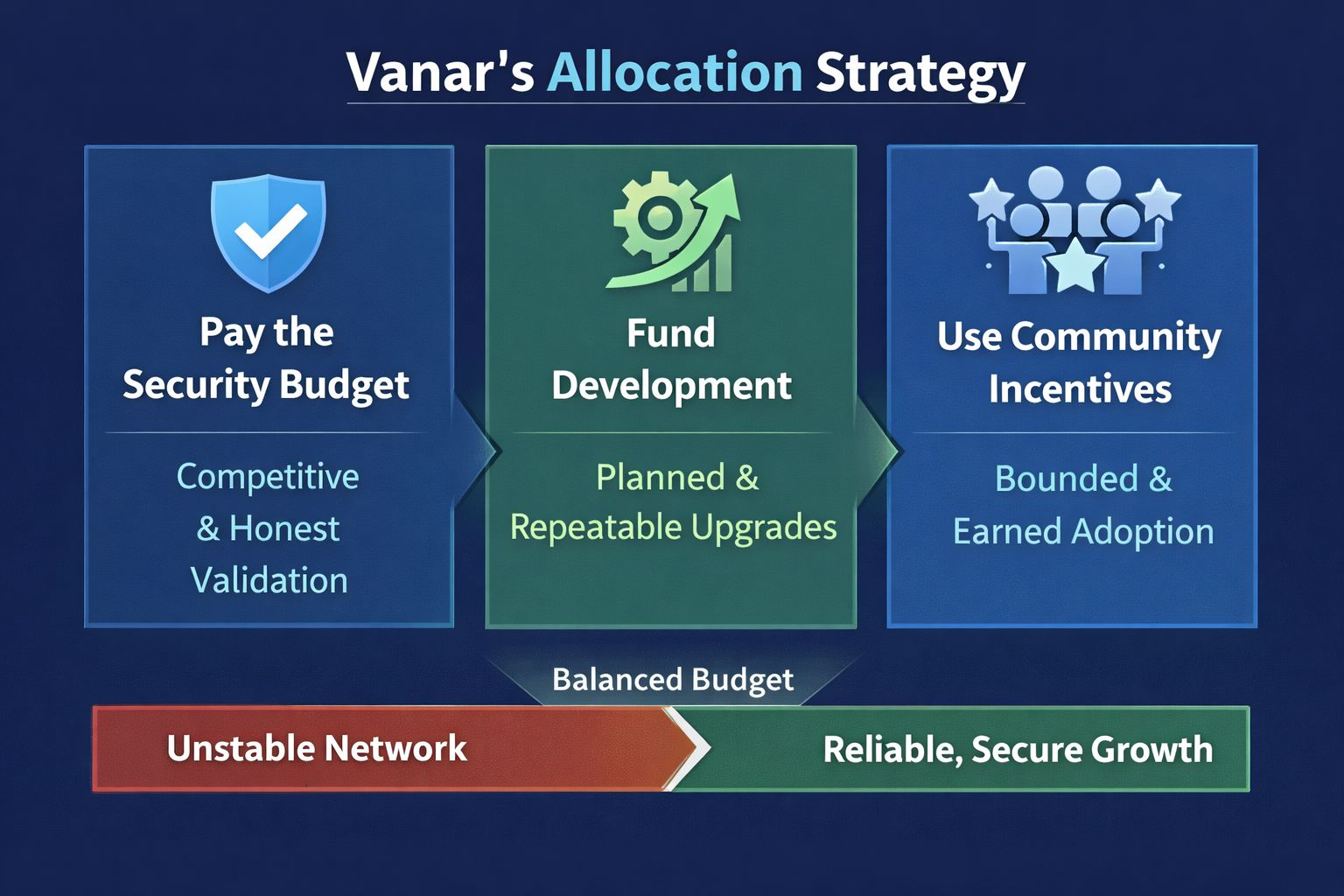
Vanar’s allocation signals a different posture. Pay the security budget so validation remains competitive and honest. Fund development so upgrades are planned and repeatable, not heroic. Use community incentives, but keep them contained so adoption is earned through product and reliability, not only through rewards.
I think about it like the week an exchange partner asked us for an uptime plan before they even talked marketing. They wanted to know who was on-call, how upgrades ship, what happens during an incident, and whether validator participation stays healthy when markets get quiet. If the only serious budget in the token model is “community incentives,” you can feel the risk immediately: validators churn, performance degrades, and the engineering team becomes reactive because there is no consistent capacity for audits, tooling, and fixes. But when issuance is explicitly split between validator rewards and development, you can answer those questions with something real. You can fund security, ship patches without drama, and keep the network stable while growth programs run on top, not instead of the foundation.
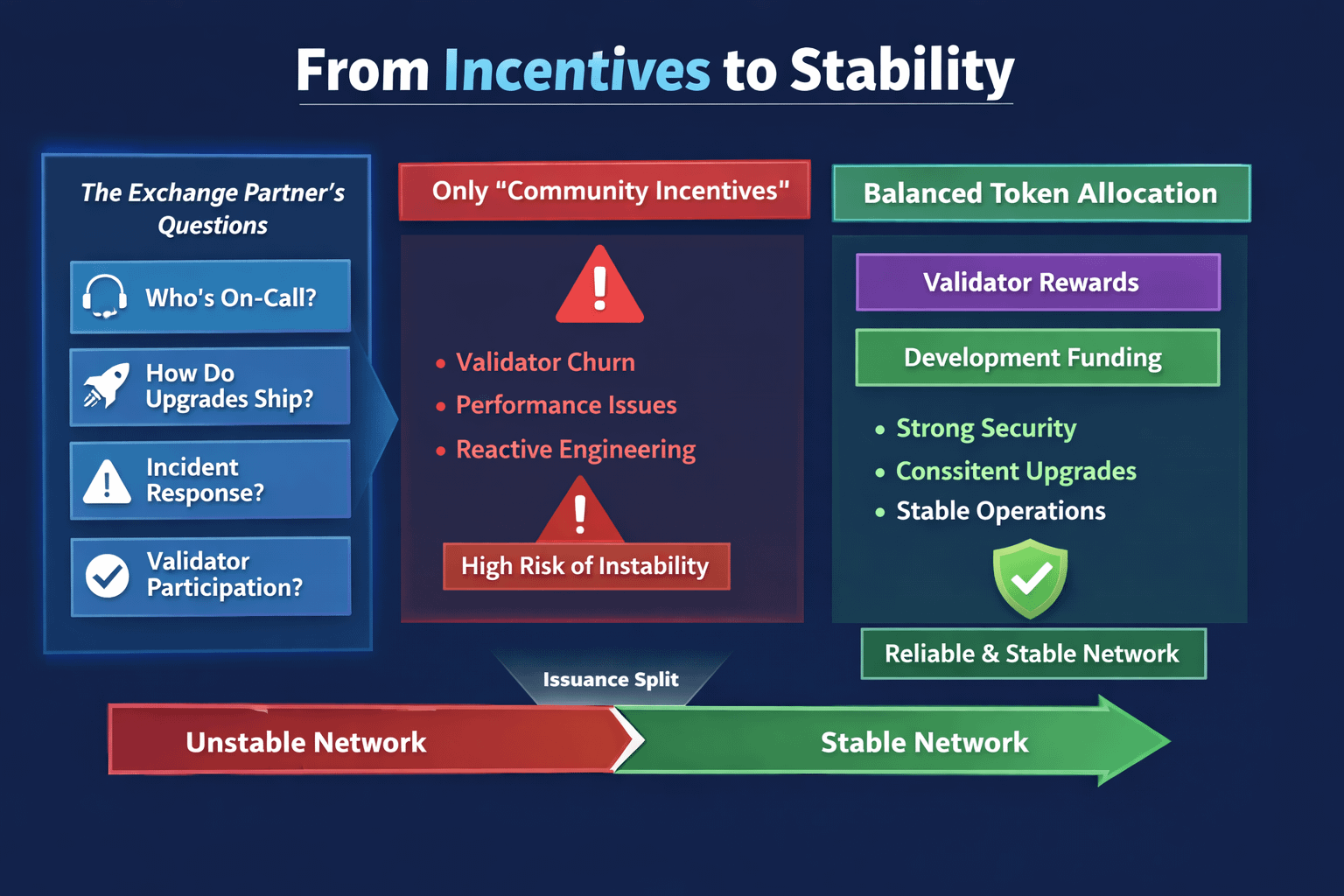
For instance, Imagine an exchange preparing a listing and setting limits. If validator rewards are too weak, downtime risk rises and the exchange tightens deposits and withdrawals. If development is underfunded, integration issues linger and support tickets pile up. A token model that budgets for validators and engineering reduces those operational surprises before they become headlines.
This is the upgrade from incentives as spectacle to incentives as operating discipline.
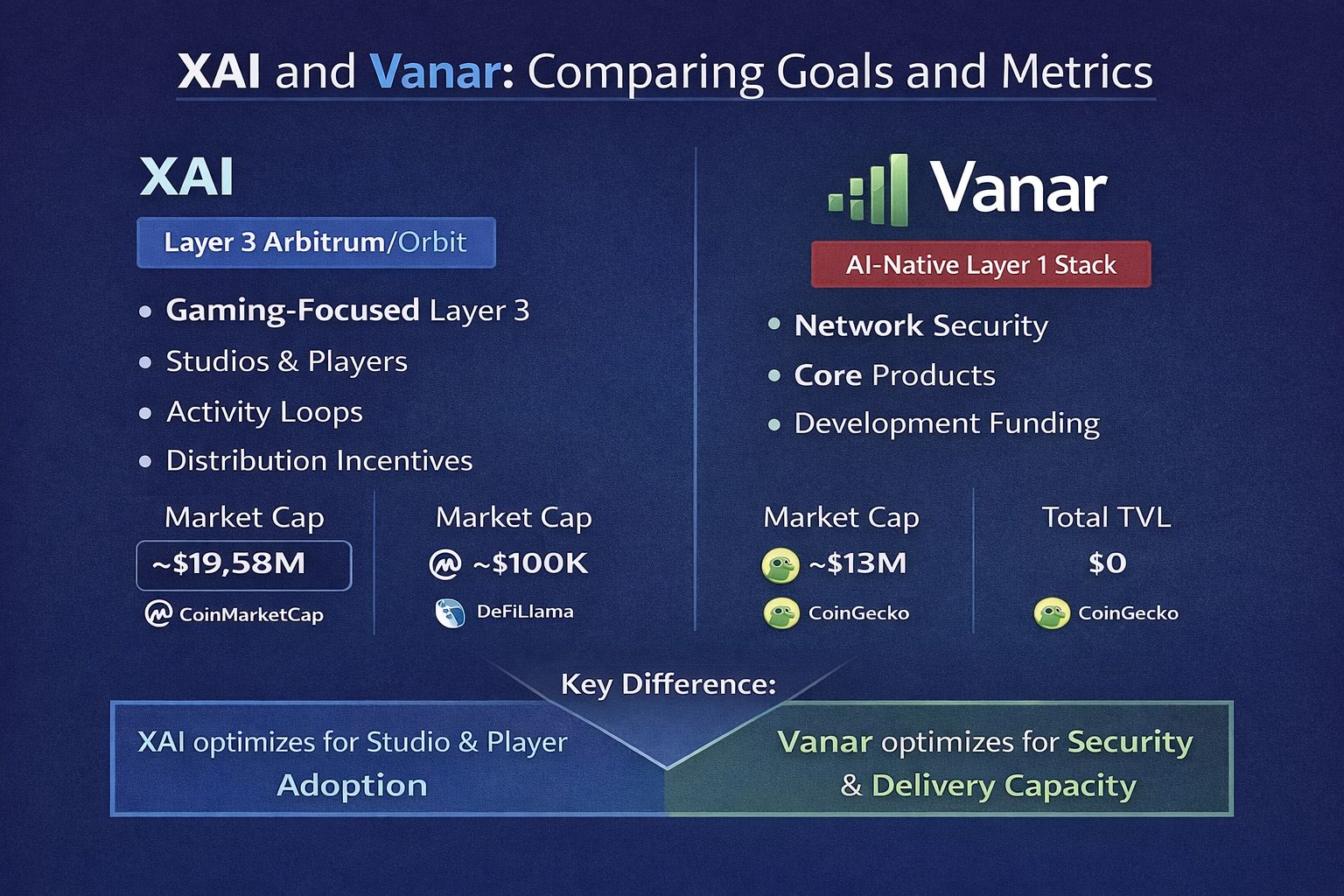
XAI and VANRY are solving different parts of the stack, and their numbers reflect that. XAI is explicitly a gaming-focused Layer 3 on Arbitrum/Orbit, so its token model and incentives are built to pull studios, players, and in-game economies onto a purpose-built execution environment, with distribution pressure naturally leaning toward ecosystem onboarding and activity loops. Vanar positions VANRY as an AI-native Layer 1 stack, so the emissions logic reads more like a budget for keeping the base layer secure and shipping the core product layers, not just subsidizing usage. On the scoreboard metrics, CoinMarketCap currently shows $VANRY around a ~$13M market cap and XAI around a ~$20M market cap, so $XAI is being valued higher despite being narrower in vertical focus. On TVL, DeFiLlama shows Xai chain TVL roughly ~$100k, while CoinGecko’s chain page for Vanar Chain shows TVL at $0, which is a reminder that TVL mostly measures DeFi liquidity, not whether an infra narrative is “real.” The practical takeaway is that XAI’s model is optimized for distribution-driven adoption in gaming, while Vanar’s model is trying to justify emissions as security + delivery capacity so the network can survive the moment incentives stop doing the heavy lifting.
The market often shrugs at this because it is not a short-term catalyst. A security budget does not trend. Development rewards do not produce a “number go up” moment. And restrained community incentives look boring next to aggressive giveaways. That reaction is normal. Most traders price momentum, not durability.
But the logic holds because the first buyers who care are the ones who have to live with the system. Exchanges, custodians, enterprise teams, and risk committees care about uptime, predictable upgrades, and clear accountability. They want to see that the chain can pay for the work that keeps it safe and usable.
As standards tighten across listings and operations, issuance design will be treated less like a narrative choice and more like underwriting. The winners will be the projects that can show their security budget is sustainable, their engineering is continuous, and their ecosystem incentives do not vanish when the campaign ends.
In short, the prize is institutional trust. And from where I sit, Vanar’s split looks like an attempt to earn that trust the practical way, by funding the parts that keep a network running when nobody is clapping.
