
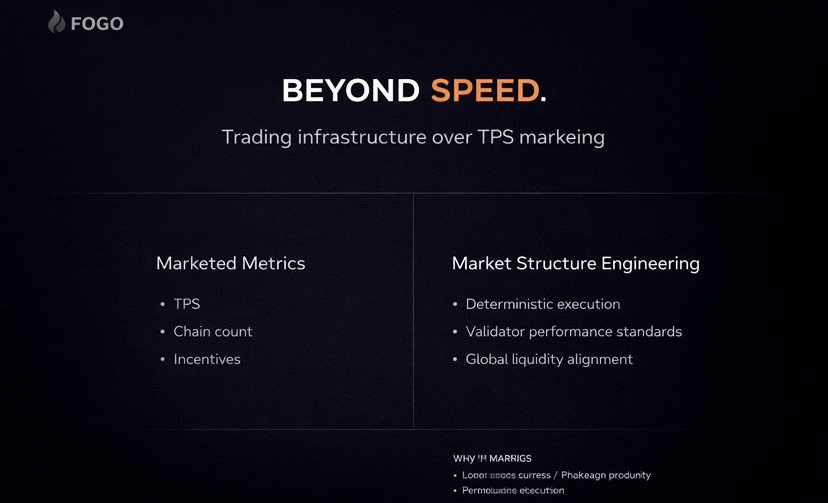
Whenever a new chain shows up, the conversation almost always starts in the same boring place: TPS, block times, latency. And I get it — speed is easy to market. But after spending time digging into Fogo, my takeaway is different.
To me, #fogo doesn’t feel like a chain that’s obsessed with being fast for bragging rights. It feels like a chain that’s obsessed with making trading feel more “real” on-chain — more aligned with how professional markets actually move, and less vulnerable to the ugly incentives that show up when every millisecond becomes a weapon.
And the funniest part? The speed isn’t the story.
Speed is just what becomes possible when the design is trading-first.
“Fast is not a feature. It’s a consequence of intent.”
“If a chain is built for markets, it should behave like a market.”
“Fairness matters more than hype — because hype doesn’t survive stress.”

The First Thing That Got My Attention: It’s SVM Without the Usual Rewrite Pain
One reason I’m even willing to take @Fogo Official seriously is that it’s built on the Solana Virtual Machine (SVM). That matters for a very practical reason: I don’t have to approach it like a totally new universe.
If you’ve ever built or traded across chains, you know the real tax isn’t learning one concept — it’s rebuilding an entire workflow. New tooling, new assumptions, new edge cases, new everything.
With Fogo, the pitch is basically: keep the SVM developer experience, keep the familiar execution environment, and let teams bring what already works with minimal friction.
And from a trader’s perspective, this is what I actually care about:
Can developers ship quickly without fighting the chain?
Can apps feel responsive without users signing their soul away?
Can the market structure reduce the “race to the next block” nonsense?
Because honestly… a fast chain that still produces unfair outcomes is not progress.
“I don’t want a faster casino. I want a cleaner market.”
“Follow-the-Sun” Consensus: A Weird Idea That Makes Sense for Trading
The most distinctive design choice I noticed is Fogo’s approach to validators and geography — what I’d describe as a follow-the-sun model.
Instead of acting like the world is one flat location, Fogo leans into reality: markets are global, and liquidity moves with time zones. So the network design tries to reduce physical distance to major market centers by rotating validator focus across major regions in defined windows.
The way I interpret this is simple:
Latency isn’t only a tech problem — it’s a geography problem.
If your chain is for trading, you can’t pretend location doesn’t matter.
If the network can stay “near” the world’s active market hours, execution behavior changes.
Now, does this introduce tradeoffs? Yes. Any approach that narrows or rotates validator participation needs to be watched carefully, because performance optimization can quietly become centralization if governance isn’t handled with real discipline.
But as a concept for a trading-oriented chain, it’s one of the few ideas I’ve seen that at least acknowledges the obvious:
“Markets don’t sleep — they rotate.”
The Real “Aha” Moment: Batch Auctions That Shift Competition Away From MEV Games
This is where Fogo gets genuinely interesting to me.
The first time I understood what Fogo is actually going after was when I looked into the market structure design around batch-style clearing — the idea that trades within a block can be processed as a group and cleared at a shared reference price.
Why is that powerful?
Because a lot of on-chain trading today turns into a sport of:
racing to be first,
outbidding each other for block space,
getting sandwiched,
and losing money to invisible intermediaries who are faster than you.
Batch-style execution changes the emotional logic of the market. If participants are cleared fairly within the same window, the competition becomes less about “who can cut the line” and more about “who offers the best price.”
That’s the kind of design that tells me Fogo isn’t trying to cosplay a centralized exchange. It’s trying to bring professional market mechanics on-chain without importing the worst parts.
“If everyone gets the same clearing price, speed stops being a weapon.”
“Less racing. More pricing.”
“A market should reward good quotes — not faster bots.”
And yes — the fact that Fogo is fast makes this feasible at the smart-contract level. On slower systems, these mechanics tend to break down or feel clunky. Here, the chain’s performance is enabling the structure rather than replacing it.
Sessions + Gas Sponsorship: Finally, On-Chain UX That Doesn’t Feel Like Self-Harm
Another thing I personally care about: user flow.
Most DeFi apps still feel like they were designed by someone who’s never watched a normal person use an app. Constant approvals. Constant signature requests. Constant interruptions.
Fogo’s “session” concept is basically a more modern way of thinking:
Instead of signing every click, I can approve a session once, define boundaries (limits, token scope, time window), and then interact smoothly until it expires.
In plain terms, it’s closer to how normal apps behave:
You authorize once,
you operate within permissions,
and you’re not spammed by popups every 12 seconds.
And if dApps can sponsor gas in certain flows, that matters too — because onboarding dies the moment new users hit friction.
“Good UX is a security feature.”
“If it feels painful, adoption won’t happen.”
“Trading needs flow — not interruptions.”
Of course, sessions also need to be handled responsibly. Permissioning is powerful, and power always cuts both ways. The “safe” version of this future is one where users truly understand limits and apps don’t overreach.
It’s Not Only a Chain — It’s a Trading Stack With Bridges, RPC, Oracles, and Indexing
What makes me take Fogo more seriously is that it doesn’t read like a chain that launched and then hopes “the ecosystem will figure it out.”
It’s positioning itself as an infrastructure bundle — the kind of thing traders and builders need on day one:
RPC and performance routing layers
bridges (and yes, bridging is always a risk category)
oracle integrations for market data
indexing to support real apps
an explorer experience that helps users verify what’s happening
That sounds basic, but it’s not. A lot of chains launch with vibes and a logo, then spend a year trying to patch the essentials.
Fogo feels like it’s trying to ship with the full checklist:
“A trading chain without infrastructure is just marketing.”
“Liquidity doesn’t care about your roadmap — it cares about reliability.”
The Validator Requirements Are Heavy — and That’s Both a Strength and a Warning
Let me be honest: the hardware requirements are serious.
When a network needs high-core CPUs, massive RAM, and fast NVMe performance, it’s usually because it wants to keep execution tight under load. That’s understandable for high-throughput systems.
But the tradeoff is always the same:
Strong performance can mean fewer operators qualify.
Fewer operators can mean tighter control.
Tighter control can mean governance risk if it’s not handled transparently.
So I don’t view the heavy validator profile as “bad” — I view it as a sign of what the network is optimizing for, and also a reminder to watch decentralization metrics over time.
“Performance is easy to admire. Concentration is easy to regret.”
$FOGO , Incentives, and the Part People Misunderstand About Points Programs
On the token side, I’m not looking at $FOGO as a meme or a price chart — I’m looking at it as the operational fuel of the system:
staking to secure the network
fees and usage
ecosystem incentives and builder support
What’s also notable is the separate “points” style incentive layer. I actually think this approach is smarter than many projects realize, because it creates a buffer between community participation and token expectations — reducing confusion and lowering the risk of people mentally treating “points” like guaranteed financial instruments.
That said, my rule is always the same:
If incentives are too generous, they attract mercenaries.
If incentives are too vague, they attract disappointment.
The best incentive systems are the ones that reward genuine usage without turning the whole ecosystem into a farming simulator.
“Incentives should create users, not tourists.”
“A points program should guide behavior — not promise wealth.”
My Risk Checklist: What I’d Watch Before Going Too Heavy
I don’t romanticize new chains. I like the ideas, but I respect the risks.
If someone asked me what to be careful about, I’d keep it simple:
Early-stage network risk: upgrades, client changes, unexpected instability
Validator concentration risk: performance focus can shrink operator diversity
Bridge risk: any large cross-chain movement increases exposure
Permission risk in sessions: convenience must not become careless approvals
If I’m personally testing something early, I’d do what I always do:
use a small dedicated wallet,
keep permissions tight and time-bound,
verify activity through the explorer,
and avoid moving “serious size” across bridges without strong reasons.
“Be early — but don’t be reckless.”
“Risk is not a vibe. It’s a checklist.”
Where I Land: Fogo Is Building For a Future Where On-Chain Trading Needs to Grow Up
My overall opinion is this:
Fogo is not trying to win with slogans. It’s trying to win with market structure, flow, and infrastructure — the unsexy things that actually decide whether a chain becomes usable for real trading activity.
The follow-the-sun design is unusual, but it’s grounded in a reality most chains ignore.
The batch-style mechanics are the most exciting part to me because they target the ugly incentive layer (MEV behavior) instead of pretending it doesn’t exist.
And the UX improvements (sessions, gas sponsorship) point toward something I genuinely want: on-chain trading that doesn’t feel like friction therapy.
Is it still young? Yes.
Is it risky? Absolutely.
But the direction feels intentional — and intention is rare.
“I’m not betting on speed. I’m watching for market quality.”
“The future of DeFi isn’t louder — it’s fairer.”
“If Fogo delivers reliability, it won’t need hype.”