
Some chains try to sell you a vision. Fogo feels more like it’s trying to fix a frustration.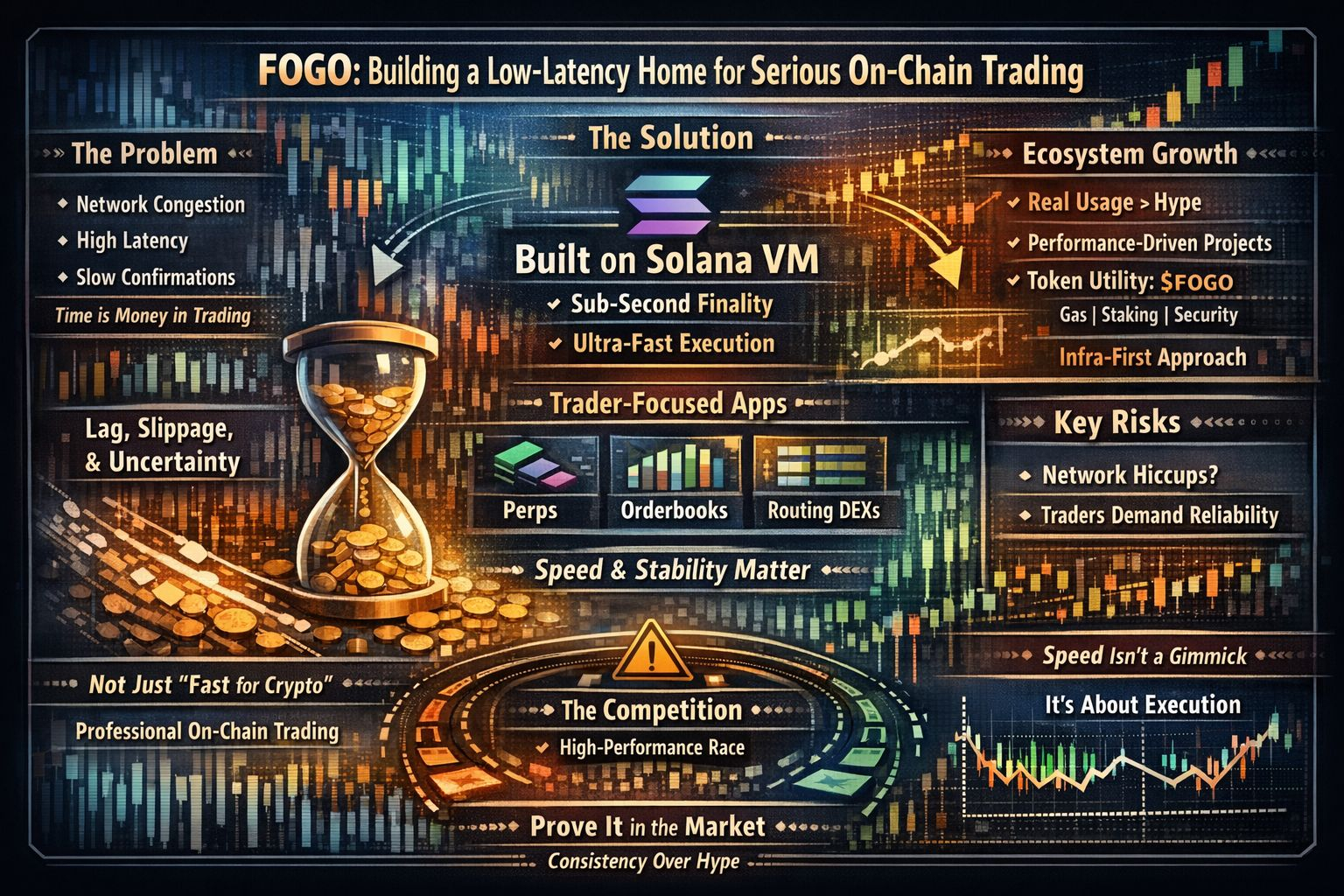
If you’ve traded through a few cycles, you know the feeling. You line up a clean setup, volatility hits, and suddenly confirmations lag, spreads widen, and execution becomes a gamble. We talk a lot about fees in crypto, but time is the hidden cost. Latency, finality delays, network congestion — that’s where real money quietly leaks. Fogo’s entire pitch, as a high-performance L1 built around the Solana Virtual Machine, is aimed directly at that pain point.
This cycle is different from the last one. On-chain trading is no longer experimental. Perps, orderbooks, complex routing — they’re becoming standard. But the infrastructure hasn’t always kept up with the expectations of serious traders. Fogo is leaning into the idea that if on-chain markets are going to compete with centralized venues, they have to feel just as responsive. Not “pretty fast.” Not “good for crypto.” Just fast, stable, predictable.
Choosing the Solana VM wasn’t random. It’s a practical decision. Developers already understand the environment. Tooling exists. There’s history behind it. That lowers friction. Fogo isn’t asking builders to learn an entirely new execution model; it’s trying to refine performance within a system that already proved it can handle real volume. That’s an infra-first mindset — less theory, more optimization.
What stands out to me is the focus on latency as a product feature, not just a benchmark. Sub-second confirmations, tight block times — these things matter when you’re trading size or building applications that depend on timing. Speed, in this context, isn’t marketing. It’s risk management. The faster and cleaner execution becomes, the less slippage and uncertainty traders face during volatile moments.
The token side is where things get more grounded. $FOGO functions as the network’s native asset — gas, staking, security. On paper, that’s standard for an L1. In reality, what matters is whether demand comes from real usage or just early speculation. Every new chain faces that phase where emissions and listings dominate the story. The shift from “narrative-driven demand” to “usage-driven demand” is the real test. If fees and activity grow organically, token mechanics begin to make sense. If not, price action can stay detached from fundamentals for a while.
Ecosystem growth will be decisive. An SVM-compatible chain can easily become a copy-paste destination unless it develops its own identity. For Fogo, that identity likely revolves around performance-heavy applications — perps, orderbook DEXs, liquidation engines, routing layers. Applications where milliseconds actually matter. If those projects find that Fogo consistently performs under pressure, that’s where stickiness begins.
Market positioning is competitive. Solana is strong. Other high-throughput chains are pushing similar narratives around speed and efficiency. Fogo isn’t entering an empty field. It’s entering a performance arms race. The advantage it’s aiming for is specialization — building explicitly for traders and latency-sensitive finance rather than trying to be everything for everyone. That focus can help, but only if execution matches the claims.
Risks are real. Speed alone is no longer a moat. Competing chains can optimize. Marketing can amplify minor differences. And the user base Fogo is targeting — active traders — is brutally unforgiving. If the network hiccups during a volatile market, trust erodes fast. Early-stage infrastructure always has growing pains, and the first stress test will matter more than any roadmap.
From a trader’s perspective, I look at supply structure, unlock schedules, liquidity depth, and relative strength against majors. Early mainnet phases are usually volatile. Accumulation, if it happens, tends to form after the first wave of hype settles and real usage metrics start telling a story. I’d rather see stable on-chain growth and clean execution during heavy volume before building strong conviction.
Here’s a contrarian thought: if Fogo keeps being described primarily as “the fast chain,” it may still be early. The real sign of maturity would be when users stop talking about speed altogether — because it simply works. When execution becomes invisible, when traders focus on strategy instead of worrying about confirmation delays, that’s when infrastructure is doing its job.
Long term, Fogo is pointing at a legitimate problem: on-chain markets need to feel professional. The architecture choice is sensible. The direction aligns with where crypto trading is heading. But infrastructure earns credibility over time, not in whitepapers or launch announcements.
Personally, I’ll be watching how it behaves during high-volatility periods, how the ecosystem develops beyond incentives, and how liquidity holds up in drawdowns. If performance stays consistent under pressure, the story strengthens naturally. Until then, it’s a project worth observing closely — with interest, but with discipline.
