
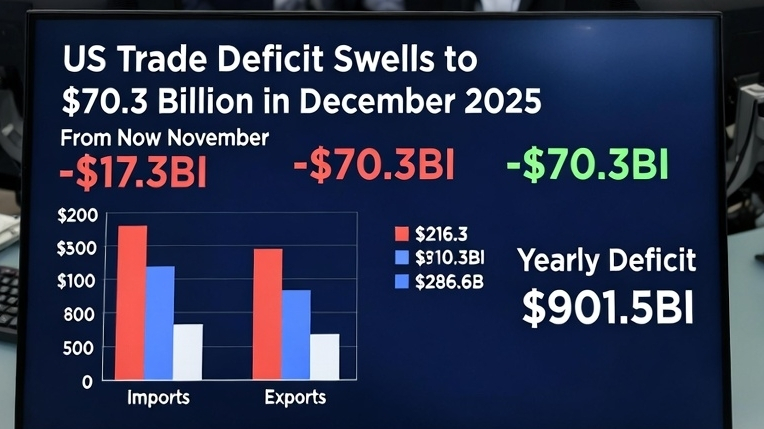
The United States closed out 2025 with a notable flare-up in its trade imbalance, as fresh data from the Bureau of Economic Analysis and Census Bureau showed a sharp monthly deterioration in December. Despite aggressive tariff measures, supply chain reshoring pushes, and geopolitical tensions throughout the year, American consumers and businesses demonstrated persistent demand for imported goods, pushing the deficit wider at year-end.
❍ December Deficit Surges to 5-Month Peak
The monthly swing caught many analysts off guard with its speed and scale.
-$17.3 Billion Increase: The goods and services trade deficit ballooned by $17.3 billion in December.
Highest Since July: This lifted the monthly shortfall to -$70.3 billion, the largest since July 2025.
Inflation-Adjusted Goods Gap: The real (inflation-adjusted) merchandise deficit widened even more dramatically to -$97.1 billion, also marking the biggest since July.
❍ Export Weakness Meets Import Boom
The divergence between the two sides of the ledger drove the expansion.
Exports Slide: US exports dropped -$5.0 billion to $287.3 billion—the lowest since August—pulled lower by declines in industrial supplies, especially nonmonetary gold.
Imports Explode: Demand for foreign goods surged, with imports climbing +$12.3 billion to $357.6 billion, the highest since March. Key drivers included computer accessories, telecommunications equipment, and other capital goods—likely tied to AI data center builds and tech investments.
❍ 2025 Full-Year Snapshot: Nearly Unchanged at ~$900 Billion
Stepping back to the annual view reveals a remarkably stable—but still massive—structural imbalance.
-$901.5 Billion Total: The year-end surge helped land the full 2025 goods and services deficit at -$901.5 billion.
Near-Record Territory: This ranks as the third-largest annual deficit on records dating to 1960.
Minimal Shift: Remarkably, the figure was virtually flat compared to 2024 (down just 0.2%, or -$2.1 billion), even amid heavy tariffs, currency swings, and efforts to reduce reliance on foreign manufacturing. Exports rose 6.2% to $3,432.3 billion, while imports grew 4.8% to $4,333.8 billion. Notably, the goods-only deficit hit an all-time high of $1.24 trillion, offset somewhat by a growing services surplus.
Some Random Thoughts 💭
The 2025 trade numbers underscore the enduring strength—and voracious appetite—of the US economy. Tariffs reshuffled sourcing (shrinking the China deficit to $202 billion from $296 billion in 2024 while widening gaps with Mexico, Vietnam, Taiwan, and others), but they failed to dent overall import volumes. Businesses and households kept snapping up tech, capital equipment, and other imports despite higher costs, reflecting confidence in growth and the dollar's strength. A $901.5 billion hole may raise eyebrows, but it's also a symptom of Americans saving less, spending more, and outpacing global peers. Without a meaningful dollar depreciation or jump in domestic savings/investment, this entrenched deficit looks set to persist well into the future. The December import spike, especially in AI-related gear, hints that tech-driven demand could keep the pressure on for months ahead.
#TokenizedRealEstate #BTCMiningDifficultyIncrease #TrumpNewTariffs #WhenWillCLARITYActPass #PredictionMarketsCFTCBacking