It started with a simple click that didn’t feel dangerous.
A wallet prompt appeared. The kind you’ve seen so many times your eyes skim it like a street sign. You were already watching the price. You were already thinking about the next step. You approved, because the market doesn’t wait for you to read every line twice. Then another prompt came right behind it, close enough that it felt like the first one hadn’t even left your screen. You approved again. Not because you were careless. Because you were human. Because when time compresses, attention gets traded away.
The first retelling stayed polite. Someone called it “approval fatigue.” Someone called it “UX friction.” Someone said, “It’s fine, it’s just two prompts.” That’s how most incidents begin: not with alarms, but with people trying to keep a thing small by keeping the language small.
Then you end up in the room where words have to match reality.
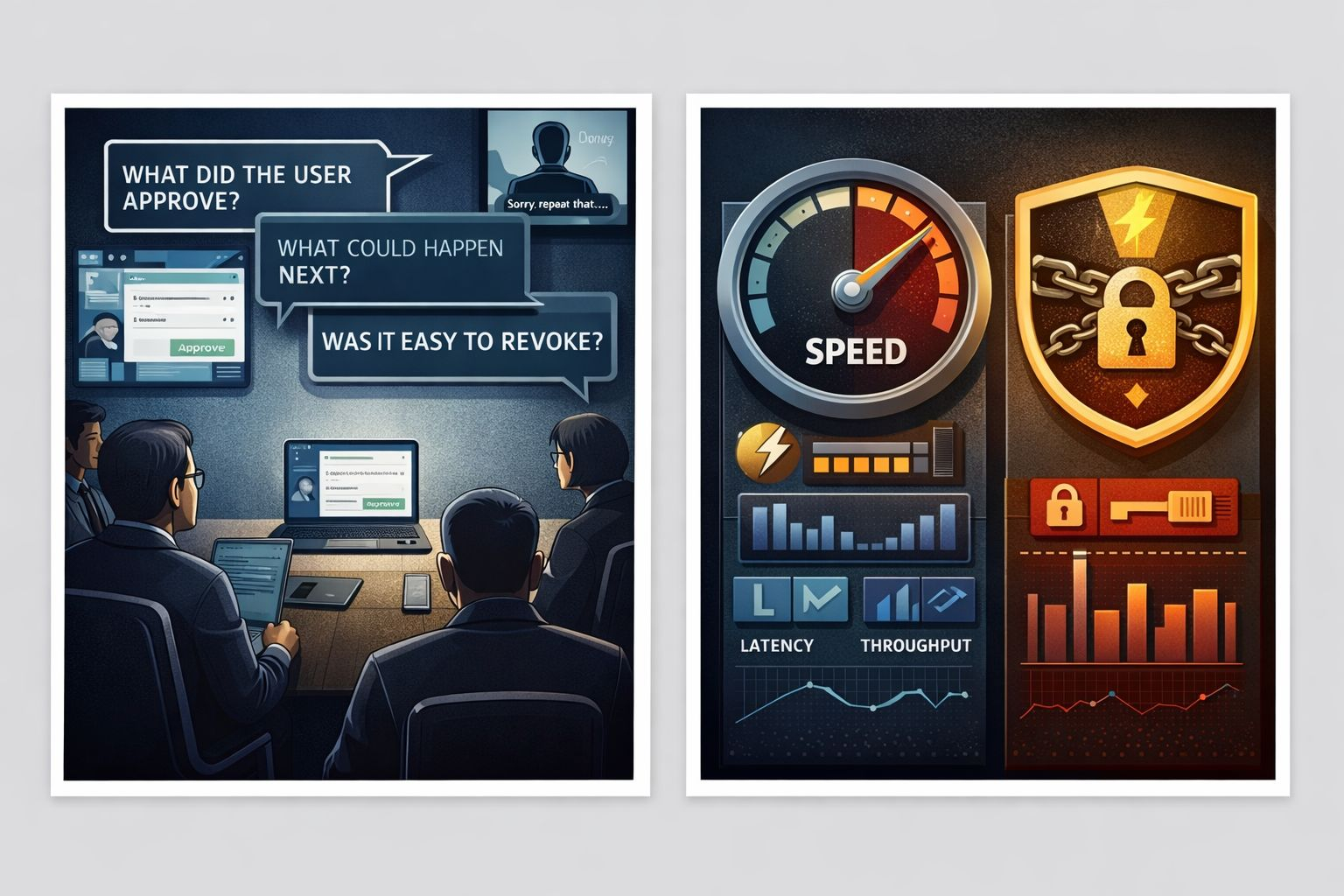
The invite is vague on purpose. The conference room is cold enough to make you sit straighter. The projector takes three minutes to wake up. Somebody is dialed in from a noisy place and keeps saying, “Sorry, repeat that.” A risk lead opens a laptop and doesn’t bother with small talk. A compliance person sits quietly, not to intimidate anyone, but because their job is to be present when optimism starts rounding corners.
The questions aren’t dramatic. They’re specific. They’re heavy in the way a door feels heavy when you realize it’s locked.
What exactly did the user approve. What could happen after that. Was it one action or a class of actions. Did it expire. Could it be revoked easily. Was there a cap. Was there scope. Was there anything enforced by the network itself, or were we counting on the user to remember to come back later and clean it up when life calmed down.
Later is where most failures live.
We keep treating speed like the main moral achievement. Lower latency. More throughput. Bigger numbers. It’s an easy obsession because it’s measurable and it looks great in slides. But if you’ve watched real damage happen, you learn what actually breaks people. It isn’t usually the extra second it took to confirm. It’s the permission that stayed open for weeks because nobody had the energy to think about it again. It’s the signature that was meant to unlock one moment, but instead unlocked a whole future you didn’t consent to.
Real failure comes from permissions and key exposure, not “slow blocks.”
That sentence sounds obvious in daylight. It sounds less obvious when you’re mid-trade and your brain is trying to keep up with moving prices. In the moment, convenience feels like control. In the moment, you tell yourself you’ll review it later. You’ll revoke it later. You’ll be careful later.
And then later arrives with teeth.
A lot of on-chain UX has been built on a quiet bargain: sign once so the app can stop bothering you. The user takes the deal because they want momentum. The app takes the deal because it’s easier than designing boundaries. And the chain just records the agreement, because recording is what ledgers do.
But “financial-grade” can’t stop at recording. It has to mean the system treats authority like a dangerous substance. It has to mean the system expects humans to be tired, distracted, and sometimes rushed, and it designs around that instead of lecturing after the fact. It has to mean mistakes don’t automatically become catastrophes.
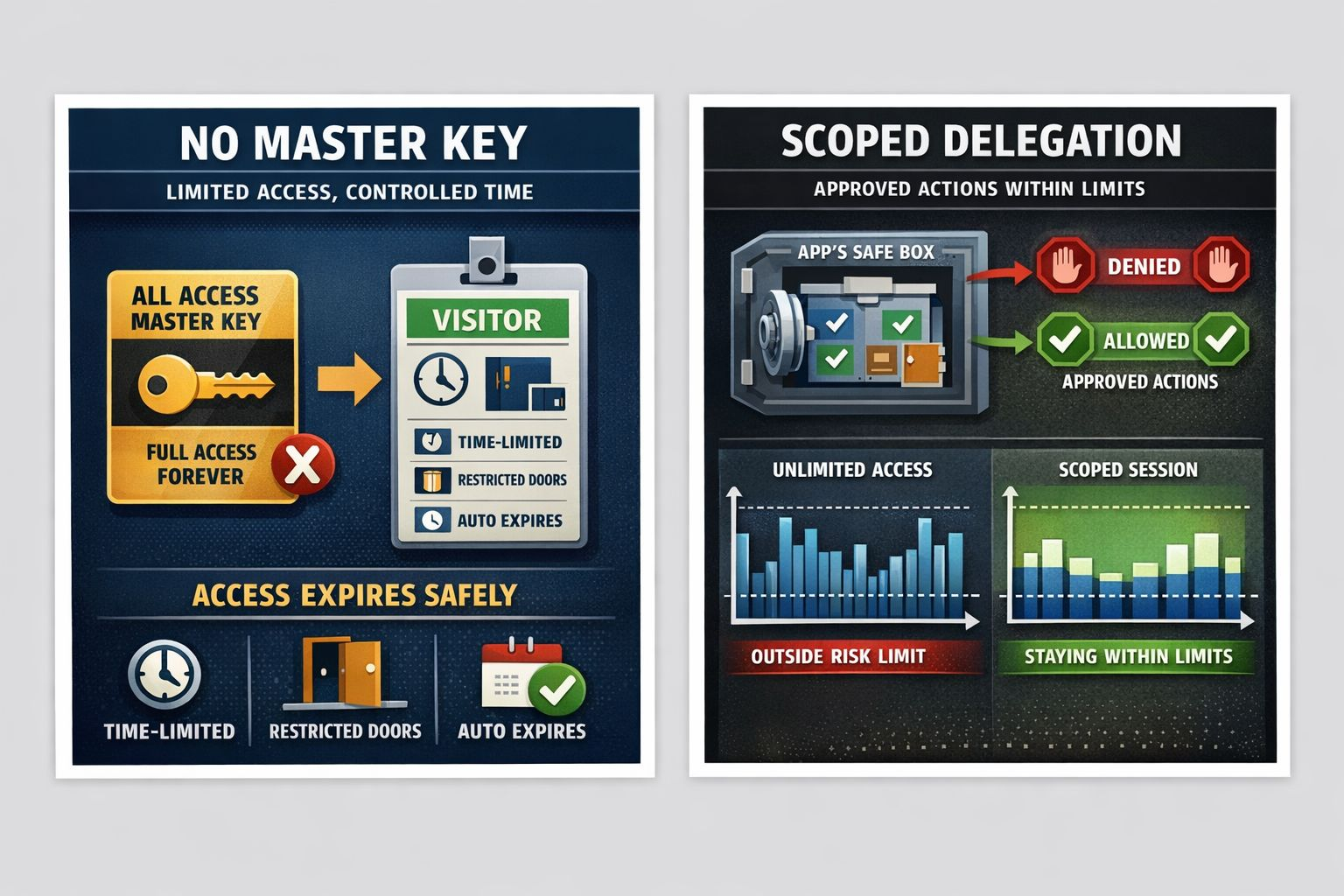
“Scoped delegation + fewer signatures is the next wave of on-chain UX.”
Fewer signatures doesn’t mean less security. It means less fatigue. It means you’re not forcing someone to make ten tiny high-stakes decisions in a row while their attention is melting. It means the app can do what it needs to do inside a safe box, and the user isn’t getting peppered with prompts like a slot machine.
Scoped delegation is the box.
This is where Fogo starts to feel like something built by adults who have sat through postmortems without trying to charm the room.
Fogo is an SVM-based high-performance L1 with Firedancer roots. That part matters because latency is real in DeFi. Slippage is real. Missed fills are real. The pressure to move fast is real. But the grown-up question is what you do with speed once you have it. Speed without guardrails is just faster regret.
Fogo Sessions is the clearest way to describe those guardrails in human terms. Think of it like a visitor badge.
In a building that actually cares about security, nobody hands you the master key. They don’t say, “Here, take full access forever, and just promise you’ll behave.” They give you a badge that opens certain doors, for a limited time, for a specific reason. It expires even if you forget to hand it back, because forgetting is normal. That’s not distrust. That’s maturity.
Sessions, done right, are enforced, time-bound, scope-bound delegation. The app can act within a pre-approved operating envelope. Outside that envelope, the chain says no. Not the UI. Not the app. The network.
That difference is everything. Apps can drift. Teams can rush. Interfaces can get “optimized” in ways that quietly widen permissions. Incentives can tilt. But the network can stay boring and stubborn. The network can enforce the limits even when somebody is tempted to loosen them for convenience.
When you look at it this way, the architecture stops being abstract. It becomes a way of respecting intent.
You can build modular execution environments above a conservative, boring settlement layer because you want motion without chaos. You want flexibility where it’s safe, and predictability where it’s sacred. You want the bottom of the system to be the part you can explain in an audit room without making excuses. You want finality and enforcement to behave the same way at 2 p.m. and 2 a.m., because the worst incidents don’t wait for business hours.
EVM compatibility belongs in this story too, but only in the unglamorous way. It’s friction reduction. It’s tooling people already know. It’s Solidity muscle memory that has been bruised into maturity. It’s the ability to reuse audits and patterns instead of forcing every team to relearn the same painful lessons on a new surface. It’s not vanity. It’s operational humility.
And still, you don’t get to pretend there aren’t sharp edges.
Bridges and migrations are chokepoints. Always. They’re where systems meet reality. They’re where good intentions become scripts, configs, and late-night procedures. They’re where audits help, but human error still finds daylight. They’re where one small mistake can widen into something you can’t contain fast enough.
Trust doesn’t degrade politely—it snaps.
It holds through minor weirdness. It holds through small outages and awkward UX. It holds while you say “temporary.” And then one incident reframes everything, and your explanation arrives after the damage, and the room gets quieter in a way you can feel in your chest.
So if this is going to end well, the story can’t end at speed.
It has to end at restraint. At enforcement. At a system that refuses to let convenience become unlimited authority.
The native token only needs one honest mention. It’s security fuel. Staking is responsibility, not yield. It’s skin in the game. It’s a way to make participants carry weight, not just collect upside. Long-horizon emissions, designed with patience, signal that the network expects to earn trust over time instead of trying to sprint it into existence.
And the final point is simple, almost boring, which is exactly how it should be.
A fast ledger that can say “no” at the right moments isn’t limiting freedom; it’s preventing predictable failure. It’s the difference between a system that records regret and a system that quietly narrows the space where regret can form. It’s a way of letting people move quickly without asking them to hand over full control just to keep up.
Start with latency, because reality demands it. End with trust, because reality punishes everything else.