
We have all been there.
You see the perfect entry on a volatile pair. You click "Buy." And then you wait.
The little spinner spins. The transaction is pending. By the time it finally goes through, the opportunity is gone—or worse, the liquidation cascade has already hit. In decentralized finance, latency isn't just an inconvenience; it is a tax on ambition.
For years, we accepted congestion as a feature of blockchain. We blamed gas wars, block size limits, or simply "network traffic." But what if the architecture was the problem all along? What if we built a highway system designed for a Sunday drive and then wondered why it gridlocked during rush hour?
Enter Fogo. And they have a radically different answer to the congestion problem.
The Problem: Speed vs. Decentralization
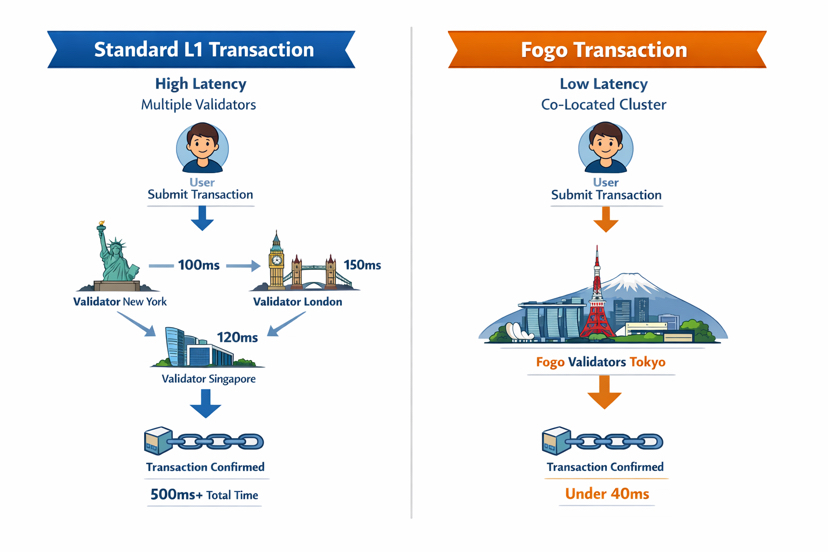
General-purpose Layer 1s are like a massive, global city. They are spread out, diverse, and decentralized. But getting a message across a sprawling city takes time. When validators are scattered across continents, the physical speed of light becomes the enemy. This "network jitter" is why you see delayed blocks and failed transactions during high-volume trading .
Fogo looked at this and asked a simple question: What if we built a blockchain specifically for speed?
The Architecture: "Multi-Local Consensus"
Instead of pretending the entire world can communicate instantly, Fogo optimizes for physics. Their architecture utilizes what they call "Multi-Local Consensus" .
Imagine a trading floor in Tokyo. The traders are all in the same room—they can shout prices and settle deals instantly. That is Fogo. By strategically co-locating primary validators in Tokyo—proximity to major financial markets—they slash communication delays to almost nothing .
This is not about sacrificing decentralization entirely; it is about curating the validator set for performance where it matters most. They utilize the Firedancer client (Jump Crypto’s high-performance validator client) in its purest form. This isn't just an upgrade; it is a complete rethink of how the software interacts with the hardware, allowing Fogo to process over 100,000 transactions per second.
The User Experience: Curing "Signature Fatigue"
Speed at the protocol level is great, but what about the user experience? How many times have you missed a trade because your wallet pop-up was lagging, or you had to approve a hundred signatures?
Fogo solves this with something called Fogo Sessions .
Think of it like a "valet key" for your wallet. You authorize a trading session for a specific time-bound period. During that session, you can trade with one-click, gasless transactions . The dApp gets temporary, limited permission to execute trades on your behalf without spamming you for a signature every millisecond.
This is huge for high-frequency trading. It eliminates the friction of manual gas payments and the dreaded "signature fatigue" that stops traders from reacting instantly . It makes the blockchain feel like a centralized exchange—smooth, fast, and invisible.
The Trust Factor: A Community-First Launch
Now, architecture wins the race, but trust wins the marathon. And this is where Fogo did something incredibly unique in January 2026.
They had a $20 million token预售 on the table. A $1 billion FDV. Easy money, right?
They canceled it.
The community felt the valuation was too high. So, Fogo listened. They pulled the预售, burned 2% of the core team’s allocation, and decided to airdrop those tokens to the community instead .
In a world of VCs extracting maximum value, Fogo flipped the script. They shifted the tokenomics to be "community-first," unlocking nearly 39% of the supply to users at launch . This wasn't just a marketing stunt; it was a signal. They are betting that sustainable growth comes from users who actually use the network, not from institutional investors looking for a quick flip.
Why This Matters Right Now
We are moving into an era of real-time finance. On-chain options, perpetuals, and high-frequency trading bots aren't coming—they are here. General-purpose chains are struggling to keep up with the latency demands of professional traders .
Fogo is the specialized tool for this specific job. It is the scalpel to the Swiss Army knife. By vertically integrating infrastructure—native price feeds, enshrined DEX mechanisms, and colocated liquidity providers—they are building the first blockchain that actually feels like it was designed by traders, for traders .
The Verdict
Fogo isn't trying to be the blockchain for everything. It is trying to be the fastest blockchain for one thing: trading.
The architecture (Firedancer + Multi-Local Consensus) solves the physical latency issue. The Fogo Sessions feature solves the user experience issue. And the cancellation of the $20 million预售 solves the trust issue.
Is this the edge needed to finally bring institutional high-frequency trading on-chain?
I want to hear from you. Do you think "specialized" Layer 1s like Fogo are the future of crypto, or will general-purpose chains eventually catch up on speed? Drop your thoughts below.
@Fogo Official #Fogo #fogo $FOGO
