
Crypto for years:
“More validators = more decentralization = more good.”
Nobody questioned it. It sounded democratic. It sounded fair. It sounded like a slogan that belongs on a T-shirt.
But the longer I study distributed systems, the more I think:
More machines online does not automatically mean better outcomes.
Sometimes it just means more noise… more delay… more people shouting at once.
And then Fogo walked in like:
“Guys… what if coordination actually matters?”
Most chains treat uptime like religion.
Go offline? Punished.
Blink? Slashed.
Take a nap? Economic consequences.
Constant participation = security.
But what if constant participation = latency chaos?
When I looked deeper into Fogo, the interesting part wasn’t just speed claims. It was philosophy.
Multi Local Consensus.
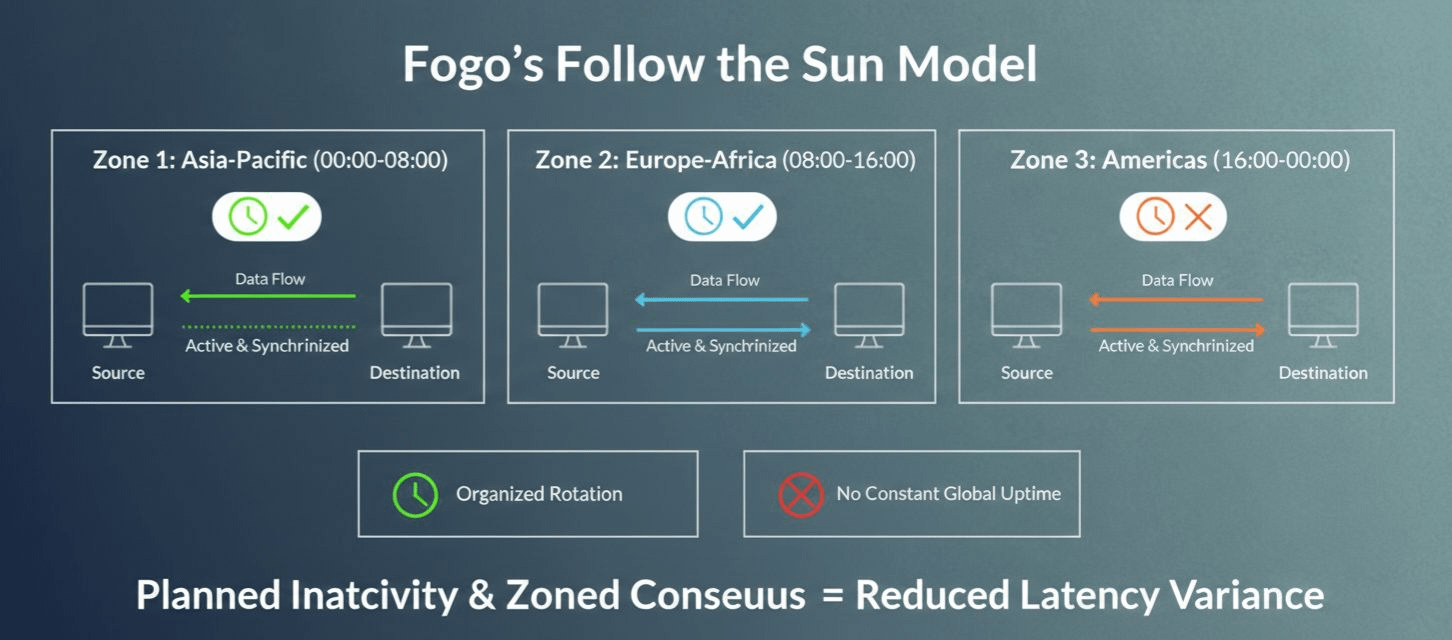
“Follow-the-sun” validator rotation.
Instead of every validator being awake 24/7 across the globe like caffeinated owls, activity is divided into zones. Regions rotate based on time and trading flow. Participation is structured, not random.
Crypto culture hears that and panics: “Wait… not everyone active at the same time?? CENTRALIZATION!!”
But from a performance angle, a validator running from the wrong region at the wrong hour doesn’t add strength. It adds network stretch. Latency variance. Messy communication loops.
Fogo’s curated validator design isn’t about exclusivity for status.
It’s: Right infrastructure.
Right geography.
Right time window.
Instead of everyone shouting at once, it’s organized coordination.
This shifts the definition of decentralization.
Not: “How many nodes are online yelling?”
But: “How clean and predictable is the outcome?”
Even traditional exchanges structure activity into sessions.
They don’t say: “Every matching engine globally must scream at the same time.”
They optimize for execution stability.
Fogo applies that thinking to blockchain consensus.
Then there’s Firedancer.
Firedancer isn’t “we optimized a few lines of code.”
It’s “we tuned this thing like a race engine.”
Hardware-aware. Bottleneck-focused. Built for serious infrastructure.
Combine zone-based validator rotation + hardware-optimized clients and suddenly the network behaves less like a scattered hobbyist cluster and more like engineered market infrastructure.
Resilience is where it gets interesting.
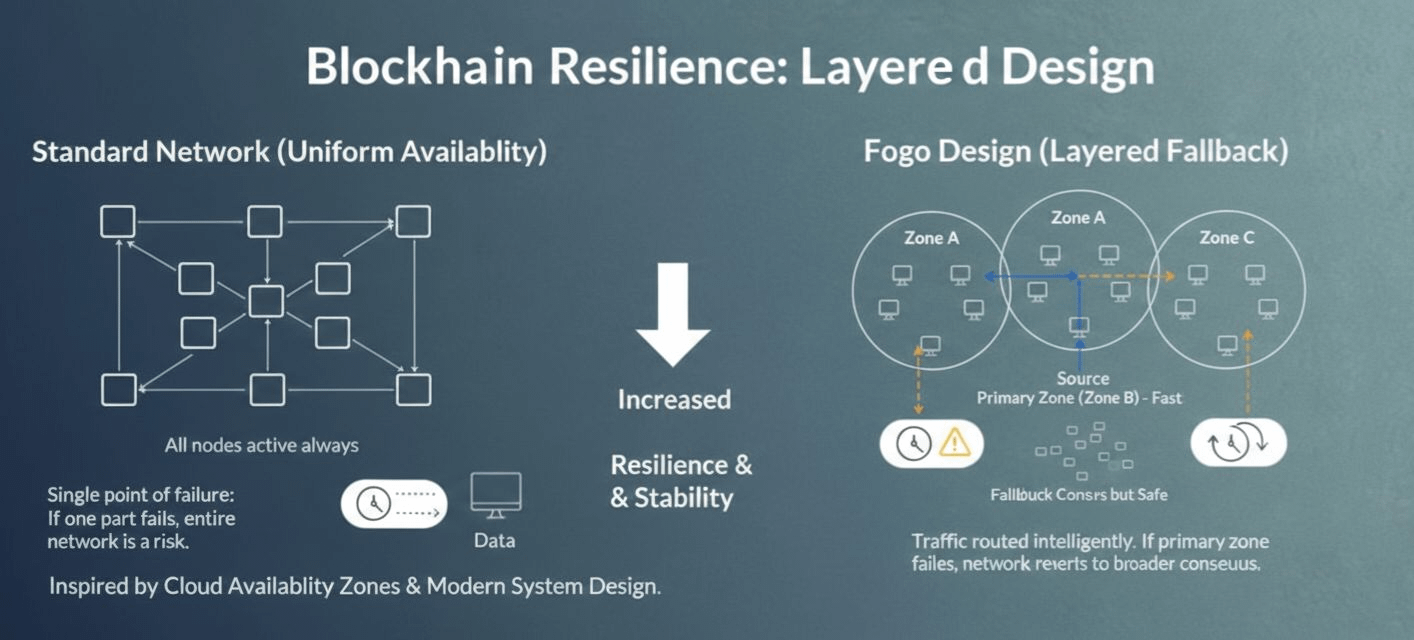
Most people think resilience = everything online all the time.
But modern cloud systems don’t work like that.
They use availability zones.
Regional failover.
Traffic routing.
Not every data center carries equal load every second.
Fogo mirrors that idea.
If one zone struggles, broader participation kicks in.
Slower? Maybe.
Unsafe? No.
That’s layered fallback — not fragility.
There’s also a trader’s perspective here:
Latency variance hurts more than slightly higher average latency.
If some transactions confirm way slower because coordination is messy, that difference becomes a hidden tax.
Structured validator zones tighten communication during peak activity. Less variance. More predictability.
Critics will say: “Curated validator sets reduce decentralization.”
That concern is fair.
But decentralization isn’t a node-count leaderboard.
It’s censorship resistance.
Fault tolerance.
Outcome integrity.
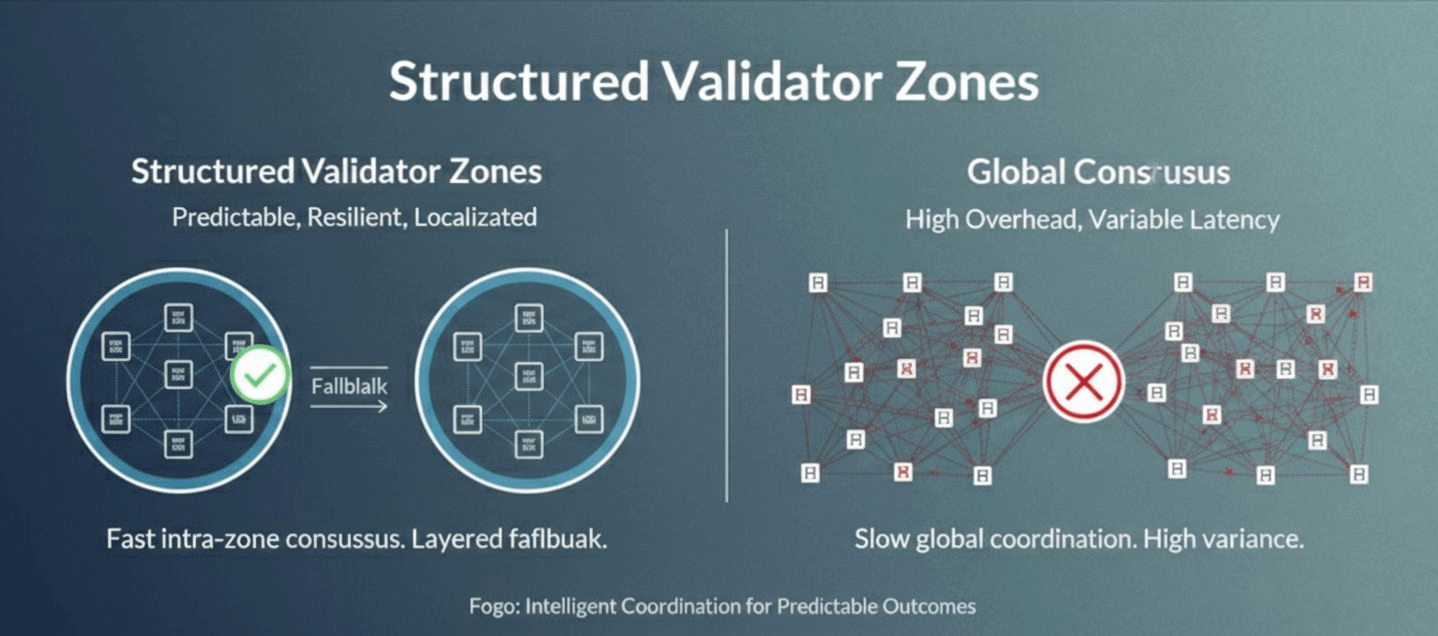
If structured coordination preserves security while improving predictability, then decentralization is evolving — not disappearing.
Crypto got comfortable marketing validator count like it’s a flex.
“Look at our 3,000 nodes!”
Okay… but are they coordinated?
Fogo isn’t doing validator theater.
It’s treating consensus like coordination engineering.
Zones rotate.
Activity follows the sun.
Fallback protects safety.
Not everyone yelling at once.
Just the right people speaking at the right time.
Whether people like it or not, the conversation is overdue.
Maybe resilience doesn’t come from perpetual equal availability.
Maybe it comes from thoughtful coordination, layered fallback, and hardware tuned for reality.
Fogo isn’t just chasing speed headlines.
It’s questioning inherited assumptions about what makes a network strong.
And in a market that increasingly demands predictable execution, that philosophical shift might matter more than raw validator numbers.
