
In DeFi, we’ve been trained to tolerate friction.
Not the obvious kind like gas spikes or failed swaps — but the subtle delay between intention and confirmation. You click approve. You wait. You refresh. You wonder if the network is congested. You debate increasing priority fees.
Over time, that hesitation becomes routine. You stop complaining about it. You adapt to it.
But adaptation does not mean optimization.
When I first heard about Fogo, I ignored it. Another “high-speed chain.” Another promise of lower latency. Crypto has heard that story many times.
What made me look closer wasn’t a slogan — it was the architectural foundation.
Fogo builds on the Solana Virtual Machine, the same execution environment that powers Solana. And regardless of market narratives, Solana proved one thing clearly: parallel transaction processing works at scale. Unlike older sequential models, SVM-based systems process transactions simultaneously, which changes how congestion behaves under real demand.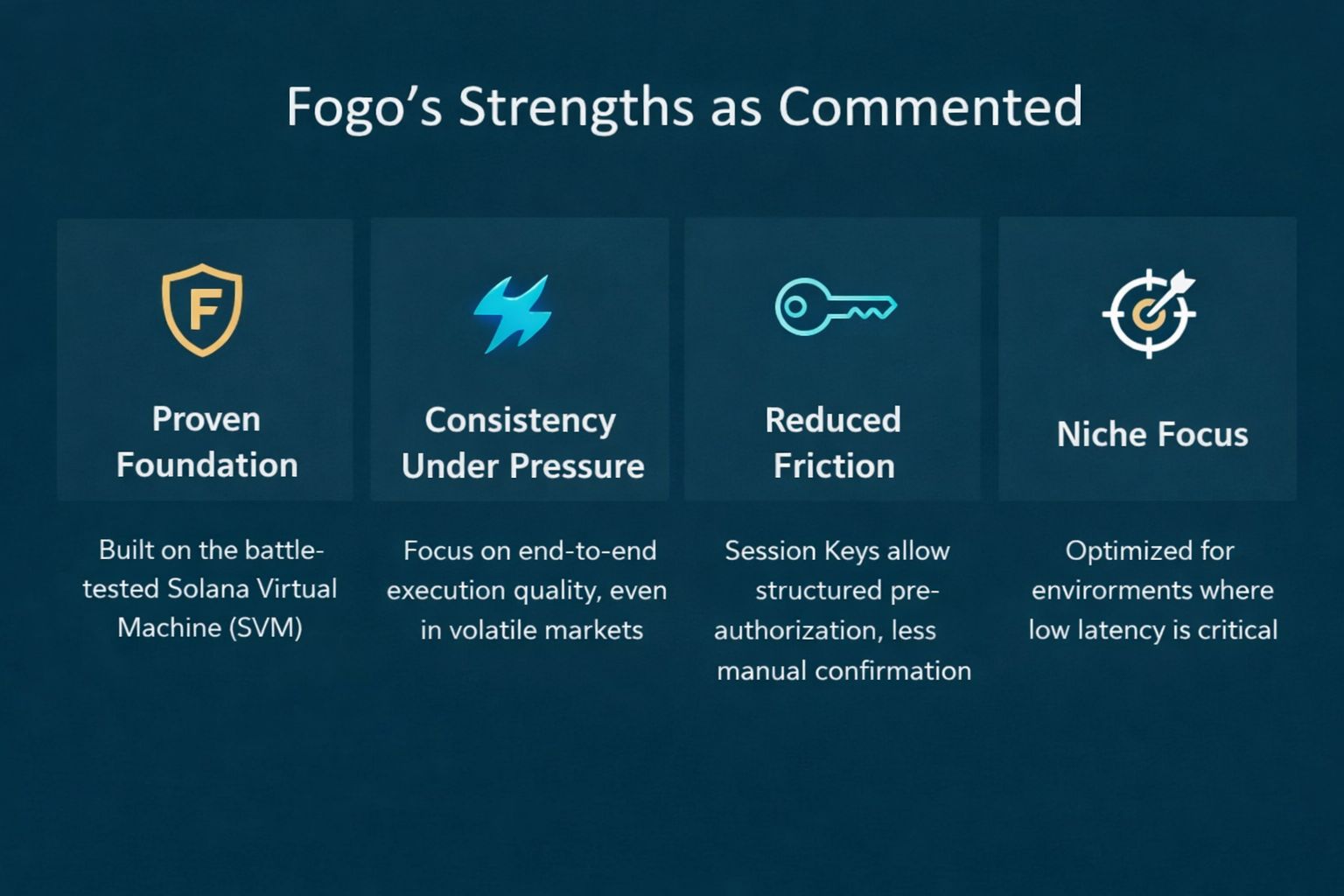
So Fogo is not experimenting with untested theory — it’s building on infrastructure that has already handled real volatility.
Crypto culture loves TPS. But traders don’t trade TPS. They trade execution quality. The number that matters is not how many transactions a chain can theoretically process — it’s how quickly your transaction settles when the market is moving aggressively.
That’s where Fogo’s philosophy feels different. Instead of optimizing for benchmark screenshots, it seems focused on tightening the full pipeline: submission, block inclusion, finality, and consistency under load. Speed that collapses under pressure is not speed. It’s marketing. Consistency is performance.
One of the most interesting elements in the design stack is Firedancer, the high-performance validator client originally developed to increase efficiency within the Solana ecosystem. Rather than being just another software implementation, it is engineered for hardware-level efficiency and reduced processing overhead. That matters because bottlenecks often appear not in theory but in packet handling and coordination delays.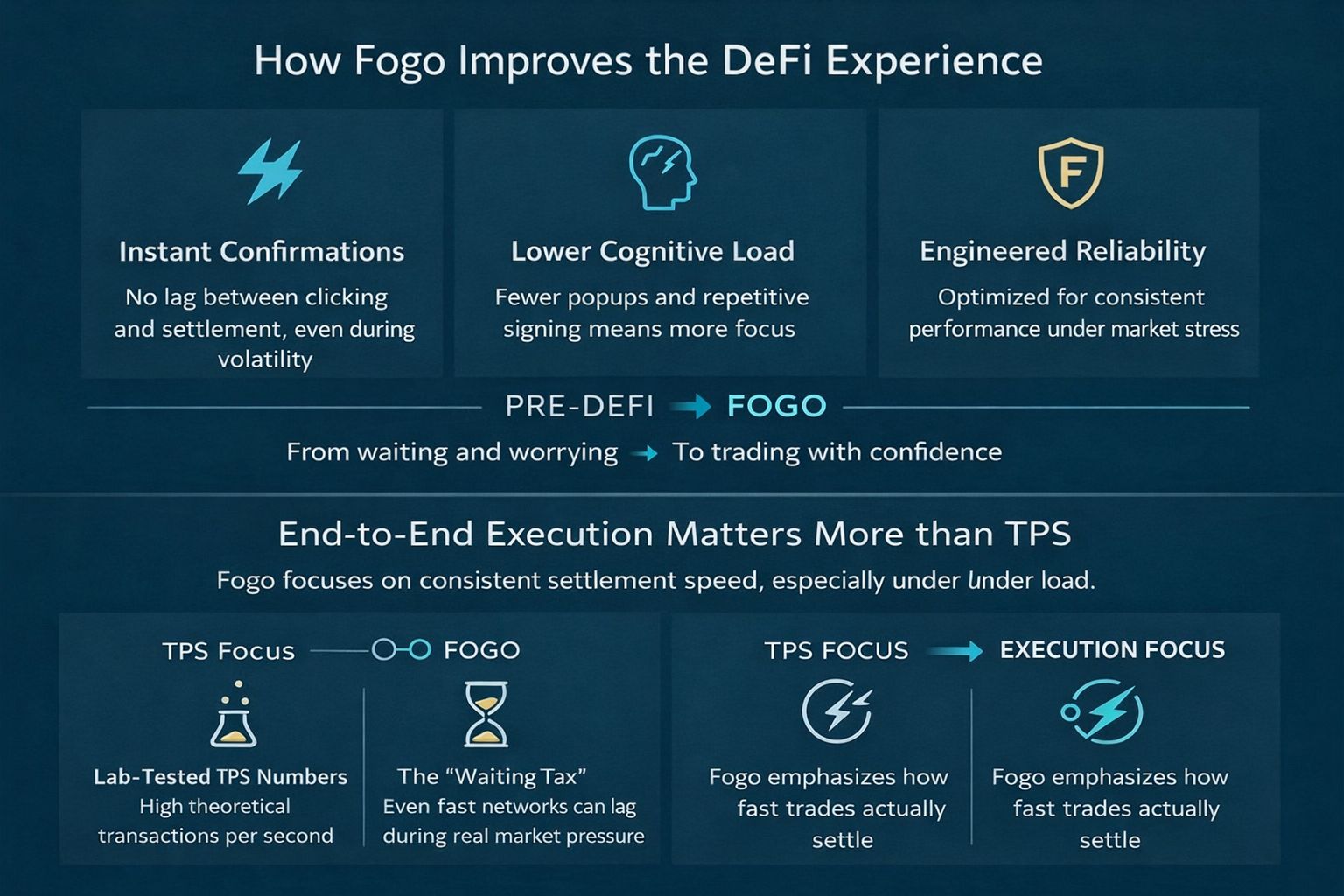
By integrating performance-oriented validator infrastructure, Fogo seems to be optimizing for reliability during volatility, not just idle conditions.
Then there’s the validator model itself. More validators can mean more decentralization — but also more coordination overhead. In distributed systems, communication has a cost. More nodes often mean more latency.
Fogo appears to accept a design trade-off: reduce coordination drag, tighten block times, and improve settlement consistency. That choice won’t satisfy every decentralization purist, but it signals clarity of purpose.
Another feature that changed my perspective wasn’t raw throughput — it was Session Keys.
In traditional DeFi workflows, every action demands manual confirmation. In volatile markets, that means constant interruptions. Popup after popup. Sign after sign. That breaks flow.
Session Keys introduce structured pre-authorization within defined limits. You control boundaries, but you don’t need to interrupt your momentum for every micro-action. Performance is not only technical. It is psychological. Reducing cognitive friction makes speed usable instead of stressful.
Technology alone doesn’t build ecosystems. Liquidity does.
Execution quality attracts traders — but deep liquidity keeps them. Historically, capital gravitates toward environments where settlement is predictable and slippage is manageable. If Fogo can demonstrate reliability under real market pressure, liquidity may follow. If not, even superior engineering won’t be enough.
There is always tension in crypto between purity and practicality. Maximum decentralization. Maximum participation. Maximum validator count.
But financial markets prioritize predictable settlement, low latency, and execution confidence. Fogo doesn’t appear to be trying to become a universal chain for every niche. It seems optimized for environments where milliseconds matter and hesitation costs money.
The moment that stood out to me wasn’t dramatic. It was simple.
I confirmed a transaction — and didn’t think about it afterward.
No refreshing. No second-guessing. No mental calculation about whether I should have increased fees. It just worked.
That feeling is easy to underestimate. Invisible infrastructure — the kind you don’t think about — is usually the kind that endures.
I’m still watching. I still have questions. Adoption will decide the outcome. But if Fogo consistently removes that “waiting tax” from DeFi, especially during volatility, then it’s not just another fast chain.
It’s a shift in how execution feels.
And in trading, feeling often matters as much as numbers.
