

I keep coming back to one simple idea when I think about Fogo.
Performance is geometry under real contention.
Not theory. Not marketing. Not the clean line you get when one user is clicking around in peace. Real performance is what happens when the same few pieces of state get hit at the same time, by a lot of people, and nobody is taking turns.
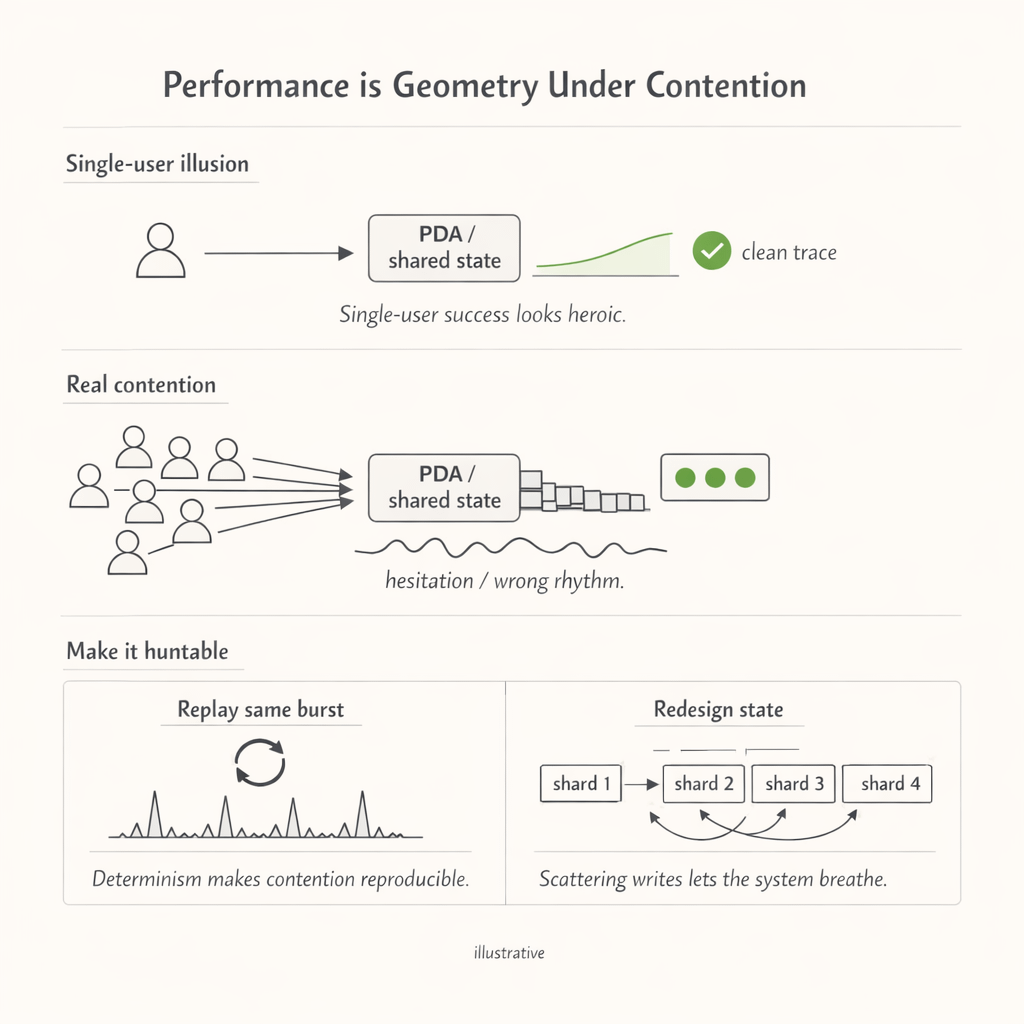
That is why single-user success is basically a lie. It is not malicious. It is just incomplete. A clean trace makes a system look heroic because nothing is fighting it. The moment you add overlap, the story changes. Production is shared state. It is overlapping writes. It is a room full of hands reaching for the same handle.
If you want to understand Fogo’s bet, you have to look at it through that lens. Not “how fast is it when it is empty,” but “what shape does it take when it is crowded.”
And the worst part is, failure rarely shows up as a loud error.
It shows up as silence.
No revert. No obvious crash. You just feel a queue. You feel hesitation. You feel the wrong rhythm. The chain is technically alive, dashboards are green, and yet the experience becomes sticky. Transactions start arriving late. Ordering gets weird. The system keeps moving, but it stops breathing properly.
That is throughput collapse wearing a mask.
This is where the geometry matters. Under contention, systems do not fail evenly. They fail at choke points. A few hot accounts, a few hot locks, a few hot state paths become the bottleneck for everything else. The network does not slow down everywhere. It slows down where the crowd compresses.
If you want to see that, you cannot rely on ideal conditions.
You have to simulate reality.
Not because you are paranoid. Because simulation is education. It teaches you where your design narrows before real users compress it for you. It is the difference between “I think this will scale” and “I know where it breaks.”
The thing that makes this learnable is determinism.
If the same burst of activity can be replayed, you can turn chaos into something huntable. You can take a messy production-style wave and run it again. If the contention pattern reproduces, profiling stops being guesswork and becomes forensic work. You can point to the exact moment the system loses rhythm. You can isolate the exact state path that starts backing up. You can stop arguing about vibes and start measuring the same failure from different angles.
This is also where state design becomes destiny.
Most bottlenecks are not magic. They are self-inflicted. The classic trap is the shared write target. The PDA everybody writes to. The one global account that becomes the meeting point for every transaction. It works beautifully in a single-user trace. It looks clean. It feels fast. Then users arrive, and suddenly you built a funnel.
And once you built a funnel, it does not matter how fast your engine is. Everyone still has to pass through the same narrow throat.
The way out is not always “make each transaction faster.” Under contention, you usually cannot. The win is making the system breathe. You scatter writes. You shard state. You redesign so different users are not forced to collide in the same place. You accept that parallelism is not a feature you toggle. It is a property you earn by how you lay out state.
That is what the geometry lesson teaches.
And that is why simulation is not optional if you care about Fogo’s kind of performance. If the chain is aiming to stay sharp under real contention, then you have to test like the world behaves. You have to overlap. You have to compress. You have to stress shared state. You have to watch for silence, not just errors.
Because the real trade is this.
You give up benchmark confidence.
You get contention truth.
And once you have contention truth, you stop optimizing in the dark. You redesign around the choke points you can finally see. You stop chasing heroic single-user traces. You start building for the geometry that only appears when everyone shows up at once.