
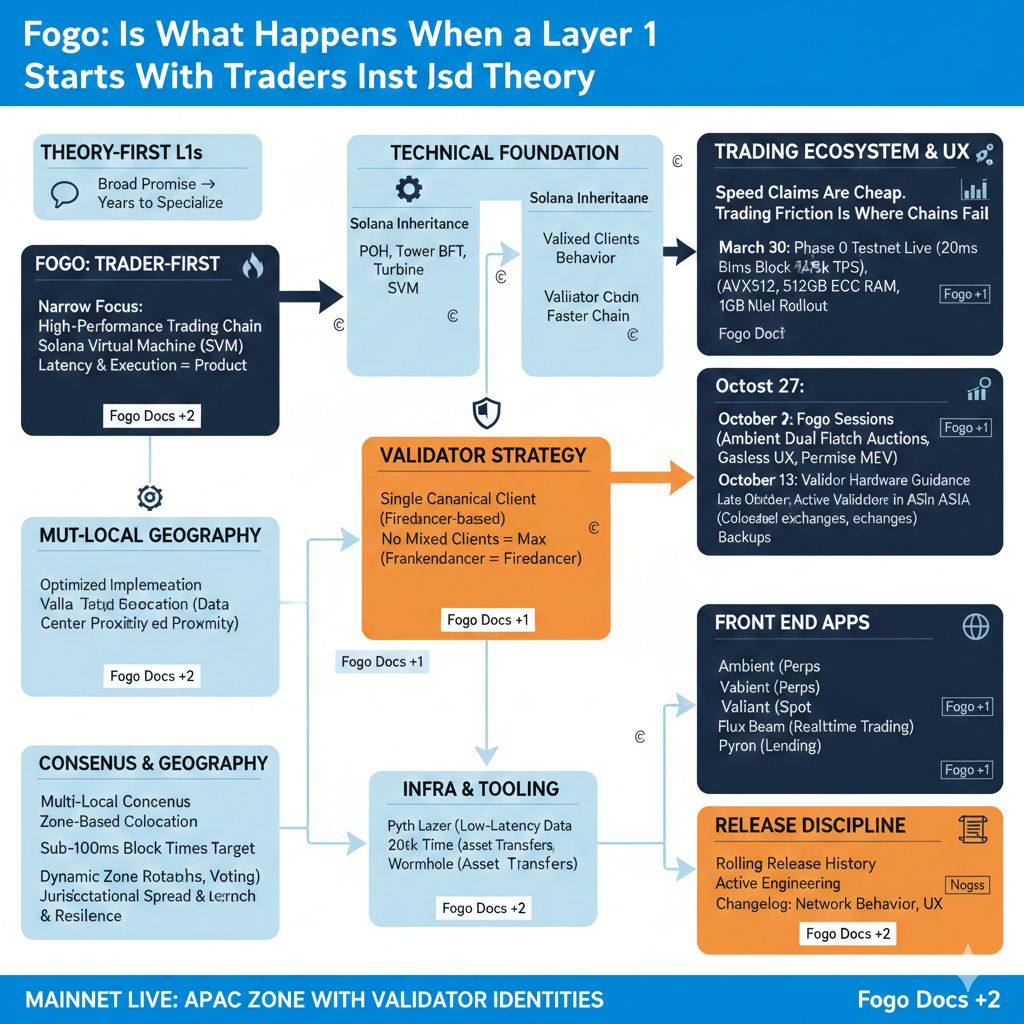
Fogo is a Layer 1 blockchain built for DeFi and trading workloads, and its core idea is very clear: instead of trying to reinvent everything, it takes the Solana execution model that already works and pushes hard on latency, execution quality, and trading focused infrastructure. In the official docs, Fogo is described as a DeFi focused L1 based on Solana architecture with multi local consensus and full Solana Virtual Machine compatibility, specifically targeting use cases like on chain order books, real time auctions, precise liquidation timing, and reduced MEV extraction.
What makes Fogo interesting is that it is not just saying “fast chain” in marketing language. The project consistently frames performance in market terms: block speed, confirmation speed, validator placement, and execution fairness. On the main site, Fogo positions itself as a high performance SVM Layer 1 built for traders, with claims around sub 40ms block times, fast confirmations, and infrastructure designed to keep up with modern finance. It also repeatedly emphasizes “SVM L1 compatibility,” meaning the chain is meant to feel familiar to Solana developers and tools from day one.
Under the hood, Fogo’s architecture starts from Solana’s proven stack rather than replacing it. The docs explicitly say Fogo builds on Solana’s foundation and inherits key pieces like Proof of History for timestamping, Tower BFT for consensus, Turbine for block propagation, the SVM execution environment, and deterministic leader rotation. That choice matters because it gives developers a known runtime model while letting Fogo focus its innovation on implementation and network design instead of asking builders to learn an entirely new programming or execution environment.
The compatibility strategy is one of Fogo’s strongest practical advantages. Fogo says it maintains full compatibility at the SVM execution layer so existing Solana programs, tooling, and infrastructure can migrate without modification. In simple terms, if a team already has a Solana app, the migration burden is much lower than moving to a chain with a different VM or account model. This is a big reason Fogo can move faster in adoption than many new L1s, because it is not forcing developers to choose between performance and ecosystem familiarity.
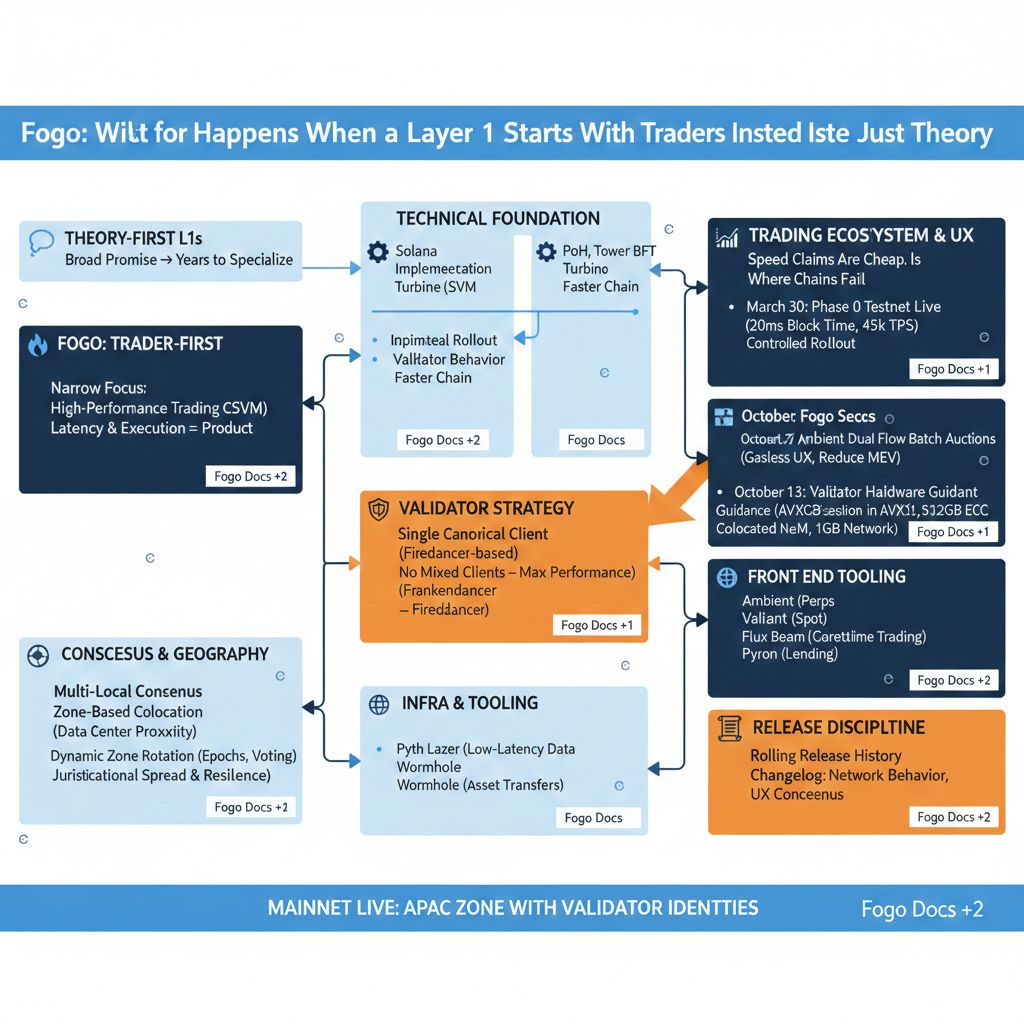
Another major design choice is the client strategy. Fogo explicitly calls out a common issue in many networks: performance gets capped by the slowest client implementation. Its answer is to standardize on a single canonical high performance client path based on Firedancer, with an initial Frankendancer deployment before moving toward full Firedancer as development matures. The docs describe why this matters in technical terms, including optimized parallel processing, memory handling, SIMD usage, and a C based networking stack, all of which are intended to reduce bottlenecks and increase throughput. This is a very different posture from chains that prioritize client diversity first and optimize later. Fogo is choosing performance determinism first.
The most distinctive part of Fogo’s design is its multi local consensus model. Fogo organizes validators into geographic zones where they are physically close to each other to minimize network latency, ideally even within a single data center environment. The docs explain that this is how Fogo targets extremely low latency consensus and sub 100ms block times. Instead of pretending geography does not matter, Fogo makes geography part of the design. That is especially relevant for financial applications, where a few milliseconds can change execution outcomes and slippage.
At the same time, Fogo tries to avoid the obvious downside of localization, which is centralization risk. The protocol’s answer is zone rotation. The docs describe dynamic zone rotation across epochs to preserve decentralization and resilience, with goals like jurisdictional decentralization, infrastructure resilience, and strategic placement near price sensitive information sources. Validators coordinate zone selection via on chain voting and prepare for future epoch locations in advance. This is a very market aware architecture: Fogo is treating validator geography as part of consensus economics, not just a networking detail.
Fogo also uses a curated validator set, and that is an important point because it shows the chain is optimizing for high quality execution rather than pure permissionless validator expansion at all costs. The docs say validators must meet stake thresholds and pass validator set approval requirements, and the network can enforce quality standards such as removing persistently underperforming nodes or actors engaging in harmful MEV behavior. Whether someone agrees with this model or not, it is consistent with Fogo’s thesis: the chain is designed for predictable performance and trading quality, so validator operations are treated as a product surface, not just governance theory.
For users, the most visible feature is Fogo Sessions. This is one of the areas where Fogo is trying to improve the user experience beyond raw throughput. The docs describe Fogo Sessions as a chain primitive that combines account abstraction with paymasters so users can interact with apps without paying gas directly or signing every individual transaction. Fogo also adds safety controls such as domain restrictions, token spending limits, and session expiry. This is a serious UX upgrade for DeFi users who want speed but also want limits and guardrails when testing new apps.
Fogo’s developer story is intentionally simple: keep using Solana tools. The official guides show developers can point the standard Solana CLI to Fogo’s RPC endpoint and deploy programs with the same workflow they already know. The docs also state Anchor works on Fogo by changing the RPC target, and they explicitly say Fogo preserves Solana compatible program structure, account models, and runtime behavior. That lowers the cost of experimentation for teams that want to test lower latency execution without rebuilding their entire stack.
Operationally, Fogo exposes public RPC endpoints for both mainnet and testnet through the Foundation, and it also points production applications toward third party RPC options for higher throughput and features like streaming. The docs list foundation sponsored public RPC endpoints for both networks, which is useful for developers because it means onboarding does not require immediate infrastructure commitments. Fogo is basically trying to reduce friction at every layer, from wallet UX to deployment to RPC access.
The network status pages give a more concrete look at how the chain is being run. The Mainnet docs state that Fogo Mainnet is live and currently operates with a single active APAC zone, while the Testnet docs describe a rotating multi zone setup across APAC, Europe, and North America, with testnet epochs moving consensus to different zones. The testnet page also states a 40 millisecond block target and explains leader terms in block counts and approximate time. Together, these pages show a chain that is actively using testnet as a proving ground for the multi zone rotation model while running a more focused mainnet configuration.
For node operators, Fogo is not pretending this is lightweight infrastructure. The running a node guide recommends a high end setup: a 24 core or larger CPU with AVX512 support, 128GB RAM, NVMe storage, and strong bandwidth, plus a recent Linux kernel and Ubuntu 24.04 LTS. It also provides an fdctl based workflow for configuring and running validators, which aligns with the Firedancer rooted architecture. This reinforces the overall positioning of Fogo as a performance chain where validator quality and hardware capabilities directly affect network outcomes.
One underrated signal is release cadence and transparency. The Fogo docs include a releases page with versioned validator client tarballs, checksums, and technical notes. Recent release notes mention changes such as moving gossip and repair traffic to XDP, changes to validator memory layout, and earlier versions mentioning inflation settings and RPC CPU improvements. That kind of release detail is useful for builders and operators because it shows the chain is shipping real client level changes, not just publishing marketing updates.
The ecosystem direction is also very explicit: Fogo is aiming at a trading stack, not just a general app marketplace. On the main site, Fogo highlights an “Arsenal” of trading oriented products and integrations, including perpetuals, spot, lending, and staking experiences, while the docs navigation also lists ecosystem support components like Pyth Lazer Oracle, Wormhole Bridge, Metaplex, Squads, explorer tooling, indexers, and data APIs. That combination matters because a fast chain is only useful if the surrounding execution, data, wallet, and market infra are already present. Fogo seems to understand that and is building around it.
On the token side, Fogo published an official tokenomics post in January 2026 that gives a much clearer picture of how the project frames utility and ownership. The post says Fogo launched with a community first approach, and it defines three primary value mechanisms for FOGO: gas for network transactions, staking yield for validators and token holders, and a “Fogo Flywheel” model where the Foundation supports ecosystem projects and receives revenue sharing commitments in return. That is a stronger utility narrative than the usual single line “gas and governance” description many L1s use.
The same tokenomics post also provides a detailed distribution breakdown and unlock structure. It lists community ownership at 16.68 percent, institutional investors at 12.06 percent, core contributors at 34 percent, foundation at 21.76 percent, advisors at 7 percent, launch liquidity at 6.5 percent, and 2 percent burned, with multiple categories subject to lockups and four year schedules. The post further states that 63.74 percent of genesis supply is locked at launch and unlocks gradually, while the remainder is unlocked for foundation, grants, airdrops, and liquidity. These details help explain how Fogo is trying to balance launch liquidity, community ownership, and long term contributor alignment.
There is also a practical distinction in Fogo’s token setup that developers and users should notice. The docs mention native FOGO and FOGO as an SPL token option on testnet, plus fUSD test tokens through the faucet, and the Solana tools guide shows how to work with native transfers and SPL token commands on Fogo. That means Fogo is not only SVM compatible in theory, it is documenting the exact Solana style workflows developers already use for wallets, token transfers, and program deployment.
If you step back, Fogo’s real thesis is not just “faster blockchain.” It is that trading quality on chain depends on an entire stack working together: fast execution, predictable validator performance, location aware consensus, app level UX that removes signing friction, and a developer surface that does not require retraining. Whether Fogo ultimately becomes a major DeFi venue will depend on liquidity, sustained ecosystem growth, and how well it handles decentralization concerns as it scales, but the technical and product direction is unusually coherent for a newer L1. It is clearly designed for people who care about fills, latency, and execution quality more than generic chain branding.
One final point worth noting is that Fogo appears to be documenting both a live mainnet and an active testnet at the same time, which is normal for a chain still iterating on client and network behavior. So the best way to think about Fogo right now is as a performance first SVM ecosystem already usable by developers and traders, but still actively evolving at the validator client, infrastructure, and ecosystem layers. That is usually where the biggest gains happen early, and Fogo seems intentionally built to keep optimizing there.