
It started with a small, stupid feeling. Not panic. Not even worry. Just that itch you get when something that normally makes noise goes quiet.
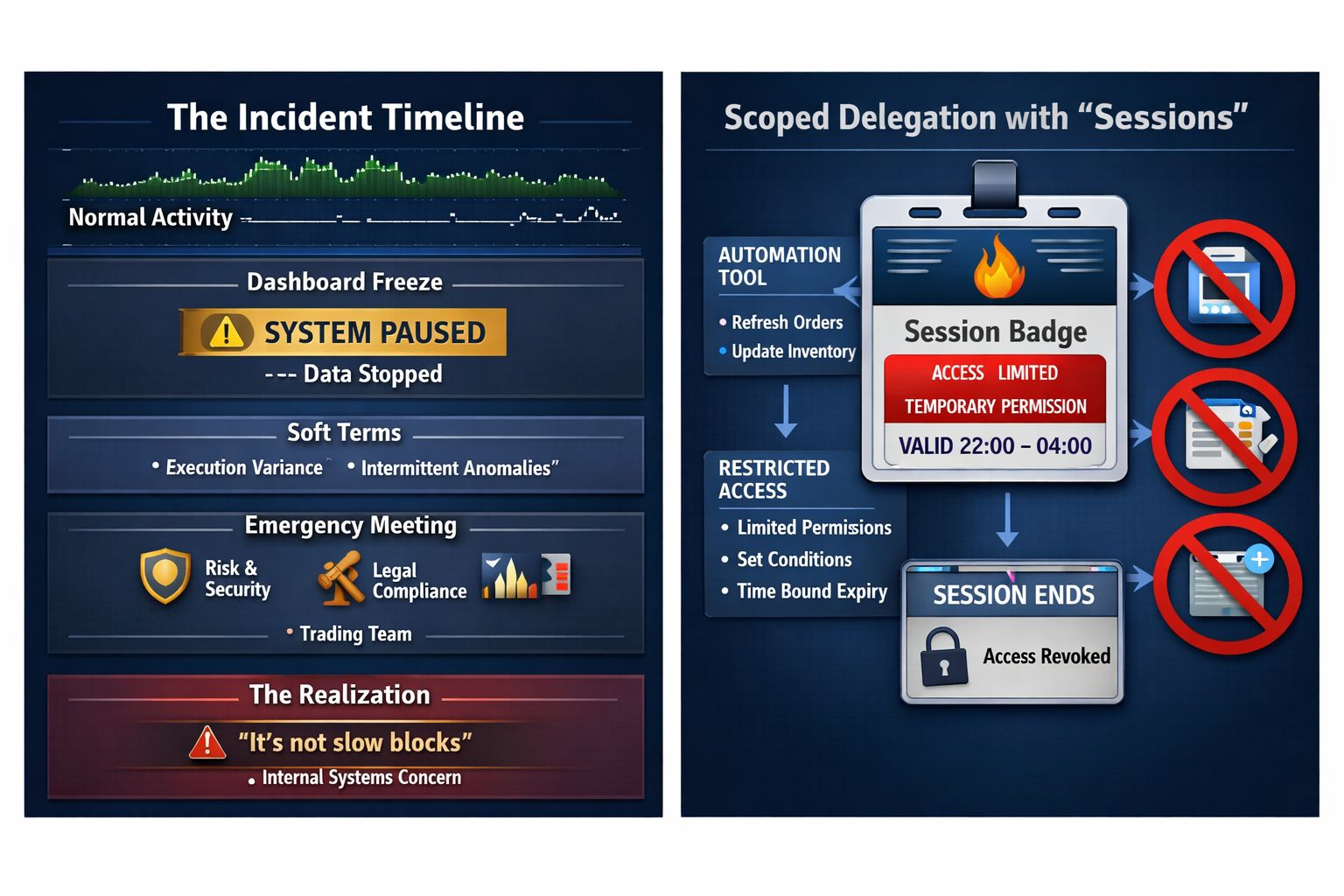
I was looking at a dashboard that usually never sits still. Spreads breathing. Inventory drifting. Fees ticking up in little, indifferent increments. Then it froze. Not crashed. Just… flat. The numbers held their pose like they were waiting for someone’s permission to move again.
We didn’t call it an incident right away. We almost never do. We gave it a softer name so we could keep our posture. “Execution variance.” “Intermittent anomalies.” Words that sound like weather. Nobody wants to be the person who says the real thing too early, because the real thing changes how everyone talks.
The meeting invite came through with no agenda, which is its own kind of agenda. The room was the same one we use when we want our voices to stay inside the walls. No windows. Fluorescent lights that make everyone look tired even when they’re not. The table was too shiny. A leftover smell of disinfectant. Someone had left a stack of printouts by the projector like a little altar to process.
Risk showed up early and didn’t sit down, just paced behind the chairs like sitting would make it feel final. Legal arrived with a pen and a blank notebook and a calm face that didn’t mean calm. Compliance asked for timestamps before anyone finished their first sentence. Security didn’t say much at all, but their fingers moved constantly, pulling logs, checking signer histories, lining up facts like sandbags.
Trading joined last, as usual, because trading always believes it can fix things faster than everyone else. They said hello in that neutral tone people use when they’re already calculating.
We did what grown-up teams do. We tried to make it boring. We walked through the obvious checks. RPC health. Node lag. Fill rates. Cancel rates. A chart or two that made everything look like it belonged in a quarterly review. Someone said “network” and you could feel half the room hoping it would be the network, because blaming the chain is emotionally cheaper than blaming your own control plane.
Then the on-call operator—the one who lives in the hours between midnight and morning—said it bluntly.
“It’s not slow blocks.”
The room got quieter, not louder. Because if it’s not the chain, it’s us. It’s our permissions. Our keys. Our habits. Our shortcuts that felt reasonable at the time.
Everybody loves the TPS conversation. It’s clean. It’s competitive. It fits in a tweet. It makes you feel like the future is a number you can raise. But on the nights that matter, the failures don’t come from being a little late. They come from being too permissive. They come from letting the wrong thing be possible, quickly.
Slow blocks don’t drain wallets. Keys do.
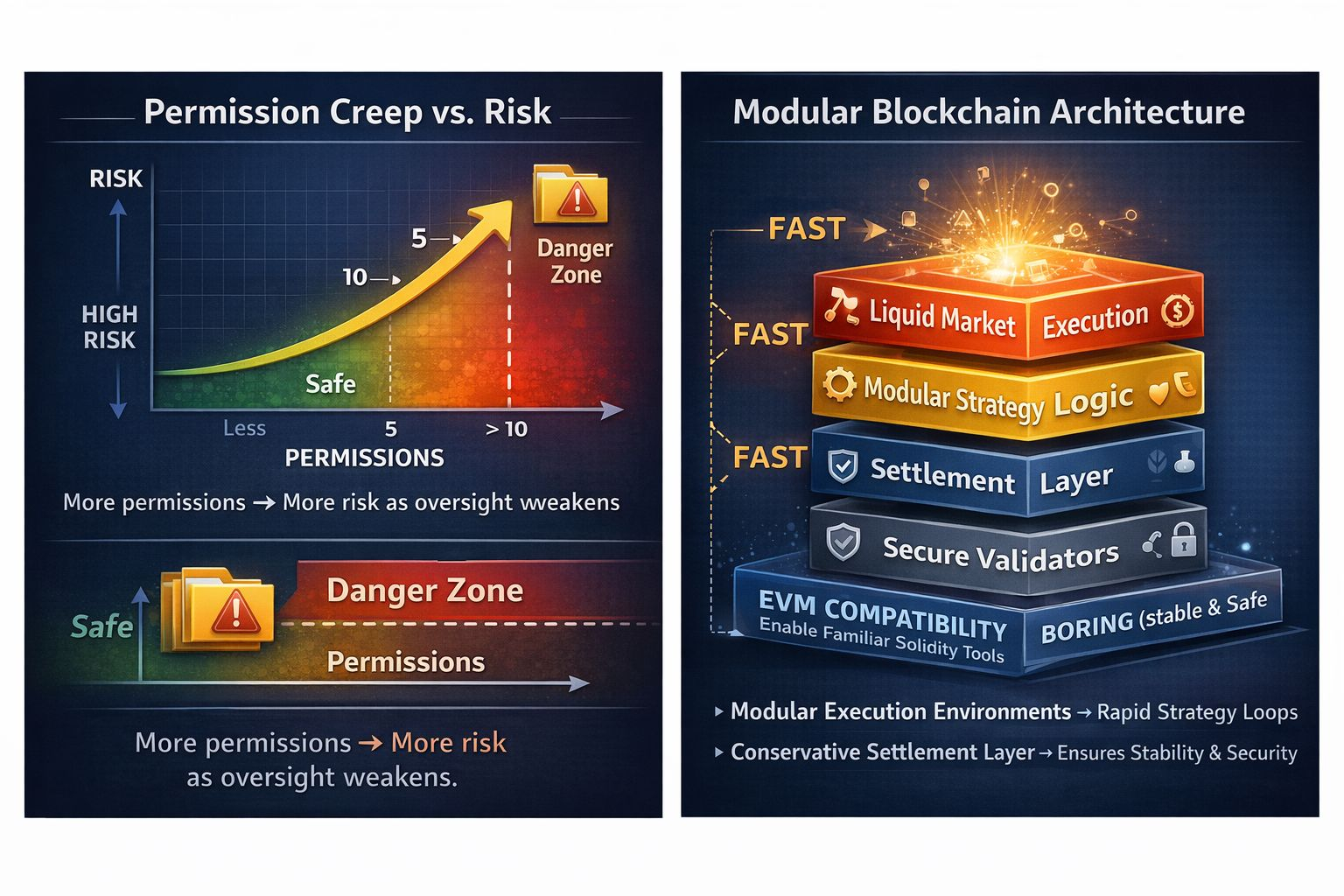
The ugly truth is that most losses don’t start with a brilliant attacker. They start with a normal day. A desk wants tighter spreads. A bot needs to rebalance faster. Someone asks for “just one more permission” so they don’t have to wake people up for routine actions. Ops agrees because ops is measured on uptime and speed. Security signs off with conditions. Conditions get lost in a thread. The approval stays open because closing it would interrupt the machine and nobody wants to be the person who interrupts the machine.
Then the routine becomes a trap.
At routine is dangerous because humans get sloppy in predictable ways. Someone gets a signing request while they’re half-reading an alert. Someone sees a familiar domain and stops thinking. Someone thinks, this is probably fine, because it was fine yesterday. And the chain, obedient and fast, does exactly what it’s told.
So the postmortem draft appears, and it reads like every postmortem draft. “Unexpected behavior.” “Edge case.” “Unintended consequence.” Soft verbs. Soft nouns. The kind of language that tries to wrap a bruise in paper so it doesn’t look like a bruise.
But eventually someone says, no, write it the way it happened.
We expanded authority beyond our ability to supervise it.
We asked humans to be perfect.
We built a workflow that punished caution and rewarded speed.
That’s where the real conversation begins, and it’s also where FOGO becomes more than a performance story.
FOGO is an SVM-based high-performance L1 with Firedancer roots. Yes, it’s fast. Yes, it’s built to move. But the part that matters for serious liquidity providers isn’t just that it can say “yes” quickly. It’s that it can say “no” with conviction. Speed with guardrails, not speed as a dare.
Because if you’re running liquidity like a business, you don’t want your safety model to be a collection of wallet pop-ups and group chats. You want the network to do some of the hard work for you. You want enforcement, not vibes.
That’s what Fogo Sessions feels like when you stop describing it like a feature and start describing it like a working adult would. It’s enforced delegation that expires. Delegation that is scoped. Delegation that stays inside an operating envelope you define.
It’s a visitor badge.
Not the symbolic kind. The real kind. The badge that opens only the doors you need, for only the hours you’re scheduled, and quietly fails when someone tries something extra. The badge that makes it harder to do something wrong than to do something right.
That’s the missing thing in too much on-chain UX. We’ve spent years making it easy to sign. We haven’t spent enough years making it hard to over-delegate.
Sessions changes the pattern. A market-maker can let automation refresh orders and manage inventory without handing over full wallet control. The tool gets authority that matches the job, not authority that matches the worst case. It can do what it was meant to do, within the limits you agreed to, for the time you agreed to. When the session ends, it ends. No lingering approval you forget to revoke. No permanent open door because it was “convenient.”
And the most practical benefit is also the most human one: fewer signatures.
Not because clicking is annoying. Because every signature is a moment where a tired person can be tricked, rushed, or numb.
“Scoped delegation + fewer signatures is the next wave of on-chain UX.”
That’s not optimism. That’s a survival mechanism. It’s what you say after you’ve watched a team spend three weeks rebuilding trust because one approval stayed open for three days too long.
The architecture around it fits the same mindset if you explain it in normal language. Modular execution environments on top of a conservative, boring settlement layer. Let the fast part be fast where it helps—strategy loops, order placement, the constant work of making markets. Let the base layer be boring where it counts—finality, correctness, enforcement. Boring at the bottom is not a lack of ambition. It’s maturity.
EVM compatibility belongs in that same category. It’s not a trophy. It’s friction reduction. It’s letting teams use tools they already understand, letting Solidity muscle memory still matter, letting audits start from familiar ground instead of forcing everyone to relearn everything while also being responsible for other people’s money. Less translation. Fewer self-inflicted wounds.
None of this removes the scary parts. Bridges and migrations are still chokepoints. They’re where operations gets brittle. They’re where a single misconfiguration can turn into a long night. They’re where audit reports meet real deployments and human hands.
And the hard part is that when trust breaks, it doesn’t break gently.
“Trust doesn’t degrade politely—it snaps.”
You feel the snap in the way people stop joking. In the way every sentence becomes evidence. In the way you start reading signature logs like they’re a crime scene. In the way everyone suddenly remembers what the controls were supposed to be.
Even the token story has to be spoken plainly. The native token, FOGO, is security fuel. Staking is responsibility and skin in the game, not yield. Long-horizon emissions signal patience—the willingness to build something that can be operated responsibly, not just showcased quickly.
And that’s what this really is, underneath the speed talk and the tooling talk. It’s a shift in what we respect. Not raw throughput, but controlled authority. Not how fast you can do everything, but how reliably you can refuse the wrong thing. Not a chain that begs users to trust it, but a chain that assumes people will be human and builds around that.
A fast ledger that can say “no” at the right moments isn’t limiting freedom; it’s preventing predictable failure.
