
When I look at the way blockchain is growing, I can honestly feel that the space is moving past experiments and into a stage where real performance actually matters, and that is where Fogo stands out to me as a high-performance Layer 1 built around the Solana Virtual Machine. I’m not just seeing another chain that talks about speed in theory, because what makes Fogo interesting is that they’re building with the intention of handling real demand, real users, and real applications without slowing down the moment activity increases. It feels less like a temporary trend and more like infrastructure designed for the long run, where performance is treated as a responsibility instead of a feature.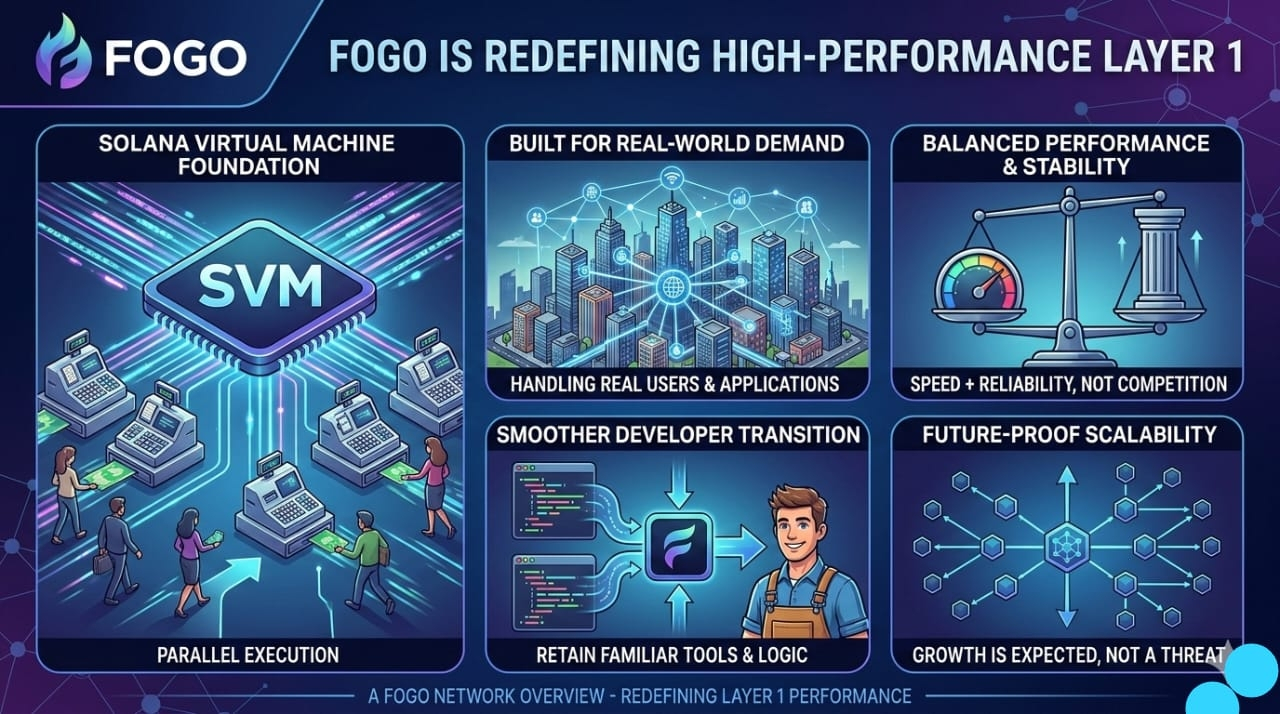
To me, the decision to use the Solana Virtual Machine says a lot about how they’re thinking. Instead of trying to invent a completely new execution system from zero, they’re choosing an environment that is already optimized for parallel processing, which means transactions can move at the same time instead of waiting in a long single line. I imagine it like opening multiple checkout counters in a busy store instead of forcing everyone to stand behind one register, and that simple shift changes the entire experience. They’re building on technology that already understands speed and efficiency, and then shaping it into their own Layer 1 identity.
What I appreciate most is that performance here does not feel like a surface-level metric. I’m not only thinking about how many transactions a network can process per second, because real performance also includes how quickly transactions finalize, how stable the system remains during high traffic, and how predictable the costs are for users and developers. Fogo seems to approach this in a balanced way, where speed and reliability grow together instead of competing with each other. They’re building something that can stay calm under pressure rather than something that looks impressive only when the network is quiet.
From a developer’s point of view, I can imagine how important it is not to constantly rewrite code every time you explore a new ecosystem. They’re making that transition smoother by using the Solana Virtual Machine, which means developers familiar with that environment do not have to throw away everything they already know. I feel like that respect for builders matters a lot, because when teams can focus on improving their products instead of adapting to unfamiliar execution logic, innovation moves faster and feels more natural. They’re lowering friction instead of adding more complexity.
Scalability is another area where I think Fogo’s approach becomes meaningful, because growth should not feel like a threat to a network. I’ve seen situations where activity increases and suddenly fees spike or confirmations slow down, and that kind of instability creates doubt. Fogo appears to be structured with the expectation that activity will grow, not with the hope that it stays manageable. By supporting parallel execution through the Solana Virtual Machine, they’re preparing the system to distribute workload efficiently so that demand does not become a weakness.
Security, of course, is something I can never ignore when thinking about Layer 1 infrastructure, because fast systems must still be trustworthy systems. They’re not sacrificing structure just to gain speed, and that balance is essential if serious applications are going to rely on the chain. When consensus and execution are carefully aligned, the network can remain stable even while processing transactions quickly, and that combination builds long-term confidence among validators, developers, and users.
I also think about the user experience in a very simple way. Most people do not care about virtual machines or architectural decisions; they just want their transaction to go through quickly and at a fair cost. If an application responds instantly and consistently, users feel comfortable interacting more often. Fogo’s performance focus creates the kind of environment where applications can feel smooth instead of delayed, and over time that smoothness shapes how people perceive the entire ecosystem.
When I step back and look at everything together, I see Fogo as a project that understands that infrastructure should feel invisible when it works well. They’re not chasing noise or temporary attention, but instead building a high-performance Layer 1 around the Solana Virtual Machine in a way that respects developers, supports scalability, and keeps efficiency at the center. To me, that feels grounded and practical, and in a space where many things move quickly, that kind of thoughtful foundation is exactly what can make a network last.
#fogo @Fogo Official $FOGO #FOGO
