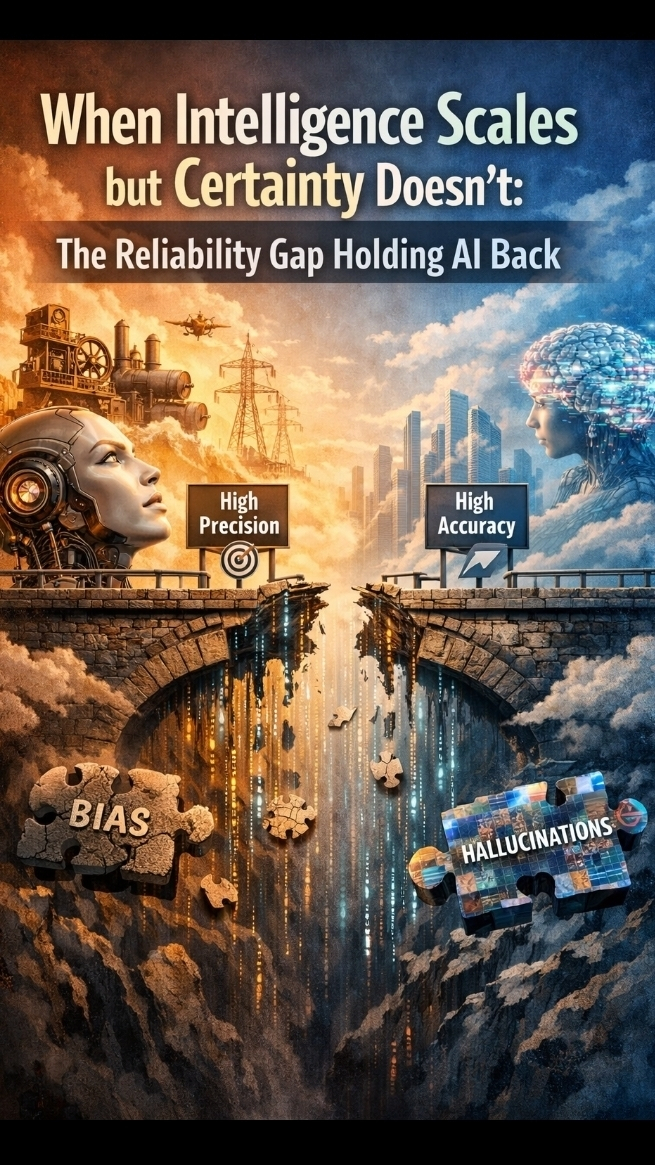
Most discussions about AI reliability happen far from systems. We talk about problems like hallucinations and bias like they're simple issues to fix. Just tweak the data change some settings add a safety net and the system improves. Benchmark scores go up error rates go down. It seems like AI is becoming reliable infrastructure.
I have learned to be cautious.In systems that run for years reliability is not about the AI model. It is about what happens after the model's part of a bigger process with deadlines, dependencies and changing incentives. A component can look stable on its own. Create problems when connected to other parts. Most failures I have seen were not caused by errors. They came from misalignments with assumptions.
AI is often evaluated like a function: input in output out.. In practice it behaves more like a service that gives probabilities inside a loop of other software and human decisions. Prompts are generated upstream outputs are parsed downstream and in between a piece of text becomes an action. That is where small problems add up. A response that is mostly correct is not a number. It is a range of meanings and automation is sensitive to the edges of that range.
Systems engineering has dealt with this dynamic for a time. Optimizing for performance can increase the risk of rare but costly failures. A controller that is perfectly tuned for conditions can become unstable at the margins. With AI the instability is not physical it is about meaning. The system does not oscillate it slowly drifts away from what operators think it is doing.
Another shift is more subtle. Traditional software produces structured outputs that can be validated easily. AI produces language that we later force into structure. That moves verification from the design phase to runtime and from checks to soft ones. Over time that changes what maintenance looks like. Of fixing code that breaks loudly you end up supervising behavior that degrades quietly.
Early design choices matter more than people expect. If you assume the model is advisory you build review paths and clear boundaries. If you assume autonomy you optimize for speed and defer verification. Both approaches make sense in their context. The difficulty is that switching later is expensive. Adding supervision to a fast pipeline introduces friction. Removing supervision from a system requires trust that may not be justified.
We have seen this pattern before in distributed systems that were designed for consistency and later asked to provide strong guarantees. Reliability can be added after the fact. The cost is always higher than if it had been part of the original design.
There is also a tension between narrowing and broadening model behavior. Constraining a model reduces variance, which makes downstream automation easier to reason about.. It increases the risk of systematic blind spots. Broadening the training signal improves coverage. It raises the cost of validation because outputs become less predictable.
Context determines which is tolerable. In safety- systems you want bounded behavior and accept reduced flexibility. In systems you accept variability and design for recovery. Now we are trying to use the same class of models for both roles, which is why the reliability conversation often feels unresolved. The expectations are incompatible.
Time introduces another variable. Models are trained on a snapshot of the world. Deployed into environments that evolve. Interfaces change, terminology shifts adversarial inputs appear organizations restructure. A model can become less reliable without any change to its parameters. Traditional software deals with this through versioning and compatibility layers. AI systems often deal with it through retraining, which resets behavior in ways that're difficult to predict and harder to audit.
Over the run maintenance dominates training. Monitoring outputs building verification layers, auditing decisions updating prompts retraining models—these are recurring costs. They do not appear in benchmark charts. They determine whether a system can run without constant supervision.
There are ways to design around this and each comes from a different starting assumption. You can treat the model as non-authoritative. Verify its outputs against deterministic sources before they affect state. You can restrict the problem so the model operates where ambiguity is acceptable. You can introduce representations so that language is translated into validated structures before execution.
Public narratives tend to reward performance gains and ignore operational resilience. A demo that works in an environment is easier to communicate than a system that fails safely under stress. Over time though the hidden cost of unreliability shows up as supervision layers and exception handling.
What matters for the term is not whether models are usually correct. It is whether incorrect outputs can be detected, isolated and recovered from without intervention. That is a property, not a benchmark score.
So the question that keeps coming regardless of model size or training method is a simple one in an AI-driven system, where does verifiable truth actually live and what keeps it stable, as everything else changes?