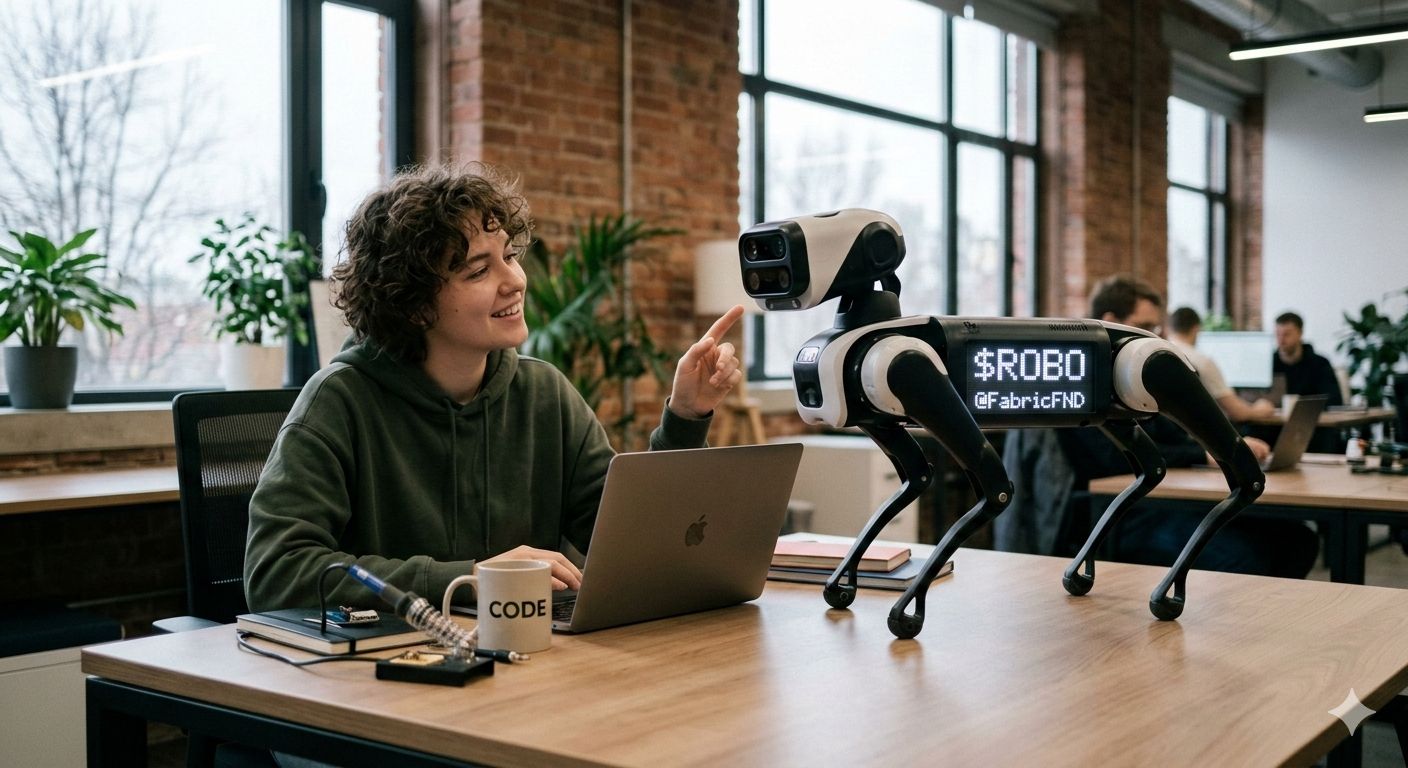
A Day in the Life of the $ROBO Economy
Imagine waking up in 2026. You aren't worrying about scheduling your grocery delivery or checking if your lawn was mowed. Instead, you glance at your tablet and see that your personal delivery drone just settled a micro-transaction using $ROBO
This isn't science fiction; it’s the reality being built by the Fabric Foundation.
Take Sarah, a freelance designer. In the old days, she’d spend hours coordinating logistics. Now, she owns a small fleet of two autonomous delivery bots. These aren't just machines; thanks to @FabricFND, they are "economic actors." They have their own on-chain identities and digital wallets. When one bot needs a battery swap at a local hub, it negotiates the price and pays the fee itself using $ROBO.
Sarah doesn't have to micromanage the payments. The decentralized protocol ensures that the "Proof of Task" is verified and the transaction is secure. Because the Fabric Foundation provides the open-source infrastructure, Sarah isn't locked into a giant corporate monopoly. She truly owns her tools and the income they generate.
As the sun sets, Sarah checks her dashboard. Her bots have successfully completed twelve local deliveries, earned enough to cover their own "maintenance fund," and even participated in a network governance vote—all powered by the utility of $ROBO
The "Robot Economy" isn't about machines replacing us; it’s about machines working for us in a transparent, decentralized way. By bridging the gap between AI and the physical world, @FabricFND is giving regular people the power to participate in the next industrial revolution.
The future is autonomous, and it’s fueled by


$ROBO