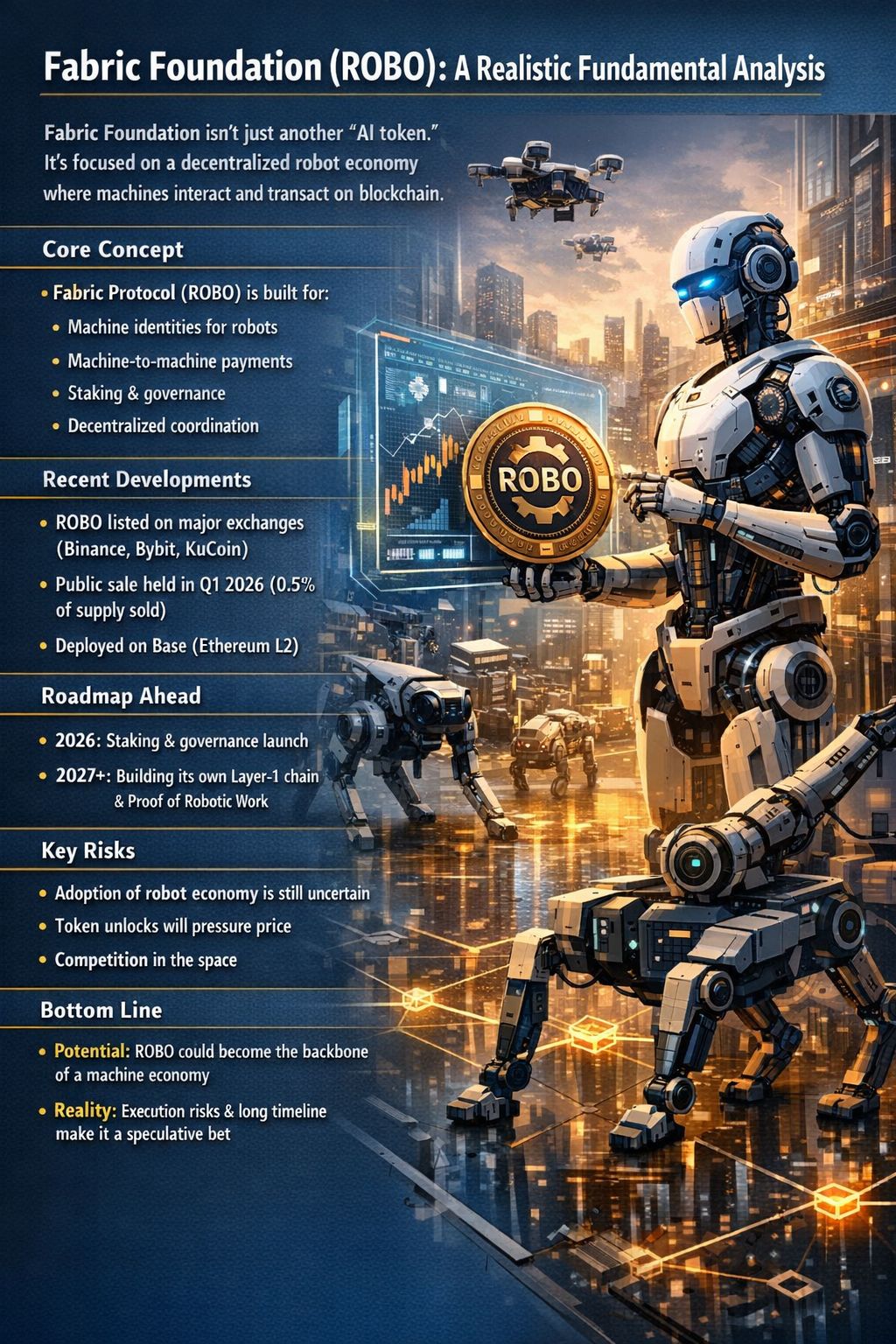
@Fabric Foundation , powered by the $ROBO token, is positioning itself as infrastructure for a decentralized robot economy. Unlike many crypto projects that simply attach themselves to the “AI” narrative, Fabric’s focus is more specific and more ambitious: enabling machines and autonomous robots to transact, coordinate, and operate economically using blockchain technology. This is not a meme-driven concept. It is an infrastructure bet on a future where machines participate directly in economic activity.
At its core, Fabric Protocol aims to provide on-chain identities for machines. In this model, robots and autonomous systems can have verifiable digital identities, allowing them to interact securely across networks. Beyond identity, the protocol is designed to enable machine-to-machine payments. This means robots could theoretically pay for services, data, maintenance, or compute resources without human intervention. ROBO functions as the economic layer facilitating these transactions.
The token also plays a role in staking and governance. Participants can stake ROBO to support network operations and potentially earn rewards, while governance mechanisms are expected to give token holders influence over protocol parameters such as fees and upgrades. The broader vision includes decentralized coordination, where robotic tasks and validations are handled through blockchain logic rather than centralized intermediaries.
From a development standpoint, Fabric has achieved several notable milestones. The ROBO token has gone through its token generation phase and is now publicly tradable on multiple exchanges, improving liquidity and price discovery. The project initially deployed on Base, an Ethereum Layer-2 network, to leverage existing infrastructure and user accessibility. This approach reduces early technical friction while the ecosystem matures.
Tokenomics, however, require careful consideration. ROBO has a fixed maximum supply of 10 billion tokens. A significant portion is allocated to ecosystem incentives, investors, the team, and foundation reserves, while only a small percentage was distributed in the public sale. This structure creates potential future selling pressure as vested allocations unlock over time. Any serious investor must factor this into risk assessment.
Looking ahead, the roadmap outlines several strategic goals. In the near term, the focus includes expanding staking mechanisms, strengthening governance frameworks, and driving ecosystem adoption. Mid-term plans suggest a potential transition toward a dedicated Layer-1 blockchain optimized specifically for machine transactions. This would be a major technical undertaking, requiring strong developer execution and sustained funding. There is also discussion of mechanisms like “Proof of Robotic Work,” aiming to reward verifiable machine-driven economic activity rather than passive speculation.
Despite its compelling vision, risks remain substantial. The large-scale adoption of autonomous machines transacting independently is still theoretical in most industries. Execution risk is high, competition in AI and blockchain infrastructure is intense, and token unlock schedules may introduce volatility. In the absence of measurable real-world robotic transaction volume, price action is likely to remain narrative-driven.#FabricFoundation #MarketRebound