
In an era where artificial intelligence is rapidly evolving from digital assistants to physical embodiments in the form of robots, the Fabric Foundation emerges as a beacon of innovation and ethical governance. As a non-profit organization, the Fabric Foundation is dedicated to creating the essential infrastructure that allows humans and intelligent machines to collaborate safely and productively. Their mission is clear and ambitious: to ensure that intelligent machines expand human opportunities, stay aligned with human intentions, and deliver benefits to people worldwide. By addressing potential pitfalls like misalignment, unequal access, and concentrated power, the Foundation is building new frameworks tailored for a future where machines participate in our economy without the need for legal personhood.
At the heart of this ecosystem lies the Fabric Protocol, a blockchain-based platform designed specifically for real-world AI systems, particularly robots. It provides decentralized solutions for identity, payments, and governance, enabling verifiable computation and secure interactions between humans and machines.
Imagine a world where robots can have on-chain identities, process payments seamlessly, and coordinate tasks in a decentralized manner; this is the vision Fabric Protocol brings to life. Initially deployed on the Base layer (an Ethereum Layer 2 solution), the network plans to evolve into its own Layer 1 chain as adoption grows, capturing economic value from robotic activities and ensuring scalability.
Central to the Fabric ecosystem is the $ROBO token, which serves as both a utility and governance asset. $ROBO is not just another cryptocurrency; it's the fuel that powers the "Robot Economy." With a total supply capped at 10 billion tokens, $ROBO aligns incentives across participants, from developers to robot operators. Here's a closer look at its multifaceted role:
Network Fees and Transactions: All fees within the Fabric network, including those for identity verification, payments, and data processing, are paid in $ROBO. This creates inherent demand as robots and AI agents require web3 wallets and on-chain identities to operate effectively.
Crowdsourced Coordination: $ROBO enables decentralized participation in robot development and activation. Users can stake $ROBO to gain access to resources, prioritize tasks, and contribute to hardware genesis. Protocol revenues are used to buy back $ROBO, generating buy pressure and rewarding long-term holders. Importantly, participation focuses on coordination rather than ownership or direct economic claims.
Ecosystem Entry and Rewards: Builders and developers stake a fixed amount of $ROBO to join the network, access tools, and build applications. In return, they earn rewards for contributions like developing robot skills, completing tasks, providing data, or validating computations—all verified on-chain.
Governance: $ROBO holders influence key decisions, such as fee structures and policy updates, ensuring the network evolves in a way that benefits humanity. This democratic approach fosters an open environment where anyone can participate, preventing centralization.
The tokenomics of $ROBO are thoughtfully designed to support sustainable growth. The allocation breaks down as follows:
Investors: 24.3% (12-month cliff, 36-month linear vesting)
Team and Advisors: 20.0% (same vesting)
Foundation Reserve: 18.0% (30% at Token Generation Event (TGE), remainder over 40 months)
Ecosystem and Community: 29.7% (30% at TGE, linear over 40 months; includes Proof of Robotic Work incentives)
Community Airdrops: 5.0% (100% at TGE)
Liquidity Provisioning and Launch: 2.5% (100% at TGE)
Public Sale: 0.5% (100% at TGE)
This structure ensures long-term alignment, with significant portions vested to prevent dumps and fund ecosystem development. As of today, February 27, 2026, $ROBO has a circulating supply of approximately 2.23 billion tokens and is trading around $0.035–$0.039 USD, reflecting strong market interest following its recent launch on platforms like Coinbase, Bybit, and others. The ongoing airdrop, which opened for claims earlier today, is distributing tokens to early supporters, further boosting community engagement.
Why does this matter? As AI robotics advances, challenges like physical safety, real-time decision-making, and resource constraints become critical. The Fabric Foundation tackles these by making machine behavior predictable and observable, while enabling inclusive participation. Robots could soon handle tasks in healthcare, manufacturing, logistics, and daily life, contributing economically without displacing humans. By owning the Robot Economy through $ROBO, participants can shape this future, ensuring it's equitable and human-centric.
The potential is immense. With backing from visionary investors and a focus on verifiable human-machine alignment, Fabric is positioned to lead the next wave of technological revolution. If you're interested in AI, blockchain, or robotics, now is the time to dive in—stake, build, and govern with $ROBO.
For more details, check out the official updates from @Fabric Foundation 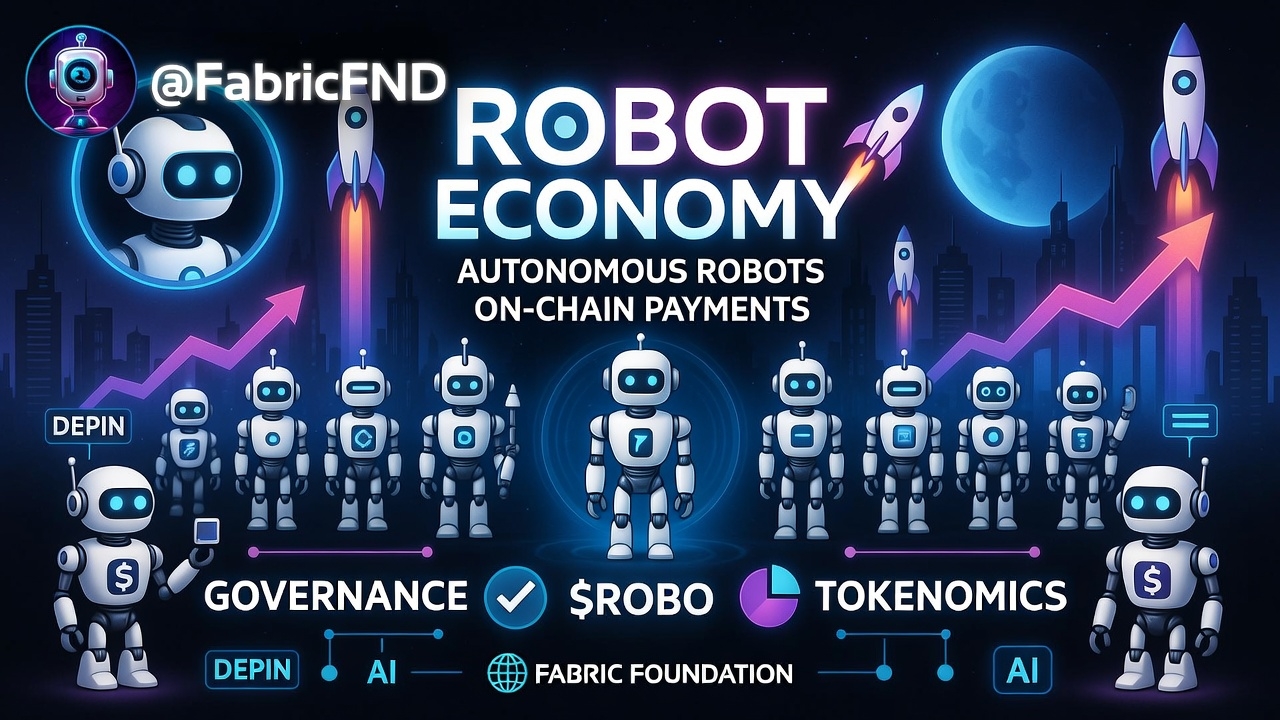 Let's build the future together!