
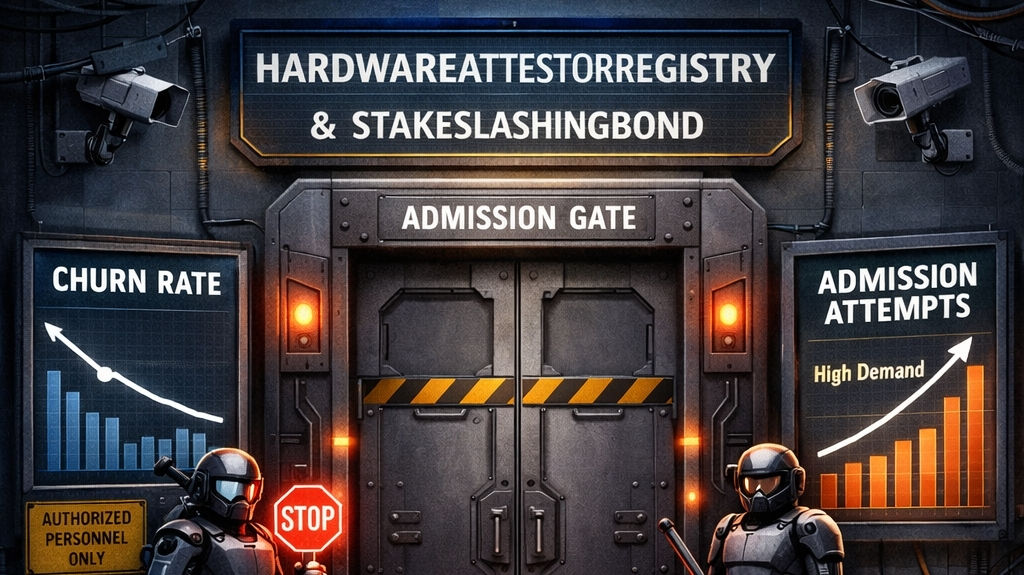
I once watched a small robot arm flinch at the wrong moment in a busy workshop, not because the code was evil, but because the people and machines around it were not lined up on what “safe” meant that day. That memory is why I keep circling back to two simple names in Fabric, HardwareAttestorRegistry and StakeSlashingBond. They sound like paperwork, and in a way they are. They decide who gets to walk through the door and help settle the work that robots depend on.
Most people, when they hear “hardware attestation,” relax a little. I have felt that too. It sounds like a metal stamp on a tool, like someone checked the serial number and the tool is real. The mispricing starts right there. Attestation can be real and still not be open. A system can have strong checks and still be shaped by a small group that controls the checks.
In this design, the biggest idea is not the stamp. It is the door. Admission is the real lever. HardwareAttestorRegistry is the list that decides who is allowed in, and StakeSlashingBond is the money-backed rule that can kick you out or punish you when you fail the required re-attestation window. The network does not just ask, “Are you using approved hardware.” It also asks, “Are you proving it again, on the schedule we demand.” That schedule matters. The constraint is plain. Operators have to show up for periodic re-attestation windows. If you miss the window, you do not just look sloppy. You can be treated as not fit to participate. It is a timed gate, not a one-time badge.
I have seen timed gates in the real world. In that same workshop, we used a lockbox for a torque wrench because the bolts mattered. The wrench was a safety tool, but the lockbox became a power tool. If one person held the key and only showed up at certain hours, work stopped. People started planning their day around that person, not around the job. Nobody called it centralization. They called it “process.”
The bond makes the gate feel serious. When there is something at stake, people behave. That is the good part. If you lie about your setup, you can lose money. The cost of cheating rises. The network is not relying on vibes. It has a built-in punishment that can be enforced when an operator is caught out of spec.
But that same seriousness also makes onboarding slower by design. You give up speed at the front door so you can resist the easy cartel behavior later. If it was instant to join, it would also be instant to swarm. A fast door is an easy door to game. Slowing it down can be a kind of safety. Still, it is a real sacrifice. New operators have to wait for the right window and the right approvals. In a world where robots may need more compute or more oversight during sudden events, waiting can hurt.
This is where the hidden risk lives. People often picture the threat as a single bad operator sneaking in. The quieter failure is a small attestor clique blocking entrants. The blockade does not have to be loud. It can be done by delay. It can be done by “lost paperwork.” It can be done by requiring tiny extra steps that look reasonable when viewed one at a time. In practice, the clique does not need to kick you out forever. They only need to keep you out long enough that you stop trying, or that your business runs out of cash.
If that happens, the clique does more than slow growth. It starts steering who can settle safety-critical compute. That phrase sounds abstract until you picture the moment a robot system needs a decision recorded, agreed, and accepted by the network. If only a narrow set of operators are consistently admitted and kept in good standing, the set of people who can “make it count” becomes a narrow set too. The network can still be global on paper. On the ground, it feels like a club.
I pay attention to signals that are hard to fake, because stories are cheap. Fabric’s own chain behavior can give you one of those signals, and it is not a vibe check. The proof is in the churn. If the attestor set stops changing, while admission attempts keep rising, something is off. The two named parts are the cause. The registry is where the set is tracked. The bond is what makes participation costly enough that the set’s shape matters. If a healthy, open system is running, you expect some steady movement. New attestors appear. Old ones rotate out. Signers take breaks. When there is demand to join, the set should not freeze like a lake in winter.
A frozen set does not prove wrongdoing by itself. Sometimes stability is earned. Maybe the early group is simply doing a good job, and others are not ready. That is why the second part of the signal matters. Demand. If you can see a rising number of admission attempts, and you do not see new accepted parties at anything like the same pace, the door is becoming a choke point. In plain language, people are knocking and nobody new is being let in.
There is another way the mispricing shows up. People treat attestation like a yes or no checkbox. But a timed re-attestation window turns it into a rhythm, like rent due dates. If you can only stay inside by paying on schedule, then whoever influences that schedule, or influences how strict it is applied, has power. Even if the rules are written clearly, real life creates edge cases. Hardware fails. Supply chains slip. Travel delays happen. If the system has no mercy for reality, it will be safe in one sense and brittle in another.
Brittle systems create their own kind of pressure. Operators start building around the window instead of around the work. They hoard spare parts. They choose vendors based on who can produce proofs fastest, not who produces the most reliable machines. They may even avoid serving regions with unstable logistics because the window penalty is too high. None of that needs a conspiracy. It is just incentives doing their job.
So when someone says, “Hardware attestation equals open safety,” I hear, “The lockbox makes the wrench safe.” It might. It also might make the whole shop depend on the person with the key. The point is not that the lockbox is bad. The point is that the lockbox becomes the center of the room. In Fabric, the admission gate becomes the center of the room.
I like that the design admits this reality by putting money at risk. That is honest. A bond says, “We expect bad behavior and we priced it in.” It also creates a clear line for accountability. If you are caught cheating, it is not just a slap on the wrist. Still, the bond does not solve the clique problem on its own. A tight group can follow the rules and still dominate the door. They can be “clean” and still be selective. A cartel does not always look like crime. Sometimes it looks like policy.
When I think about how to watch this in practice, I imagine two simple charts made from public data. One chart shows how often the attestor set changes over time. Another chart shows how many admission attempts happen over the same period. If attempts rise and churn collapses, the system is telling you something. It is not telling you about a single transaction. It is telling you about a pattern.
This is also why “periodic windows” matters so much. A window creates natural cliffs in time. Near the deadline, people rush. After the deadline, people wait. If a small group controls the pace at those cliffs, they control who gets to recover from bad luck and who does not. You might see bursts of submissions followed by long flat lines. You might see the same signers over and over, even as the crowd at the door grows. Over time, the network’s safety story becomes less about verified machines and more about verified membership.
I do not think most teams set out to build a club. I think they set out to make robots safe in a world where “safe” is hard to define. That is a good intention. But intentions do not run networks. Doors do. And in this angle, the door is the product. The market is paying attention to the stamp and ignoring the bouncer.
If the Gini coefficient of attestor signature share crosses its alert threshold and the median time-to-admit doubles, the “hardware attestation equals open safety” claim is wrong.
@Fabric Foundation #FABRIC $ROBO
