
The robots are coming. Not as science fiction props or factory curiosities, but as economic actors that will need to pay for electricity, verify their identities, and settle transactions without calling a human accountant. This is the premise behind @Fabric Foundation and their native asset $ROBO, a project that quietly emerged as one of the most ambitious infrastructure plays in the intersection of artificial intelligence and decentralized networks.
What exactly is Fabric building? At its core, the Fabric Foundation operates as the nervous system for what they term the Robot Economy. Think about the current state of robotics. A humanoid from UBTech cannot talk to a quadruped from AgiBot. They exist in closed loops, running proprietary software, unable to share skills or coordinate tasks. Fabric solves this isolation problem by creating a universal layer where machines can communicate, transact, and verify their actions onchain.
The architecture rests on three pillars. First is OM1, an operating system described as the Android for Robotics. It allows developers to write a skill once and deploy it across any compatible hardware, whether that is a warehouse arm or a delivery bot. Second is the Fabric Protocol itself, which functions as a trust and coordination layer. This is where robots register their identities, post bonds for work, and settle payments. Third is the economic engine powered by $ROBO, the token that serves as both fuel and governance mechanism for the entire network.
Why does this matter now? The timing aligns with several converging trends. AI has graduated from chatbots to physical systems capable of navigating warehouses, folding laundry, or assisting in elder care. Meanwhile, the infrastructure for these machines remains fragmented. A robot cannot open a bank account or hold a passport. It needs cryptographic identity and a wallet to participate in economic life. Fabric provides exactly that, allowing autonomous agents to pay for their own charging, maintenance, or cloud compute without human intermediaries.
The mechanics of how this works are straightforward but elegant. When a robot joins the network, it receives an onchain identity through the Fabric registry. This acts as a global passport tracking permissions, performance history, and ownership. To accept tasks, operators must stake $ROBO as a work bond. This collateral ensures accountability. If a machine fails to complete assigned work or behaves maliciously, a portion of the bond gets slashed. Completed tasks are verified through Proof of Robotic Work, a consensus mechanism that rewards participants for verified labor, data contributions, or hardware coordination.
Developers access the ecosystem by staking ROBOtopublishskillsontheRobotCraftermarketplace.AlogisticscompanyneedingshelfstockingcanpurchasethatskillanddeployitinstantlyacrossanyOM1compatiblefleet.Thepaymentflowsautomatically,settledin ROBO, with a portion of protocol revenue directed toward open market buybacks. This creates persistent demand pressure on the token while funding ongoing development.
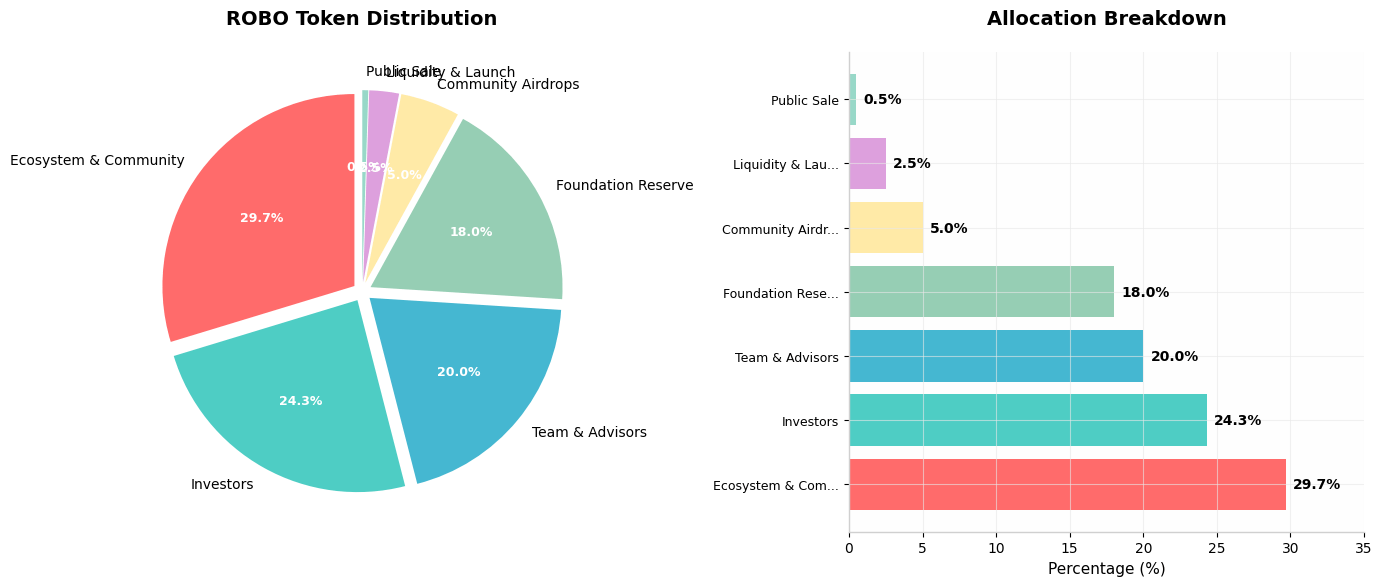
The tokenomics reveal a carefully constructed distribution designed for longevity rather than quick pumps. Total supply is fixed at 10 billion tokens with zero inflation. The largest slice, 29.7 percent, flows to ecosystem and community incentives. These rewards are not handed out for passive holding. They are earned exclusively through verified work, whether that is completing robot tasks, contributing training data, or supplying GPU compute. This design makes robo functionally equivalent to wages rather than investment yield.
Investors hold 24.3 percent, but face a twelve month cliff followed by three years of linear vesting. The team and advisors follow an identical schedule. This means no insider dumps in the first year. The Foundation Reserve keeps 18 percent for long term stewardship, while community airdrops account for 5 percent fully unlocked at launch. Liquidity provisioning and public sale make up the remaining 3 percent.
The utility of $ROBO extends across multiple functions. Network fees for identity verification, task settlement, and data queries all require the token. Governance rights come through veROBO, where locking tokens yields time weighted voting power over protocol parameters. Perhaps most interesting is the delegation mechanism, where token holders can augment an operator's work bond, effectively betting on reliable providers and sharing in their task flow while accepting joint slash risk.
Fabric has already secured partnerships with major humanoid manufacturers and recently completed a 20 million dollar funding round led by Pantera Capital. The project launched on Base but plans migration to its own Layer 1 as adoption scales. Recent exchange listings on Coinbase, Crypto.com, and Binance Alpha signal growing institutional recognition of the robotics narrative.
The road ahead carries both promise and uncertainty. Real world adoption depends on whether manufacturers actually adopt the OM1 standard and whether the Proof of Robotic Work mechanism can scale beyond pilot programs. Competition exists from other AI infrastructure projects, though few focus specifically on the hardware coordination layer. Supply inflation from vesting unlocks could create price pressure over the next few years.
What Fabric represents, however, is a fundamental reimagining of how machines participate in economic systems. By giving robots wallets, identities, and the ability to transact autonomously, they are building the financial rails for an automated future. The robo token captures value not through speculation alone, but through actual usage as machines begin earning and spending in a decentralized economy. For those watching the convergence of AI and blockchain, this is infrastructure worth understanding.