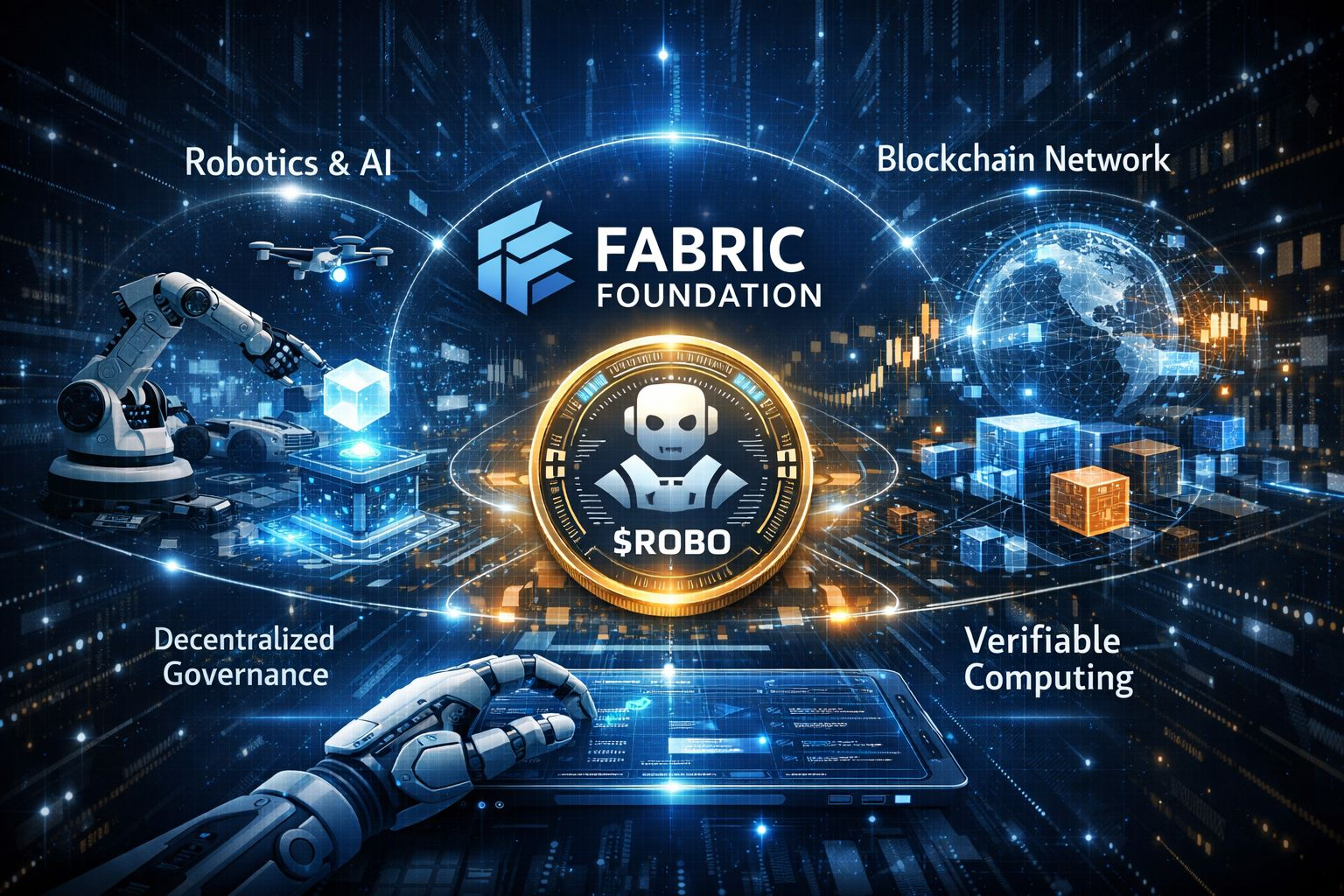
In an industry crowded with short-term narratives and recycled innovation, Fabric Foundation stands out as a long-term infrastructure play—bold, technical, and deeply transformative. As someone who closely follows emerging ecosystems, I genuinely believe this is one of the most forward-thinking initiatives bridging robotics, AI, and decentralized coordination.
Fabric Foundation is not just building another protocol. It is engineering a global open network designed to support the construction, governance, and collaborative evolution of general-purpose robots. That alone shifts the narrative. While most blockchain projects compete within finance, Fabric extends blockchain utility into the physical world—into machines that think, move, learn, and interact.
A New Layer for Machine Coordination
At its core, Fabric Foundation enables verifiable computing and agent-native infrastructure. This means robots and AI agents can coordinate data, computation, and governance through a transparent public ledger. The implications are massive:
🔸Trustless machine-to-machine collaboration
🔸Auditable computation processes
🔸Modular robotic development
🔸Secure data exchange across global contributors
Instead of siloed robotics systems owned by centralized corporations, Fabric promotes a permissionless innovation model. Developers, researchers, and institutions can build modular components that plug into a shared ecosystem. This accelerates progress while maintaining accountability and security.
Why $ROBO Matters
The $ROBO token is more than a digital asset—it is the coordination mechanism of the ecosystem. It facilitates governance, incentivizes contributors, and aligns economic participation with technological advancement. In my view, the strength of $ROBO lies in its functional integration with infrastructure, not hype cycles.
Utility-driven tokens backed by real-world technical architecture have long-term sustainability. Fabric’s model rewards those who contribute computing power, data validation, and robotic improvements. This creates a circular economy of innovation where value flows to builders and validators.
Infrastructure Built for Scale
What makes Fabric Foundation truly admirable is its modular architecture. It integrates:
🔸Public ledger coordination
🔸Verifiable computing frameworks
🔸Agent governance layers
🔸Regulatory-compatible infrastructure
This layered approach ensures scalability while maintaining compliance adaptability. As global regulation evolves around AI and robotics, networks must be built with foresight. Fabric appears to understand this deeply.
The protocol coordinates not only code but responsibility. Governance mechanisms enable stakeholders to collectively evolve standards for safety, ethics, and operational integrity. In a world increasingly concerned about AI alignment, this is not optional—it is essential.
The Bigger Picture
We often discuss Web3 as a financial revolution. Fabric expands that conversation into a machine economy revolution. Imagine autonomous delivery systems, collaborative robotic manufacturing, distributed AI research networks—all interoperating through a shared protocol layer.
Fabric Foundation positions itself as the connective tissue between human governance and machine execution. That is a powerful narrative, but more importantly, it is backed by tangible infrastructure design.
From my perspective, projects like this define the next cycle—not meme-driven spikes, but foundational layers enabling new industries. Robotics and AI will shape the coming decades. A decentralized coordination layer for that evolution could become one of the most critical technological primitives of our time.
Long-Term Conviction
Innovation requires courage. Fabric Foundation is building where few dare to experiment—at the intersection of blockchain, robotics, AI, and governance. That complexity alone deserves recognition.
ROBO is not just another ticker. It represents participation in a network aiming to redefine how intelligent machines are built and governed globally. For those who look beyond short-term volatility and focus on structural transformation, this ecosystem offers something rare: vision with architecture.
As we move deeper into the era of autonomous systems, I see Fabric Foundation as an early architect of decentralized machine collaboration. And that, in my opinion, is a narrative worth paying attention to.
#ROBO #FabricProtocol #FabricFounddation @Fabric Foundation $ROBO