We are entering a strange phase of technology. Robots are no longer experimental novelties locked inside labs. They are delivering packages, inspecting infrastructure, assisting in warehouses, and increasingly making decisions that carry financial and operational consequences. Yet the systems that coordinate them still rely heavily on closed databases, private agreements, and trust in centralized operators. That gap between autonomy and accountability is exactly where Fabric Protocol places its bet.
Backed by the non-profit Fabric Foundation, Fabric is not trying to build a better robot arm or a faster navigation model. It is trying to build the invisible layer that allows robots, developers, operators, and clients to coordinate safely and transparently. In simple terms, Fabric treats robots as economic participants rather than just programmable machines.
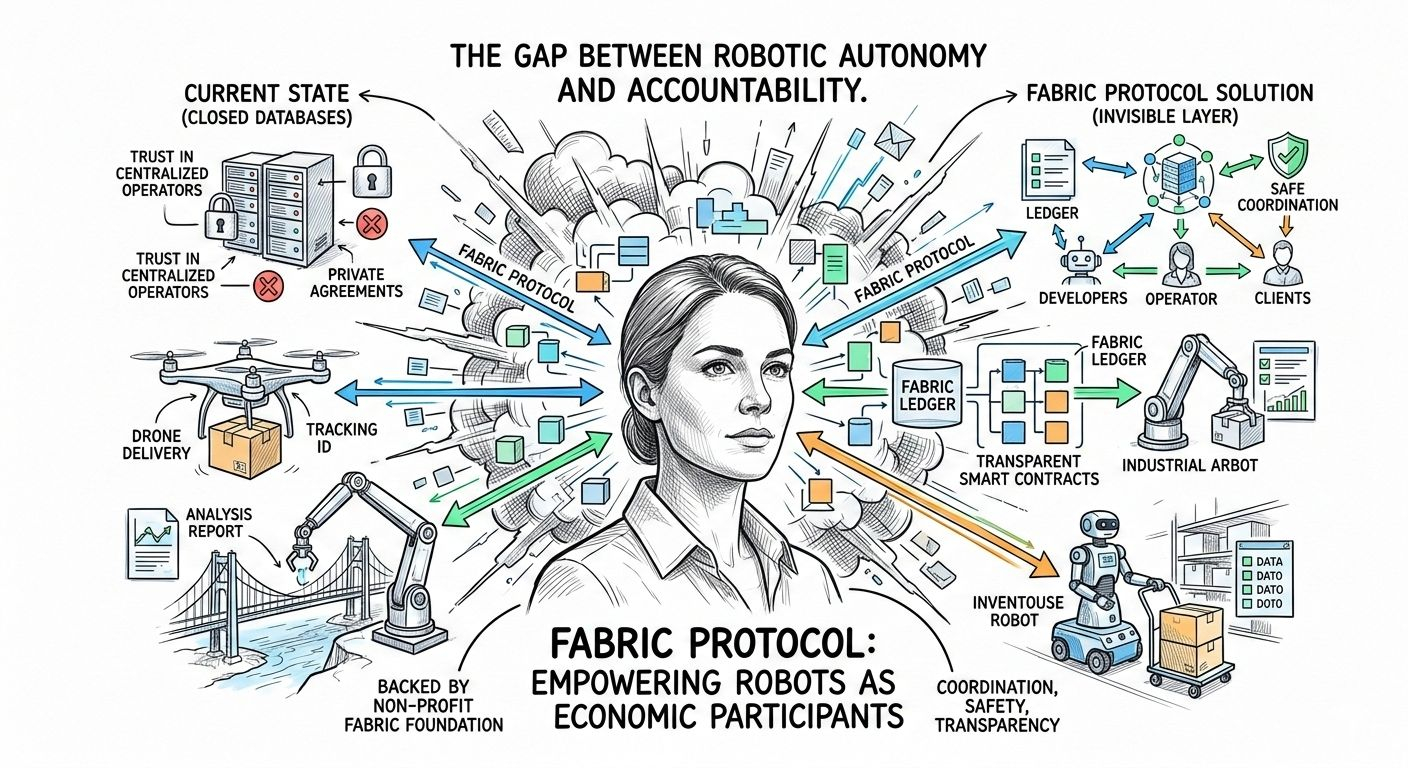
The idea feels almost obvious once stated clearly: if a robot can complete a task with real-world value, it should have a verifiable identity, a way to record proof of its work, and a mechanism to receive payment. Today, those elements are usually handled through private systems controlled by companies. Fabric proposes moving key pieces of that coordination onto a public ledger, where records are transparent, auditable, and governed collectively.
The architecture reflects practical thinking. Fabric does not attempt to run high-speed control systems on-chain. Real-time motor commands and sensor feedback remain off-chain, where milliseconds matter. Instead, the blockchain layer anchors what truly needs shared trust: identity registration, verification receipts, governance votes, and financial settlement. That separation shows maturity. It acknowledges both the strengths and limitations of distributed ledgers.
A central component of the system is verifiable computing. Rather than asking partners to trust internal logs, Fabric encourages the publication of cryptographic proofs or structured attestations of completed tasks. In a logistics or industrial environment, that can reduce disputes and increase confidence between parties that may not fully trust one another. The goal is not surveillance — it is shared accountability.
The token, often referred to within the ecosystem as $ROBO, plays a functional role rather than a decorative one. It is used to pay protocol fees, participate in staking, access services, and engage in governance decisions. More importantly, it can serve as a programmable settlement asset between machines and humans. A robot completing inspection work or fulfilling a service request could theoretically receive tokenized payment automatically upon verified completion.
From an economic standpoint, this creates alignment. Validators and participants stake tokens to secure the network. Users spend tokens to access verification and coordination services. Governance participants use tokens to shape protocol parameters. When designed carefully, this structure encourages long-term participation rather than short-term speculation. At the same time, it requires thoughtful management to avoid volatility undermining real-world utility.
What makes Fabric compelling is its grounded ambition. It does not promise futuristic humanoid societies. It focuses on solving coordination problems that already exist. Robotics today is fragmented. Vendors control their own data. Clients rely on opaque reports. Disputes are handled through contracts and manual reconciliation. Fabric offers a neutral layer where identity, proof, and payment can coexist under transparent rules.
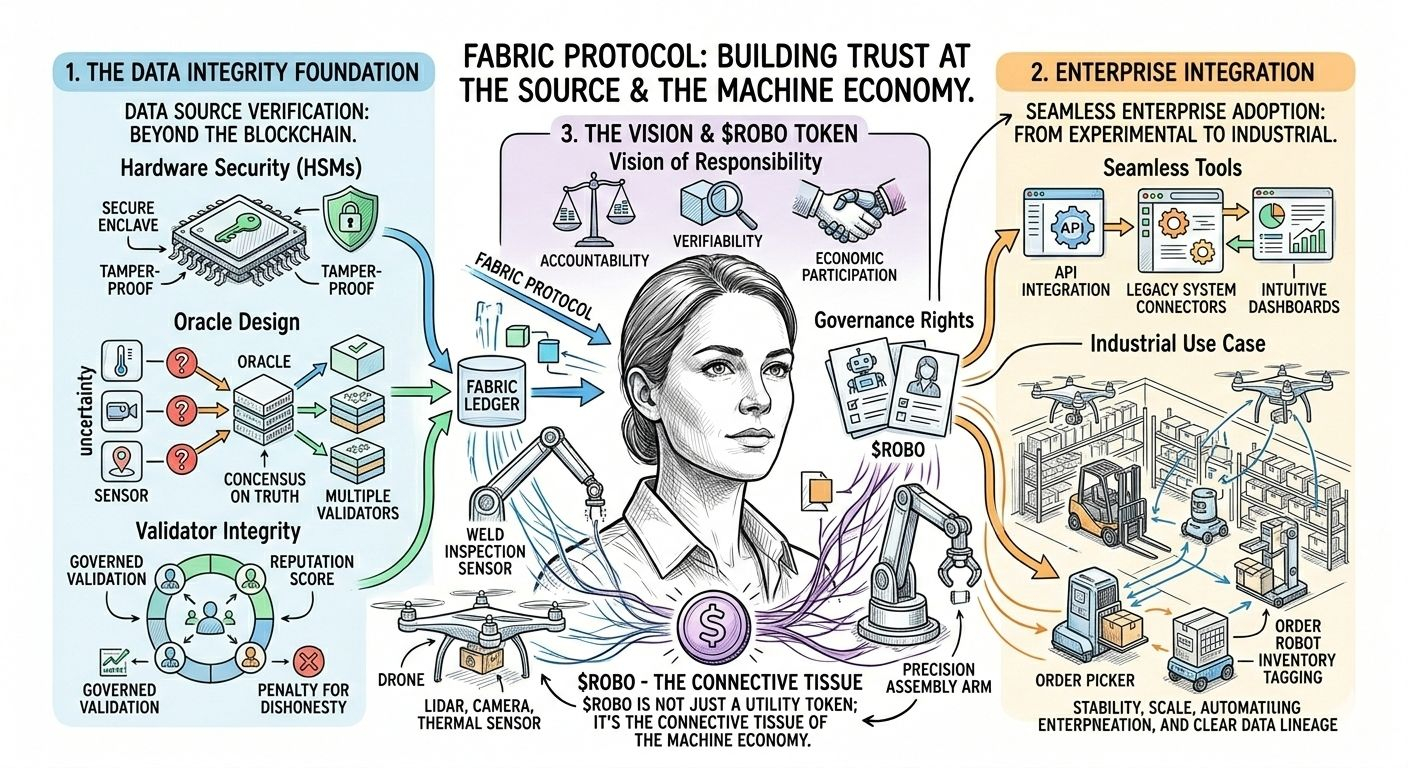
There is still work ahead. Trust at the data source level remains critical. A blockchain can verify that something was recorded, but it cannot guarantee that the original sensor input was accurate. Hardware security, oracle design, and validator integrity will determine whether the system can support serious industrial use. In addition, enterprises need integration tools that feel seamless rather than experimental.
Yet the vision carries weight. As robots take on more responsibility, society will demand clearer accountability. Fabric’s approach suggests that autonomy should be paired with verifiability and that economic participation should be matched with governance rights. In that framework, $ROBO is not just a utility token — it becomes the connective tissue of a machine economy.
If Fabric succeeds, it will not be because of marketing momentum. It will succeed because companies, developers, and operators quietly adopt it as the standard way to register, verify, and settle robotic activity. The protocol would then fade into the background, functioning as trusted infrastructure rather than a headline. And in that quiet normalcy lies its real potential: transforming robots from isolated tools into accountable participants in a shared economic system.
@Fabric Foundation #ROBO $ROBO