
This is the quiet friction point in modern artificial intelligence. Models generate language with fluency that often exceeds human speed, sometimes even human clarity. But fluency is not verification. A sentence can be grammatically perfect and factually empty.

Mira positions itself in that gap.
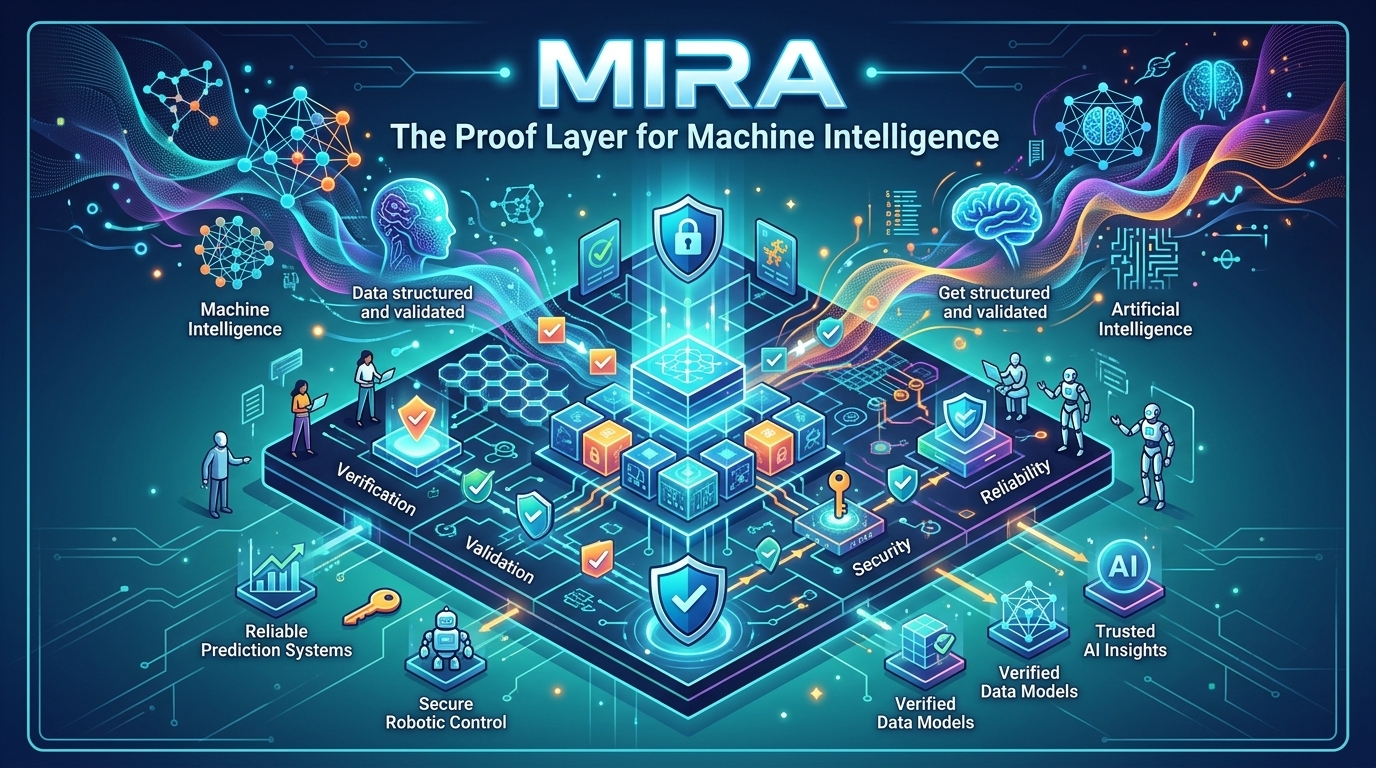
The idea behind a proof layer for machine intelligence is less abstract than it first appears. Every AI output contains claims, even when disguised as narrative. A statistic about unemployment. A dosage recommendation. A summary of a court ruling. Mira breaks those outputs into discrete, verifiable statements and routes them through a structured review process. Instead of trusting the originating model, it subjects its claims to independent validation.

The mechanics are procedural by design. A claim is submitted with its supporting evidence—links, documents, datasets. Validators, who may be specialized models or human reviewers depending on the domain, assess the claim against the source material. Accuracy earns them rewards and builds a track record. Repeated inaccuracy erodes both.
This staking mechanism is not about theatrics. It introduces consequences. In many online systems, being wrong costs nothing. In Mira’s model, careless validation carries a financial penalty. Over time, reputations accumulate. A validator who consistently reviews biomedical claims accurately becomes identifiable as such. The ledger does not forget.
The approach acknowledges a practical reality. AI systems are being embedded into workflows faster than verification norms are evolving. Customer service bots draft responses without a second look. Research assistants summarize dense reports for analysts under time pressure. Developers rely on code generated in seconds. In some cases, the output is reviewed carefully. In others, it moves forward because it sounds plausible.
Mira’s premise is that plausibility is not enough.
The blockchain component is less about ideology than about record keeping. Traditional fact-checking often happens behind closed doors. Decisions are stored in internal systems, subject to revision without public trace. By writing validation results to a distributed ledger, Mira makes the process inspectable. Anyone can see which validator reviewed which claim and what conclusion they reached. Transparency does not eliminate error, but it makes patterns visible.
There are tradeoffs. Verification takes time. Opening source documents, cross-referencing data, confirming context—these steps slow the pipeline. In environments optimized for speed, friction feels like regression. But speed without reliability carries its own cost. The legal profession learned this when attorneys submitted briefs containing fabricated cases generated by AI tools. The embarrassment was public. The lesson was expensive.
A network of validators can agree on a flawed interpretation. Bias can creep in. It is a system built to improve probabilities, not guarantee perfection.
The proof layer also forces a more granular way of thinking about machine intelligence. Rather than asking whether a model is generally reliable, it asks whether specific claims are verifiable. This reframing matters.
A financial report generated by an AI assistant includes a revenue figure and cites a quarterly filing. Mira’s network checks the filing, confirms the number, and logs validation. The end user may never see the process. They see only a confirmation badge or a verified status. Behind that small signal lies a structured review that did not exist before.
Consumer applications may apply it selectively, balancing friction against convenience.
There is also a philosophical undertone. For years, debates about AI centered on capability—how smart models could become, how convincingly they could mimic human reasoning. The proof layer shifts attention to accountability.
The claim is marked inaccurate. The validator’s record updates accordingly. The language model remains unchanged; it will generate another answer in milliseconds. What changes is the environment around it. Instead of moving unchecked into a report or a decision, its output passes through a layer that asks, quietly but firmly, “Is this true?”
Mira’s wager is that in an era defined by machine-generated language, proof will matter as much as production. Intelligence may be measured by what a system can create. Trust will be measured by what it can defend.$MIRA @Mira - Trust Layer of AI #mira