When I first dug into Fabric, I expected the standard package: a token pitch, a timeline, and a quiet assumption that the hardest problems could be deferred to some future phase. What I found instead was narrower and, oddly enough, more exposed—an argument that feels almost conservative by crypto standards.
The paper doesn’t warn that robots themselves are the threat. It suggests the risk lies in control. As machines move deeper into the economy, the real power may settle with whoever holds the software, the skill modules, the payment channels, and the governance keys. That concentration of control is where the leverage begins to tilt.
That isn’t a hype line. It reads more like a caution sign.
Fabric Protocol describes itself as a global open network backed by a non-profit, the Fabric Foundation, built to coordinate how general-purpose robots are created, governed, and improved over time. When the Foundation uses the word “stewardship,” it doesn’t sound ornamental. It sounds like language chosen by people who assume their choices will eventually be examined and questioned.
The paper is careful about roles. It spells out that the token issuer is Fabric Protocol Ltd., set up in the British Virgin Islands and fully owned by The Fabric Foundation. It also names OpenMind as a key contributor, but makes a point of separating it from ownership and governance of the issuer, describing the relationship as commercial rather than controlling. Those aren’t throwaway clarifications. They read like answers drafted in advance for the inevitable questions: who holds the treasury keys, who writes the rules, who stands to gain, and who takes the fall if things go sideways.
The legal framing follows the same tone. The document states that the token does not grant profit rights, dividends, or revenue share, and references an opinion arguing it should not be treated as a security. You can see that as standard compliance language for the space. You can also see it as an attempt to avoid becoming a de facto public company from day one. Either way, it suggests Fabric wants its structure to be solid enough to withstand scrutiny, not just launch-day enthusiasm.
The corporate structure is just the entry point. The deeper argument shows up when Fabric names a problem most projects prefer to sidestep.
Blockchains can prove what happens on-chain with clean finality. Robots operate in the physical world. If an operator says a machine cleaned a hallway, dropped off a package, or ran an inspection, there isn’t some universal cryptographic receipt that settles the claim beyond doubt. Fabric states this plainly in its whitepaper: work in the real world is only partially observable, and in most cases it cannot be proven with pure cryptography alone.
That single line shifts the mood. It’s Fabric effectively admitting, “We understand where your skepticism lives, and it’s justified.”
Instead of pretending robot work can be made perfectly provable, Fabric leans in a different direction. The goal isn’t flawless proof. It’s to make lying economically irrational.
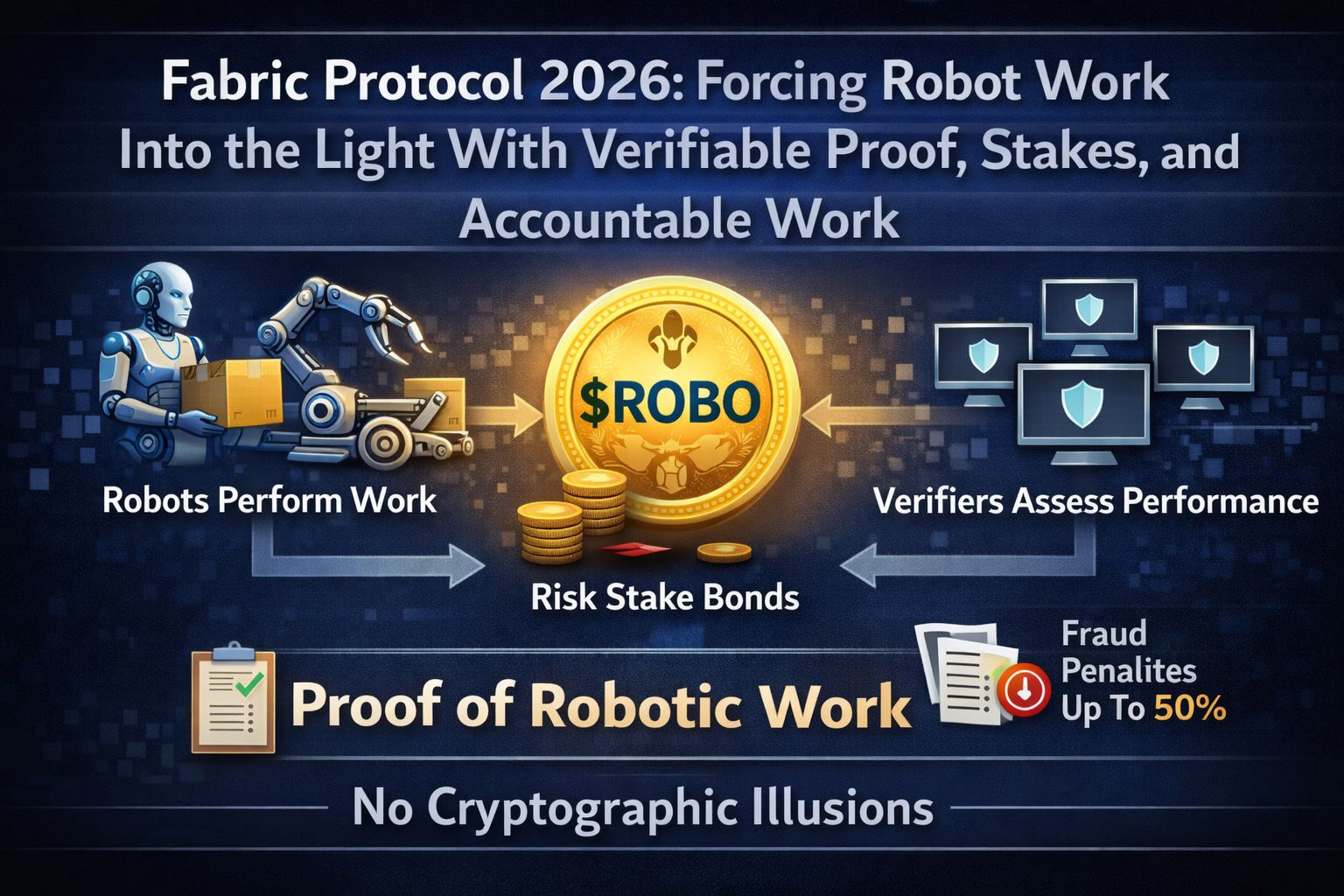
The whitepaper lays out a structure where service providers, essentially robot operators offering tasks to the network, lock up collateral when they accept jobs. On the other side sit validators, whose role is to observe and assess performance. They also stake bonds, collect a portion of protocol fees, and can receive bounties for exposing misconduct. If a provider is shown to have cheated, their stake can be cut. The document is unusually concrete about this. It references fraud penalties in the range of 30% to 50% of the task stake, uptime tracked over a 30 day epoch with a target around 98% availability, and a quality bar where slipping below roughly 85% can pause reward eligibility.
There’s nothing subtle about it. Fabric is constructing a system built around consequences.
The real issue is whether that kind of structure can hold up when the evidence is imperfect and the incentives are anything but.
Anyone who has spent time around real operations—logistics, field service, facilities management—knows how quickly things turn gray. One party insists the robot showed up. Another swears it never did. Someone points to missing camera footage. Someone else argues the sensor data was tampered with. At that point, you are no longer sorting out a tidy on chain disagreement. You are untangling a human conflict with financial stakes attached.
Fabric is wagering that this kind of chaos can be handled with incentives: require bonds, impose penalties, offer bounties, and run disputes through a process where dishonesty becomes too expensive to justify.
It’s a rational approach. It’s also one where the cracks are easy to picture.
If disputes almost never happen, bad behavior slips through. If they happen constantly, legitimate operators get dragged into endless friction and eventually walk away. If validators drift into a tight inner circle, the network may advertise openness while functioning like a closed room. The whitepaper does leave space for uncertainty, labeling parts of the design as governance choices still to be refined, which makes it feel thoughtful rather than careless. But uncertainty has a double edge. It also means that what the network accepts as “truth” will, at least in part, be shaped by whoever holds influence inside it.
Then I reached the section that felt like it was written by people who have actually watched token networks wobble under their own incentives: emissions.
Fabric doesn’t lay them out as a flat schedule on a timeline. Instead, it sketches what it calls an adaptive emission engine, more like a control loop than a countdown clock. Rewards are meant to shift depending on how the network is being used and how well it is performing.
In their framework, utilization is measured as protocol revenue in dollar terms divided by the total robot capacity across the network, also translated into a dollar based throughput figure. Quality is drawn from validator attestations and user feedback signals.
The mechanism adjusts rewards upward when usage is weak and trims them back when activity is strong, with a cap on how much emissions can move in a single epoch so the system does not lurch from one extreme to another. The paper even floats example benchmarks: 0.70 utilization, 0.95 quality, and a ceiling of 5% change per epoch.
If you have seen token economies inflate endlessly while real demand never shows up, the reasoning is obvious. They are trying to anchor incentives to actual performance instead of letting them run on autopilot.
But tying emissions to revenue opens another door. If revenue can be gamed, emissions can be gamed too.
That is where Fabric adds a less familiar layer: a graph based model that helps determine who actually earns rewards.
Rather than handing out rewards based purely on headline “revenue” or a simple task counter, the paper sketches the network as a producer–buyer graph, with robots and service providers on one side and users on the other. From there it builds a blended graph score that combines two inputs: verified activity and actual revenue, weighted by a parameter that can shift as the system matures. Early stages can emphasize verified activity. Later stages can tilt more toward revenue.
Why is that important? Because the most obvious trick in any incentive system is to transact with yourself. Spin up fake users, spin up fake providers, loop payments between them, manufacture “revenue,” and harvest rewards.
Fabric’s position is that schemes like that tend to reveal themselves as isolated pockets inside the network graph—tight clusters of accounts mostly transacting among themselves. By applying centrality analysis, the protocol can discount those clusters. Put simply, even if you simulate activity, you start to look like a tiny closed loop with no meaningful ties to the broader market. Over time, the rewards you pull in are supposed to fall below the cost of sustaining the façade.
It doesn’t claim to eliminate wash behavior entirely. The aim is to make it financially irrational.
You only build with that mindset if you expect pushback—if you’re designing for opponents, not just hoping for good actors.
The paper is written alongside CryptoEconLab, a group that specializes in incentive design, and that influence is hard to miss. Fabric comes across like a careful attempt by mechanism designers to stop a functioning marketplace from collapsing into a reward farm. Still, even the smartest incentive structures can’t escape a basic truth: markets have a habit of concentrating power. Fabric doesn’t pretend otherwise. It openly addresses the possibility of winner take all dynamics in robotics, where scale advantages, once a strong general purpose robot emerges, could let one player stretch across industries and gather an outsized share of real productive capacity.
This is the moment where the Foundation’s institutional tone stops sounding like window dressing and starts to feel deliberate. If you truly believe robotics could pool power in a few hands, you would want governance and economic rails that are not owned outright by a single firm.
Even so, there’s a practical tension you can’t ignore. In the beginning, Fabric expects its validator group to include partners selected by the Foundation, with broader decentralization planned later. That’s common. It may even be unavoidable. But it’s also the first real stress test for the ideals. Who gets chosen? Under what criteria? And how do you make sure that an initial circle of validators doesn’t quietly solidify into a permanent inner ring? A network can repeat the word decentralization as often as it likes. The only proof is whether power actually spreads over time.
Then you get to the token breakdown, which is detailed enough that anyone can run the math. The total supply is set at 10 billion. The allocation is spelled out across investors, team and advisors, a foundation reserve, ecosystem and community rewards tied to what they call “Proof of Robotic Work,” plus airdrops, liquidity and launch buckets, and a small public sale slice. Vesting isn’t hand-waved either. There are cliffs, then gradual unlocks over time.
The phrase that lingers is “Proof of Robotic Work.” It sounds tidy. But earlier the paper already conceded the uncomfortable part: robot activity in the real world cannot be proven in a purely cryptographic sense. So what Fabric is actually constructing is a structured approximation of proof, with validators, monitoring, disputes, user feedback, and graph based screens all working together to stop that approximation from falling apart.
That isn’t a deal breaker. It may be the only workable path. But it does mean Fabric’s outcome hinges less on elegant code and more on how governance and day to day operations hold up: what counts as valid evidence, how disagreements get handled, and whether the system can move fast enough to curb abuse without turning into a slow moving bureaucracy.
To see why Fabric is stepping in now, it helps to zoom out. Robotics is accelerating. Major players are building shared software stacks, simulation layers, and general purpose models so skills can be reused instead of rebuilt for every setting. Fabric’s idea of modular “skill chips,” capabilities that can be contributed and reused across machines, lines up directly with that broader shift.
Here’s the part that’s easy to overlook when you’re deep in a whitepaper instead of standing on a factory floor: robots cost real money, rollouts take time, and safety rules are not optional. Even if Fabric’s incentive model is thoughtfully built, it still depends on a reality where enough machines are out there doing real, paid jobs so the network becomes more than a subsidized trial run.
After sitting with all of it, my take on Fabric is pretty direct.
It doesn’t feel like a standard crypto project dressing itself up in robotics language. It feels like a crypto economic attempt to build a marketplace for robot labor that doesn’t hinge on blind faith and doesn’t automatically concentrate control in one company’s hands. The goal is to swap “trust us” for something more concrete: here is the collateral, here are the penalties, here is how disputes get rewarded, here is how self dealing is supposed to be caught and discouraged.
It’s a thoughtful framework. It’s also delicate, because it relies on real people stepping in to contest fraud, validators staying principled when incentives get sharp, and governance maturing without quietly being steered off course.
Fabric could work. It could just as easily stumble. What feels most honest right now is this: the real signal won’t come from the pitch.
It will show up in the first genuine disputes, the first organized efforts to bend the reward system, the first cracks of validator politics, and the first time the Foundation has to decide between scaling fast and holding the line on standards.
That’s the point where you find out whether Fabric is actually assembling a robot economy, or just authoring an elegant blueprint for one.
@Fabric Foundation #ROBO $ROBO