
What Is Fabric Foundation #FabricFoundation @Fabric Foundation
What Is Fabric Foundation?
Fabric Foundation is a non-profit organization focused on building the governance, economic, and coordination infrastructure for a future where intelligent machines and robots participate as aligned, safe, and open economic agents. Its mission centers on making advanced robotics interoperable, transparent, and accessible to the global community, ensuring that autonomous systems benefit humanity without concentration of control.
Unlike traditional robotics efforts that treat machines as isolated downstream tools, Fabric’s philosophy positions robots as first-class economic participants—with identities, wallets, and programmable interaction capabilities.
2. Key Developments & What They Mean
🔹
Robot Identity & Blockchain Integration
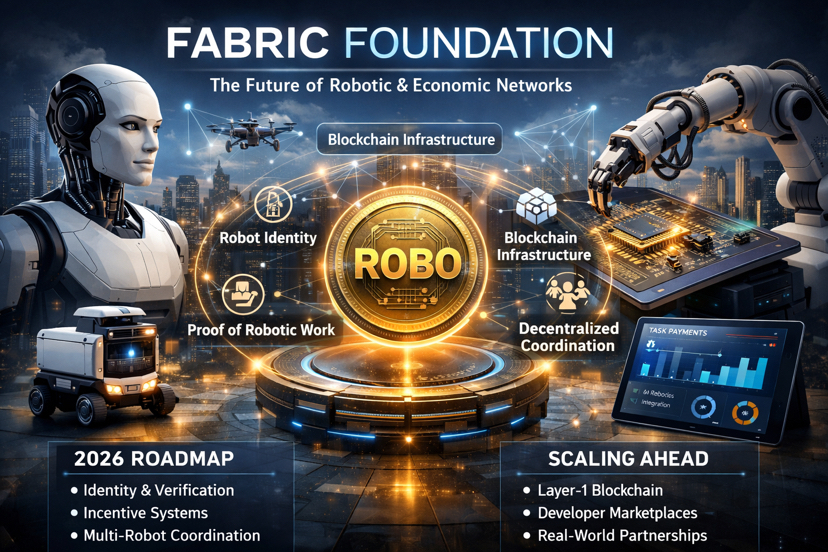
One of Fabric’s core breakthroughs is giving robots persistent on-chain identities — essential for verification, global interoperability, and trust. This identity infrastructure enables:
Verifiable robot history and performance.
Autonomous wallets for payments and services.
Decentralized coordination across fleets and operators.
This goes beyond simple registrations: robots can interact financially as autonomous agents, similar to how humans use bank accounts. Without such infrastructure, robotic deployment at scale remains siloed and inefficient.
🔹
$ROBO Token and Incentive Structure
Fabric’s native token, $ROBO, is designed as the utility and coordination engine of the network:
Used for network fees (identity verification, task payments, data exchange).
Required for participating in coordination primitives and staking.
Includes Proof-of-Robotic Work incentives, rewarding contributions tied to real-world robot tasks, data, and compute — not just passive holding.
This economic model aligns incentives for builders, operators, and contributors while linking token issuance more directly to network utility rather than speculative trading.
🔹
Blockchain & Scalability Strategy
Initially, the Fabric network is being deployed on Base (an Ethereum Layer-2) to take advantage of existing scaling, transaction cost reductions, and ecosystem interoperability.
Once adoption increases, Fabric plans to migrate to its own Layer-1 blockchain, optimized for:
High-throughput robotic coordination transactions.
Native machine-to-machine settlement.
Economic value capture from robotic activity directly.
This phased blockchain approach allows the project to bootstrap network effects before taking full operational control.
3. Strategic Roadmap: Where Fabric Is Headed
While Fabric doesn’t publish a detailed quarterly breakdown in easily digestible public charts, multiple sources outline a phased roadmap for 2026 and beyond:
🗺️
2026 — Bootstrapping Infrastructure
✔ Infrastructure for robot identity, verification, and settlement goes live.
✔ Intro of contribution-based incentives tied to verified tasks.
✔ Multi-robot workflows and broader coordination primitives rollout.
✔ Refinement of incentive structures, fee systems, and governance processes.
This stage focuses on building critical network functionality — a foundational layer that must exist before real-world deployment.
🌐
Post-2026 — Scalability & Ecosystem Expansion
📌 Transition to a dedicated Layer-1 blockchain.
📌 Launch of developer marketplaces (e.g., robot skills app store).
📌 Integration with broader AI and robotics hardware ecosystems.
📌 Focus on real-world partnerships, insurance frameworks, and service contracts.
In this era, Fabric aims to go beyond theory into tangible economic activity, where robots actually offer services, contribute compute or data, and participants earn based on measurable work contribution.
4. Why This Matters
Fabric Foundation represents a unique intersection of robotics, AI, and blockchain:
It addresses a real coordination and economic infrastructure gap in robotics by leveraging decentralized technology.
Its token-based incentive system aims to reward real contributions rather than speculative behavior.
If widely adopted, it could reshape how automation is deployed globally — shifting from corporate-owned robots to networks where builders, operators, and communities coordinate autonomously.
However, risks remain:
Real-world deployments at scale require complex non-tech collaborations (e.g., insurance, regulation).
Long timelines and technological dependencies mean adoption may be slower than ideal.
Impact depends heavily on actual use cases and industry partnerships.
 #fabricfundation #fabricfundation @Fabric Foundation