We are entering a time where robots are no longer futuristic concepts or factory-bound tools. They are slowly stepping into shared spaces — warehouses, hospitals, delivery networks, and eventually public streets. As that happens, one uncomfortable question becomes impossible to ignore: how do we trust them? Not just technically, but economically and socially. Who verifies what they did? Who is accountable when something goes wrong? Who decides the rules they operate under?
Fabric Protocol is built around that tension.
Rather than trying to build better robots, Fabric focuses on building the coordination layer that robots and AI systems will eventually need. It treats machines not as isolated devices, but as economic actors that must identify themselves, prove what they have done, and operate under shared governance. That shift in perspective is subtle, but powerful. It reframes robotics as part of a broader machine economy.

The protocol’s core idea is straightforward: critical actions and decisions made by robots can be anchored to a public ledger in a verifiable way. Not every sensor reading. Not every line of code. Just the moments that matter — identity registration, task completion proofs, model updates, compliance checks, governance changes. Heavy computation remains off-chain where it belongs. What gets recorded are proofs, attestations, and economic commitments.
This separation shows restraint. It acknowledges that robotics and AI are computationally intensive and cannot live entirely on-chain. Instead, Fabric uses the blockchain as an integrity anchor — a place where trust can be verified, not simulated. That design choice makes the vision feel more grounded and less speculative.
The architecture reflects this philosophy. Robots and AI agents can interact directly with the network through agent-native interfaces. They can establish decentralized identities, sign actions, and submit verifiable proofs. Participants stake value to signal credibility and accept economic consequences if they misbehave. Governance mechanisms allow stakeholders to update parameters and standards collectively rather than relying on a single centralized authority.
At the center of this system is the $ROBO token. It is not positioned as a decorative asset, but as the mechanism that keeps the network honest. Fees power the coordination layer. Staking aligns incentives. Governance gives token holders a voice in protocol evolution. In theory, this creates a self-reinforcing loop: the more meaningful the network becomes, the more economically valuable participation becomes, and the stronger the incentive to behave honestly.
But this is where reality matters. Token distribution, staking thresholds, and governance concentration will shape whether Fabric remains open or gradually centralizes influence. Economic design is not a cosmetic layer; it determines who controls the rules of the machine economy.
Recent momentum around the project — token rollout, exchange exposure, and ecosystem visibility — suggests Fabric is moving beyond abstract design. Yet adoption is the real test. A coordination protocol only becomes valuable when independent actors rely on it. The true signal will be robotics companies, AI developers, auditors, or institutions choosing to anchor real processes to the network.
What makes Fabric interesting is its ecosystem role. Today, robotics is fragmented. Hardware manufacturers, AI model developers, deployment operators, and regulators all operate within separate systems. Fabric proposes a shared backbone — a neutral layer where identity, verification, and governance intersect. Instead of trusting internal logs or private audit trails, stakeholders could rely on tamper-evident attestations. Instead of informal trust agreements, they could use staking-backed commitments.
That vision is ambitious. It also carries risk. Verifying complex AI behavior in a cryptographically meaningful way is technically demanding. Bridging on-chain attestations with legal accountability is not straightforward. Governance systems often drift toward concentration if incentives are not carefully balanced. These challenges are structural, not cosmetic.
Still, the broader direction feels inevitable. As autonomous systems take on economic roles, they will require economic infrastructure. Machines that deliver goods, manage data, or make decisions cannot operate indefinitely inside opaque silos. The machine economy, if it matures, will need coordination rails that are transparent, incentive-aligned, and programmable.
Fabric is betting on that transition.
What stands out most is not the marketing narrative, but the positioning. Fabric does not attempt to replace robotics platforms or AI frameworks. It aims to connect them. It focuses on trust, accountability, and shared governance — the invisible infrastructure that becomes essential once systems scale beyond single organizations.
If it works, Fabric’s impact will not be measured in short-term token cycles. It will be measured by whether robots and AI systems can participate in markets with verifiable identities and economic accountability. It will be measured by whether institutions feel comfortable anchoring compliance and certification to its ledger.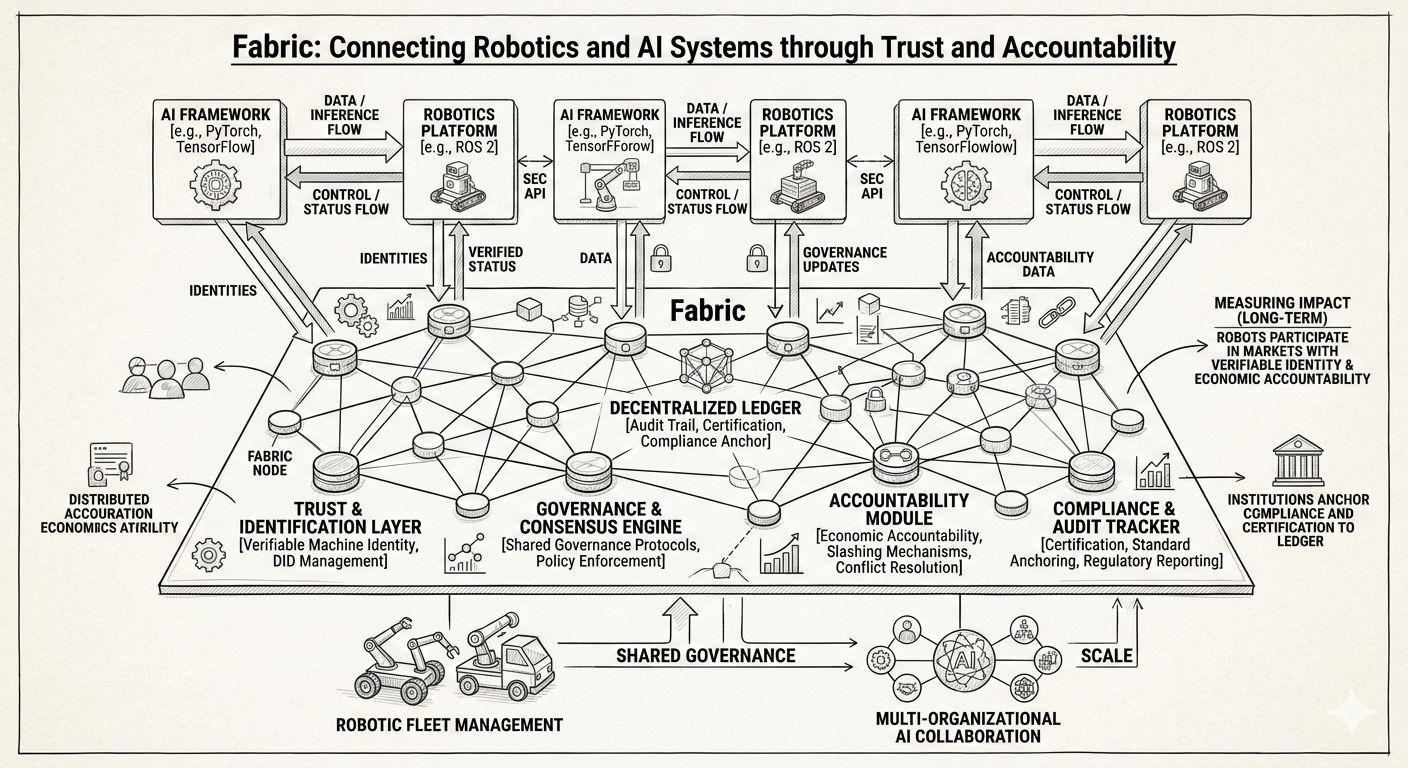
In the end, Fabric is less about robots themselves and more about the relationships around them. It is about creating a space where machines, developers, businesses, and regulators interact under shared, enforceable rules. If the next era of automation is going to be collaborative rather than chaotic, something like this will likely be required. Fabric is simply one of the first serious attempts to build that foundation.
@Fabric Foundation #ROBO $ROBO