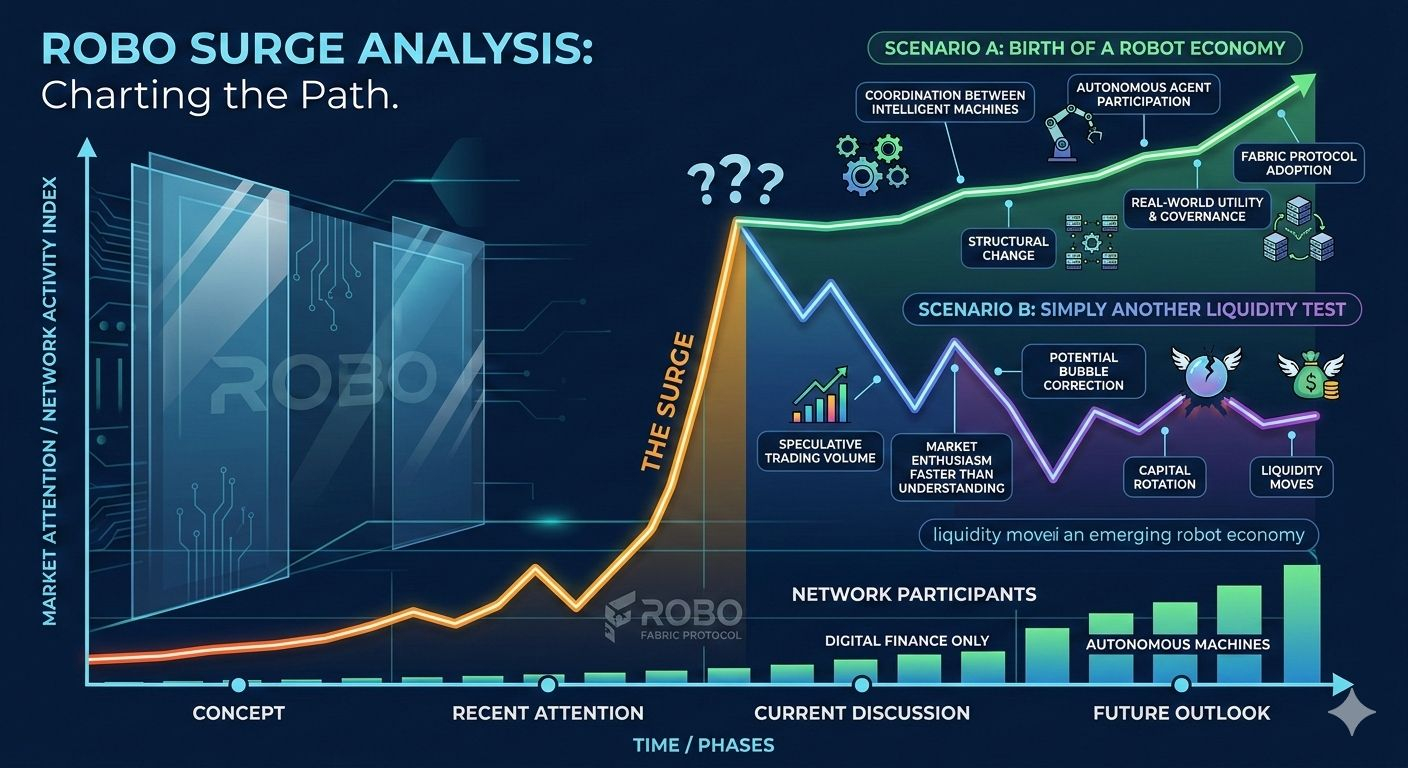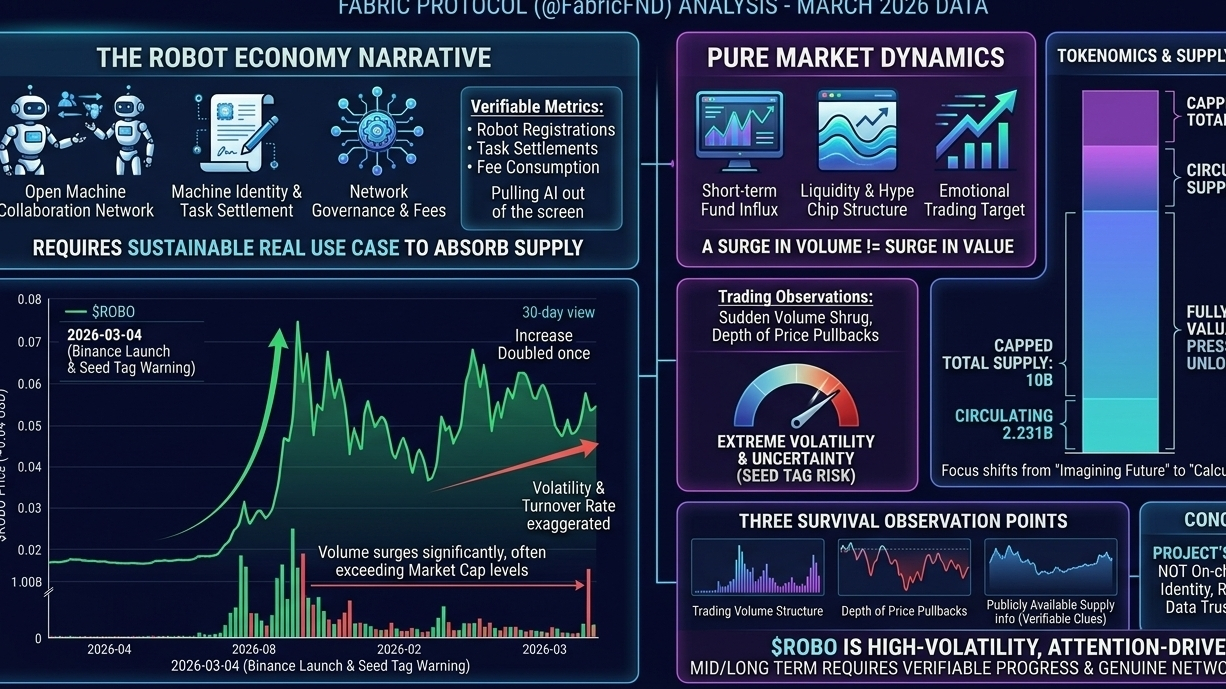

The recent attention surrounding the ROBO has pushed me into a phase of careful observation rather than excitement. Every cycle in crypto introduces a narrative that promises structural change and the current discussion around Fabric Protocol feels larger than a typical trend. Conversations now frame ROBO as a gateway toward an emerging robot economy yet the speed of market enthusiasm also raises a quieter question. Are we witnessing the beginning of a real technological transition or another moment where liquidity moves faster than understanding.
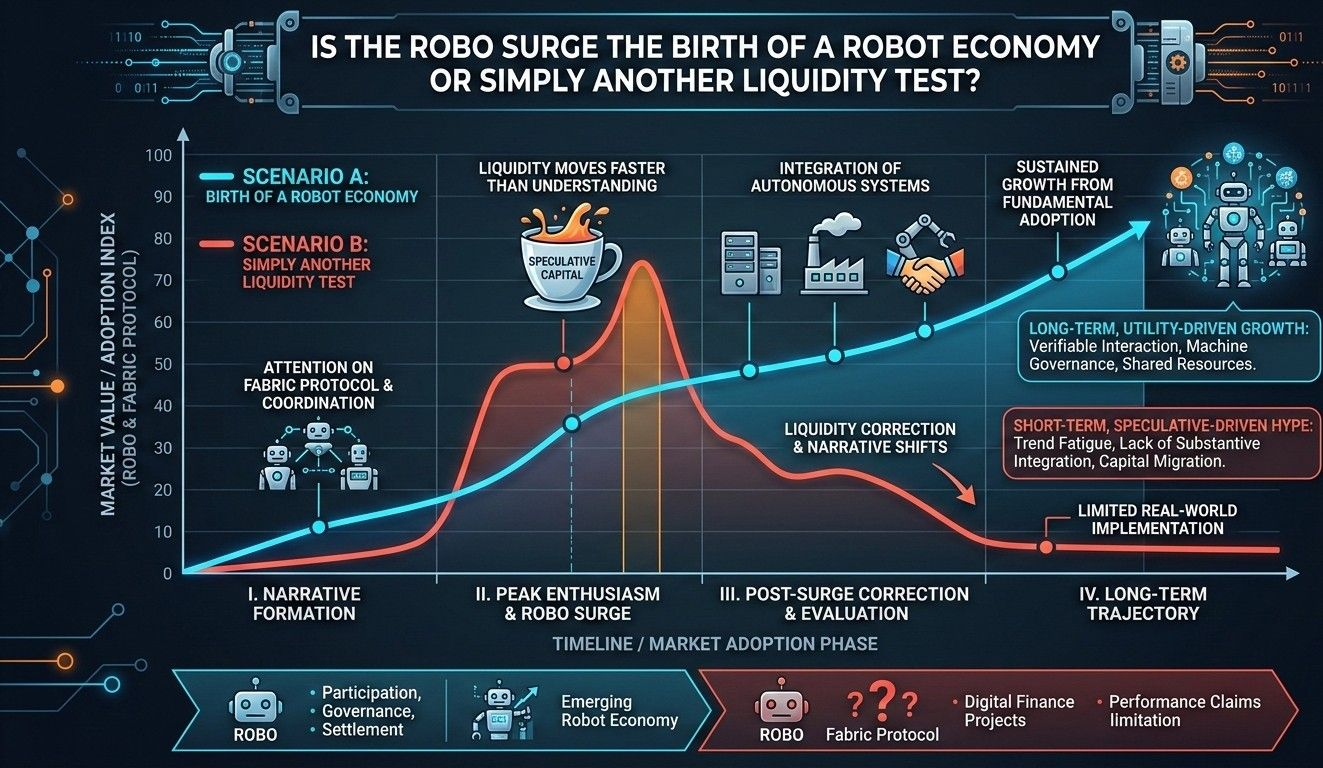
When I first began studying about Fabric Protocol the concept appeared different from traditional blockchain expansion. The network does not compete through transaction speed or performance claims. Instead it attempts to establish coordination between intelligent machines computing resources and applications operating within shared environments. ROBO exists inside this structure as the mechanism enabling participation governance and settlement between autonomous agents. This positioning immediately separates it from projects focused purely on digital finance.
The idea of treating the robots as network participants initially feels ambitious yet it reflects a logical progression in automation. Machines already rely on distributed computation cloud infrastructure and shared datasets. As autonomy increases systems eventually require reliable methods to cooperate without centralized supervision. Fabric Protocol approaches this requirement by introducing verifiable interaction where execution can be confirmed across participants. In theory this allows autonomous systems to function within predictable operational rules rather than isolated control frameworks.
What complicates the current moment is how market attention formed around ROBO before large scale robotic adoption becomes visible. The fundraising structure and early liquidity dynamics created strong momentum which naturally attracted speculation. Rapid participation signals belief but belief alone does not confirm infrastructure maturity. Markets often move ahead of technological timelines especially when narratives combine artificial intelligence robotics and decentralized systems.
While observing this phase I began separating two parallel developments. On one side Fabric Protocol attempts to build coordination infrastructure capable of supporting future autonomous economies. On the other side liquidity flows respond to anticipation of that future rather than confirmed deployment. ROBO therefore sits at the intersection between technological experimentation and financial expectation. The tension between these forces explains why opinions around the project appear sharply divided.
Looking deeper into the protocol vision reveals why interest continues expanding. Fabric Foundation promotes an ecosystem where robots applications and computational services interact through shared governance rather than centralized ownership. If successful this model could enable machine driven services operating across industries without relying on single controlling entities. Education healthcare logistics and companionship technologies become potential participants within coordinated networks rather than standalone products.
Yet execution difficulty remains significant. Building decentralized coordination for physical systems introduces challenges beyond software adoption. Hardware integration operational reliability and regulatory adaptation require extended timelines. Crypto markets however operate on shorter emotional cycles. This mismatch often transforms early infrastructure projects into liquidity experiments long before their practical value can be measured.
My own interpretation now sits somewhere between optimism and restraint. The attention surrounding ROBO may indeed signal early recognition that autonomous systems will eventually require shared coordination layers. At the same time popularity alone cannot confirm whether demand already exists or is still forming. Infrastructure tends to prove itself slowly through usage rather than rapid valuation shifts.
What makes this moment interesting is not whether ROBO experiences volatility but whether Fabric Protocol succeeds in demonstrating real cooperation between autonomous agents over time. If machines begin interacting through verifiable environments the current phase may later appear as the starting point of a new economic structure. If adoption struggles the same surge could simply represent another liquidity cycle searching for narrative direction.
For now I find it more useful to observe behavior rather than choose sides. The discussion around ROBO reveals how strongly markets want to believe in the convergence of artificial intelligence robotics and decentralized coordination. Whether this belief becomes foundation or fades as speculation will depend on execution that unfolds far beyond present hype. The calm approach may be to recognize that both possibilities exist simultaneously and that the true answer will emerge only when autonomous systems begin operating together through Fabric Protocol in measurable reality.