
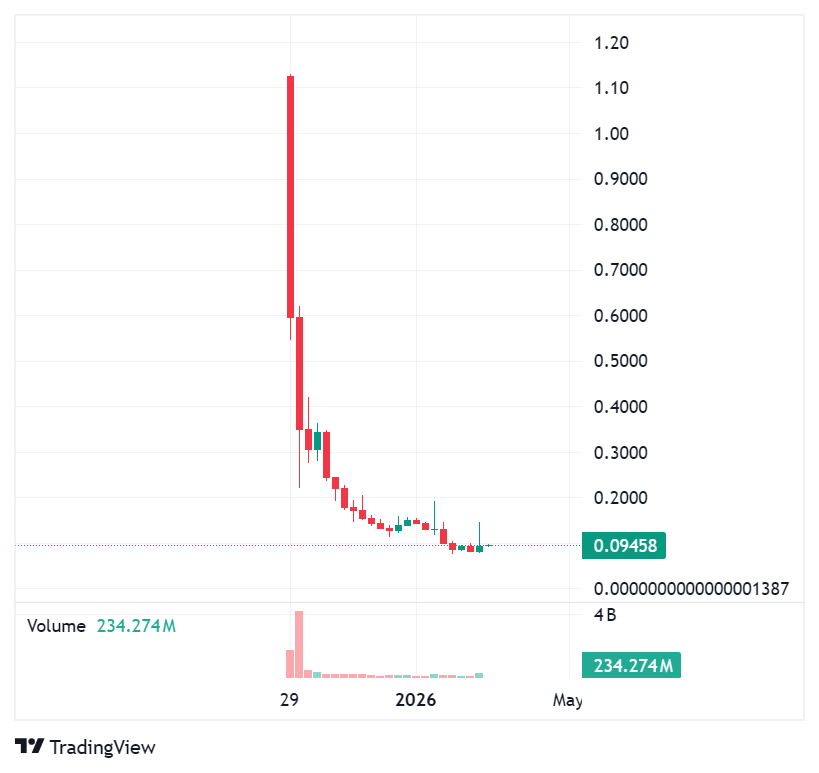
The live Mira price today is $0.09734 USD with a 24-hour trading volume of $35,536,337.17 USD, according to CoinMarketCap. For a token that launched in September 2025, that volume signals genuine interest. But here's the problem: it has a circulating supply of 244,870,157 MIRA coins and a max supply of 1,000,000,000 MIRA coins. That's 24.49% circulating at current prices. The other 75.51% is locked, vesting, or waiting to hit the market.
The real question isn't whether AI verification is valuable infrastructure. It's whether Mira's emission schedule and utility mechanisms can support sustainable demand as billions of tokens unlock over the next seven years.
The Tokenomics Structure
The MIRA token has a fixed total supply of one billion tokens, distributed according to the principle that 'the network belongs to those who use it, build on it and secure it'. That sounds noble. Here's what it actually looks like:
6% Initial Airdrop to early ecosystem participants including Klok and Astro app users, node delegators, Kaito yappers, ecosystem stakers, and Discord community members; 16% Future Node Rewards through programmatic emissions to validators performing honest inference; 26% Ecosystem Reserve for developer grants, commercial partnerships, and growth incentives; 20% Core Contributors with 36-month vesting schedule and 12-month cliff; 14% Early Investors subject to lockups; and 15% Foundation reserved for governance and protocol development</parameter>.
The initial airdrop was 100% unlocked at TGE. That's 60 million tokens immediately liquid. The ecosystem reserve (260 million tokens) gets released gradually to fund growth. Node rewards (160 million tokens) vest programmatically as validators earn them.
Why This Matters Now
This matters because AI hallucination is the biggest bottleneck preventing autonomous systems from operating in high-stakes environments. Mira Network currently attracts 4–5 million users, processing 19 million queries weekly, with its AI Verification Layer increasing AI output accuracy to 96% and reducing hallucination rates by 90%. The timing positions Mira to become critical infrastructure as AI moves from supervised tools into autonomous agents. But the window for establishing network effects is narrow—competitors are building verification layers, and whoever captures developer adoption first wins.
The Seven-Year Unlock Schedule
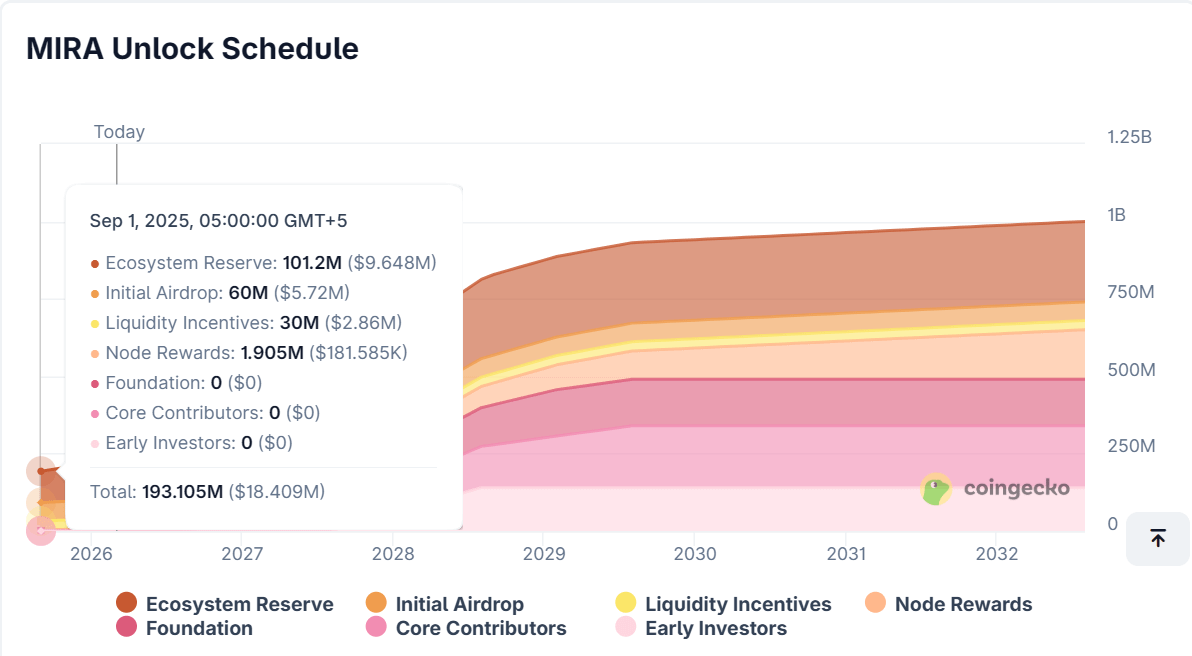
The emission schedule gradually increases supply over time, with roughly 33% unlocked in year one, 61% by year two, 83% by year three, and full unlock expected by year seven, according to BingX. This is slow-bleed dilution, not a cliff event. But it's persistent sell pressure unless real utility demand scales proportionally.
Core Contributors tokens are locked with a 36-month vesting schedule and a 12-month cliff, while Early Investors have a 24-month vesting schedule and a 12-month cliff. The 12-month cliff for both allocations expires in September 2026. That's when 340 million tokens (34% of supply) start linear vesting over 24-36 months. If adoption hasn't scaled significantly by then, those unlocks create sustained downward pressure.
Utility Mechanisms: Does Demand Match Supply?
$MIRA powers access to APIs and to Mira Flows, a marketplace of ready-made AI packages for tasks such as summarization and data extraction, with all usage paid in MIRA and priority access and preferential pricing for token holders. This creates direct demand. Every API call, every verification transaction, every marketplace purchase requires MIRA.
The staking mechanism ties supply to network security. Node operators who run AI models for verification must stake MIRA tokens to participate, with the network employing sophisticated detection mechanisms to identify malicious or lazy behavior and slashing staked tokens when detected. This is economic alignment—dishonest operation becomes financially irrational.
The governance layer gives token holders control over protocol parameters. Token holders vote on critical parameters including emission rates, protocol upgrades, and strategic network design changes CoinMarketCap. This matters for long-term sustainability because the community can adjust emissions if supply overwhelms demand.
The Economics: Real Numbers
Here's the calculation that matters: Mira processes 19 million queries weekly. If we assume a conservative $0.01 per query in API fees (Mira hasn't disclosed exact pricing), that's $190,000 in weekly revenue, or $9.88 million annually. At current market cap of $23.8 million, that's a price-to-sales ratio of 2.4x—reasonable for infrastructure if growth continues.
But here's the problem: those numbers require continuous scaling. If query volume plateaus at 20 million weekly while 610 million tokens unlock over the next 24 months (61% of supply by year two), demand needs to increase 2.5x just to maintain current price levels.
The allocation breakdown shows where pressure comes from:
Investor + Team allocation: 34% of total supply (340M tokens)
Ecosystem Reserve: 26% (260M tokens)
Node Rewards: 16% (160M tokens)
If ecosystem grants distribute 260M tokens over 36 months, that's 7.2M tokens monthly. Node rewards vest as earned, but validator count needs to scale for that distribution to be sustainable. The foundation reserve (15%, or 150M tokens) has a 36-month vesting schedule with 6-month cliff, adding another 4.2M tokens monthly starting March 2026.
The Risks You Need to Know
Initial circulating supply is 19.12%, with major sell pressure from the airdrop and partial ecosystem reserve unlocks in the short term, unlocks from core contributors and early investors triggering significant volatility in year 2+, and unlocking stabilizing after 3+ years. The airdrop recipients (60M tokens) have zero lockup. That's immediate distribution to users who may not have long-term conviction.
The real risk is adoption velocity. Mira needs to scale from 19 million queries weekly to 50+ million to absorb year-two unlocks without price collapse. That requires partnerships, integrations, and developer adoption at a pace that's difficult to sustain in AI infrastructure where switching costs are low and competition is intense.
Second, the project is built on Base but is compatible with mainstream chains such as Bitcoin, Ethereum, and Solana, supporting smart contracts, DApps, and DAO. Cross-chain compatibility is ambitious but introduces technical complexity. If bridge security fails or cross-chain verification creates latency issues, network effects fragment.
The Outlook
The tokenomics are designed for long-term alignment. Slow unlocks, governance control over emissions, and utility-driven demand create structural support. The problem is execution risk at massive scale.
Proprietary products such as the Klok chatbot and Astro search tool already boast over 500,000 users. That's real product-market fit. Converting those users into sustained transaction volume—and expanding to enterprise AI deployments—determines whether Mira becomes critical infrastructure or another verification layer that gets commoditized.
The foundation raised capital, built real products, and launched with legitimate partnerships. The network is processing millions of queries. But 755 million tokens are locked, waiting to vest. Whether demand scales faster than supply determines if this is infrastructure for autonomous AI or another token with great technology and unsustainable economics.
Can Mira scale query volume 3x before 610 million tokens unlock by year two, or will persistent sell pressure compress prices regardless of technical progress? 👇
@Mira - Trust Layer of AI #Mira