
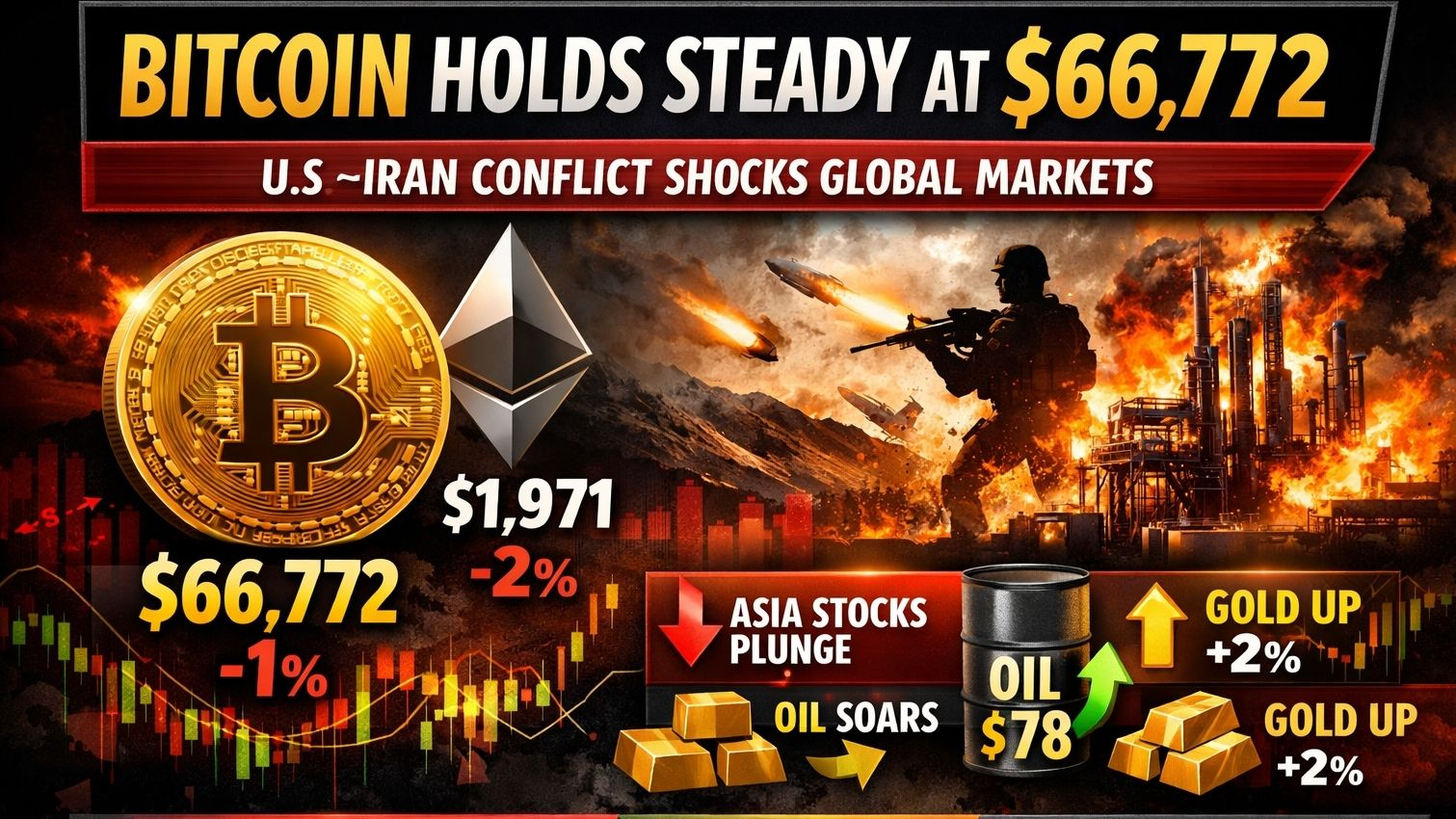
Bitcoin remained relatively stable around the $66,000 level on Monday, even as global markets reacted sharply to escalating tensions between the United States and Iran.
Over the past 24 hours, Bitcoin slipped roughly 1% to trade near $66,772, while Ethereum declined about 2% to around $1,971. Despite the dip, crypto losses were moderate compared to traditional financial markets.
The volatility followed dramatic weekend developments, including reports that Iran’s Supreme Leader, Ali Khamenei, was killed in a joint U.S.–Israeli strike. The geopolitical shock triggered risk-off sentiment across global markets.
While traditional stock exchanges were closed over the weekend, crypto markets—trading 24/7—became the first space where investors adjusted their positions. Bitcoin briefly fluctuated between $63,000 and $66,000 before stabilizing.
Analysts say this reaction highlights crypto’s growing resilience. Unlike past crises that caused sharp selloffs, this time digital assets showed controlled volatility.
📉 Asian Markets React Strongly
When Asian markets reopened, the response was more dramatic.
Japan’s Nikkei 225 dropped over 2.5%, while the broader TOPIX fell nearly 3%.
Elsewhere:
Hang Seng Index declined almost 2%
Straits Times Index slipped close to 2%
TAIEX eased around 0.9%
Investors clearly shifted away from risk assets as uncertainty increased.
🛢 Oil Surges, Gold Rises
Oil prices jumped sharply in early Asian trading. Brent crude climbed to about $78 per barrel, marking a gain of more than 7% in just one day.
Gold also strengthened, rising nearly 2% as investors sought safe-haven assets.
Market experts warn that oil is the key factor to watch. If crude prices climb above $90 and stay elevated, inflation pressures could return, pushing bond yields and the U.S. dollar higher. In that scenario, crypto could behave like a high-risk macro asset and face stronger pressure.
⚠ Strait of Hormuz in Focus
Concerns are also centered around the Strait of Hormuz, a crucial global shipping route responsible for about one-fifth of the world’s oil supply. Any disruption there could intensify inflation fears and complicate central bank rate decisions.
📊 Crypto Market Stability
Despite the geopolitical tension, on-chain data and derivatives markets showed no signs of systemic stress. There were no major liquidation cascades or stablecoin instability.
Some analysts believe that continuous derivatives trading platforms helped absorb the shock in real time, allowing price discovery to happen smoothly over the weekend.
🔎 What’s Next?
For now, crypto is moving in line with broader macro sentiment but remains more stable than traditional equities.
Traders are closely watching:
Oil price movements
U.S. inflation expectations
Bond yields and the U.S. dollar
Further developments in the U.S.–Iran conflict
If tensions ease, markets could recover quickly. But if oil keeps rising and financial conditions tighten, volatility may remain elevated.
For now, Bitcoin’s ability to hold near $66,000 suggests cautious confidence rather than panic.#Binance