
Somewhere between a whitepaper and a working wallet, reality usually fades. In crypto, the line between “this solves a real problem” and “this is actually solving it” gets blurred by trading volume, social engagement, and incentive-driven optimism.
That’s why Fabric Foundation is worth watching carefully.
Not with blind optimism. Not with reflexive skepticism. But as a case study in whether this space can truly build long-term infrastructure — or if it mainly excels at monetizing the narrative of building it.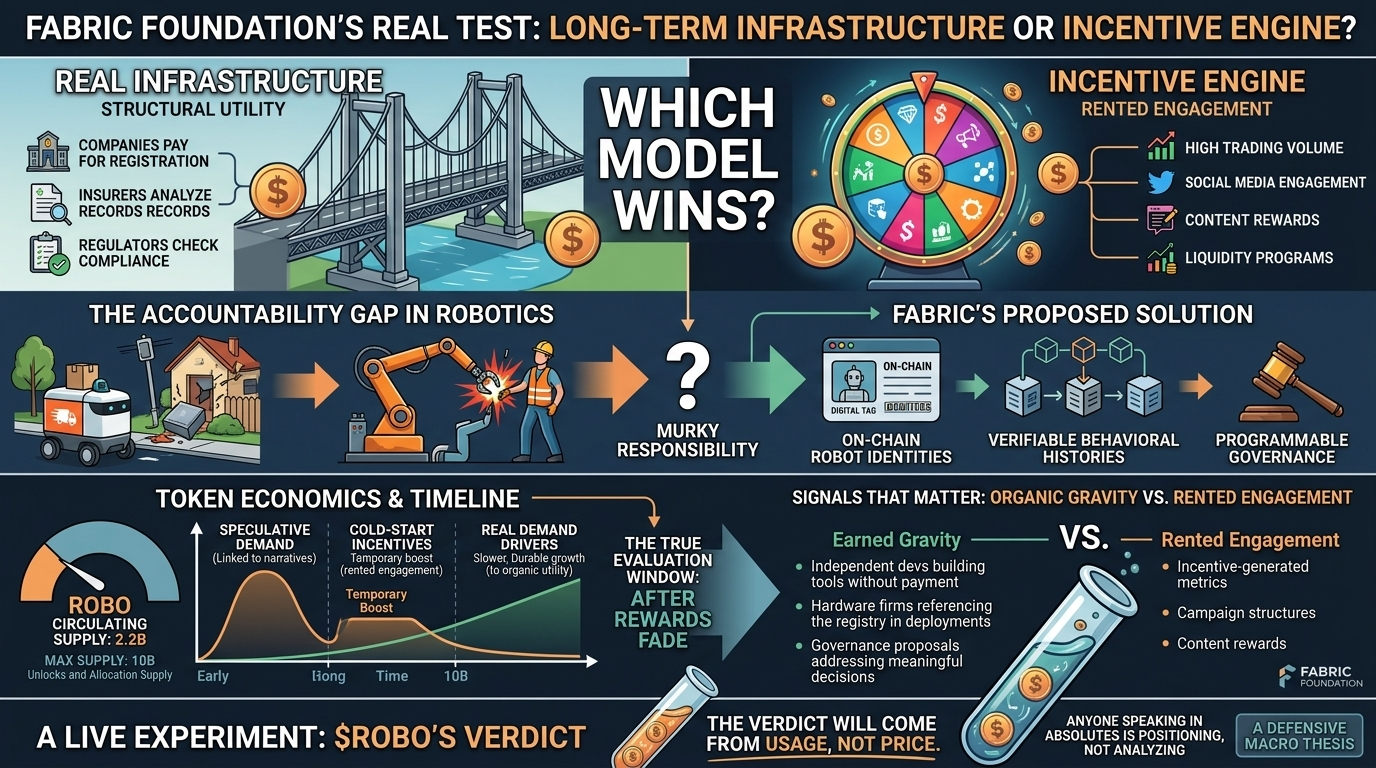
The accountability gap in robotics is not theoretical. As autonomous machines move into public, commercial, and industrial environments, responsibility becomes murky. When a delivery robot damages property or an industrial arm causes injury, existing legal systems struggle to trace clear accountability. That’s a structural problem.
Fabric’s proposed solution — on-chain robot identities, verifiable behavioral histories, programmable governance — logically maps onto that gap. The architecture makes sense. A public ledger anchoring machine identity and task history could become foundational if the robot economy scales.
The issue isn’t whether the problem exists.
It’s whether the timeline is realistic.
Crypto markets are notorious for pricing in future infrastructure long before it exists. When a compelling thesis emerges, speculation often discounts years of potential into present valuations. With ROBO’s circulating supply around 2.2 billion against a 10 billion max, token economics matter. Every unlock and allocation introduces new supply that must be absorbed by real demand — not sentiment.
And real demand in this model is specific.
It means companies paying ROBO to register fleets because accountability reduces operational risk. Developers staking ROBO because the protocol offers capabilities they can’t replicate elsewhere. Insurance providers or regulators interfacing with behavioral records because it lowers verification costs.
Those are durable demand drivers.
Campaign structures, content rewards, and liquidity programs are not inherently negative. Early-stage public infrastructure often needs incentives to survive the cold-start phase. But incentive-generated metrics are not product-market fit.
The true evaluation window opens after rewards fade.
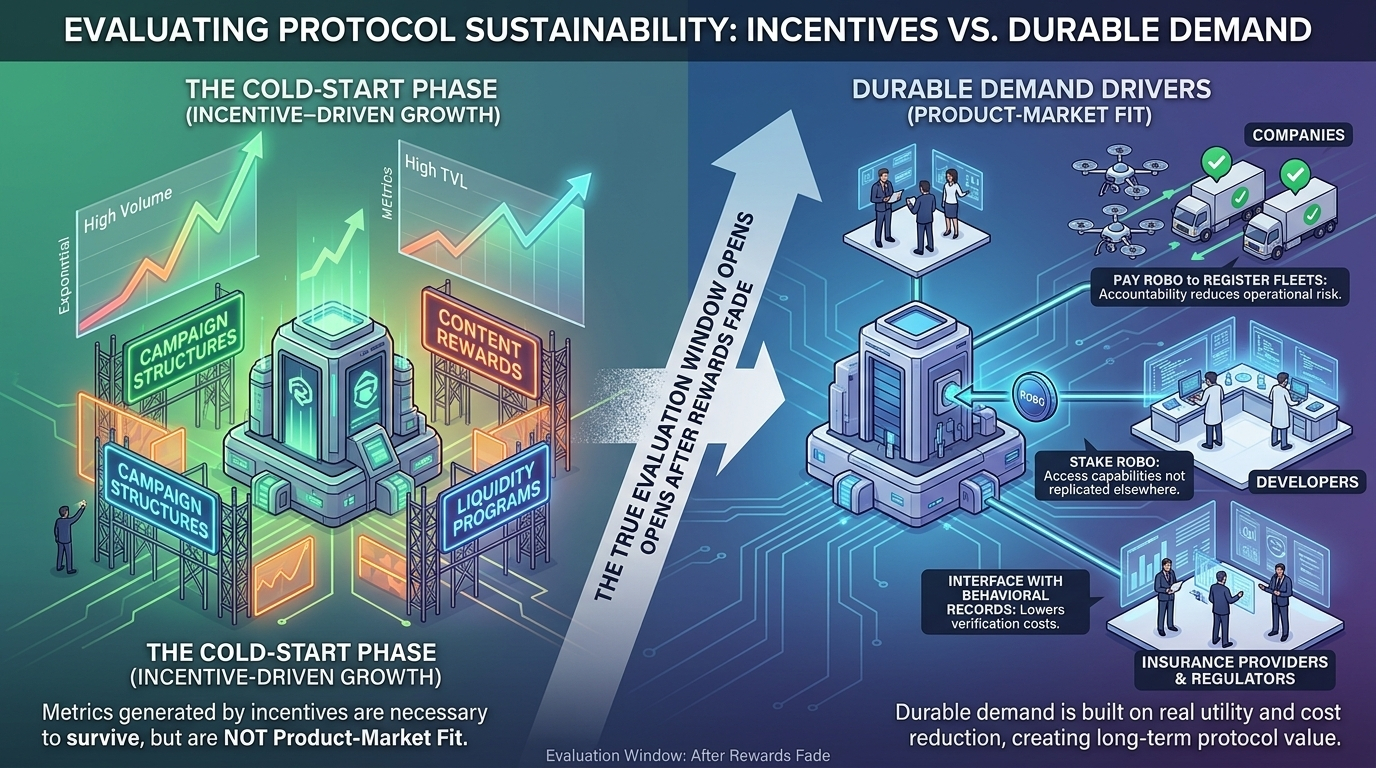
If developer activity, technical discourse, and on-chain usage persist without financial stimulation, that’s organic gravity. If activity declines sharply, it suggests engagement was rented, not earned.
Signals that matter won’t trend on social feeds. They’ll show up quietly:
Independent developers building tools without payment.
Hardware firms referencing the registry in real deployments.
Governance proposals that address meaningful network decisions.
The robot economy, if it reaches scale, will likely require an open accountability layer similar to what Fabric describes. That macro thesis is defensible.
What remains unproven is whether this particular implementation — at this moment, with this token structure and community composition — becomes that layer.
There is no definitive answer yet.
Anyone speaking in absolutes is positioning, not analyzing.
$ROBO isn’t just another token narrative. It’s a live experiment in whether crypto can move from storytelling to structural utility.
The verdict will come from usage, not price.