
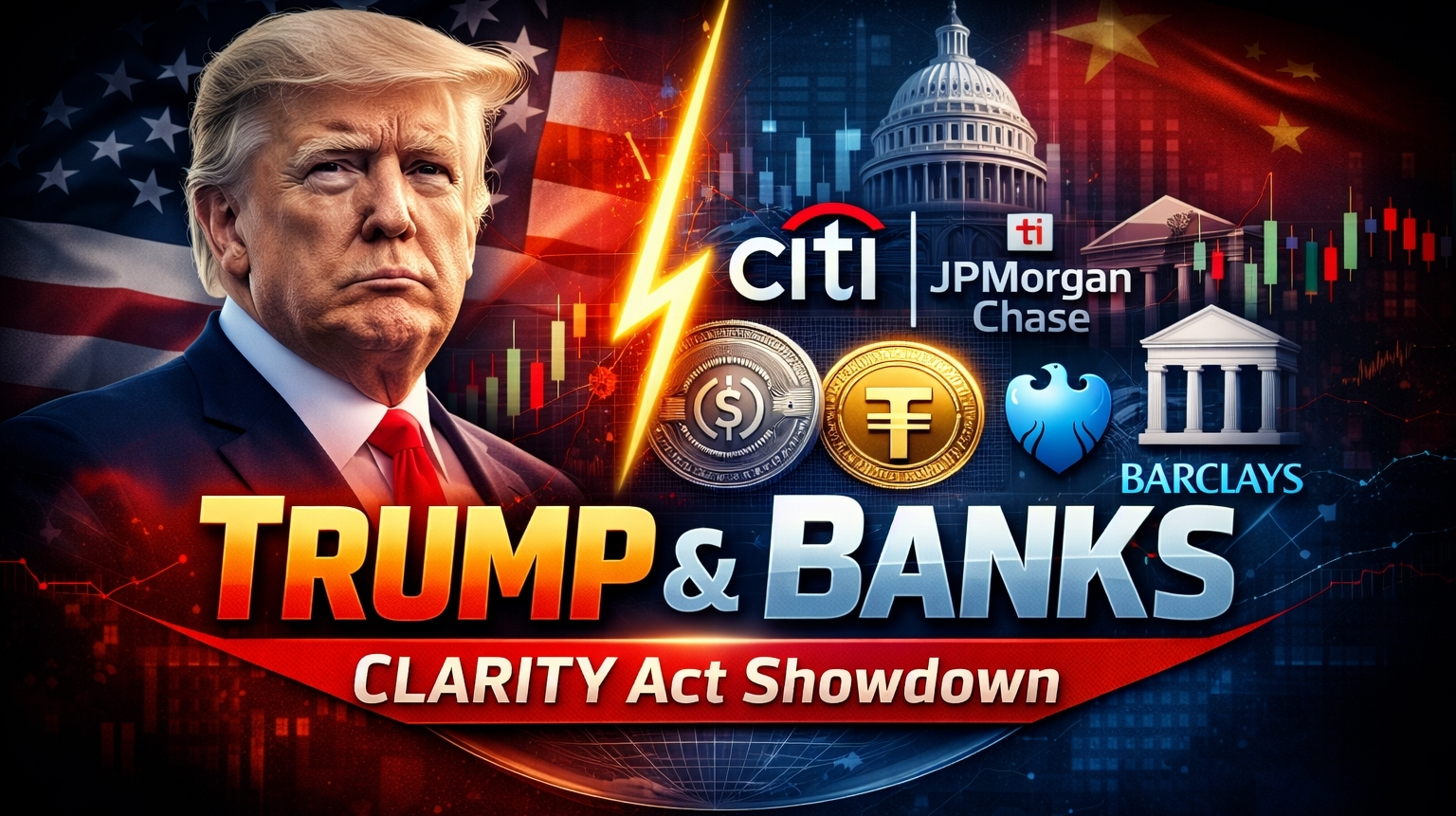
Former President Donald Trump has publicly accused major American banks of standing in the way of crypto legislation, arguing that their actions are slowing the United States’ progress in digital finance.
In a March 3 post on Truth Social, Trump claimed large financial institutions are attempting to derail efforts to pass key crypto laws — particularly the Digital Asset Market Clarity Act of 2025, better known as the Digital Asset Market Clarity Act of 2025.
According to Trump, failure to move quickly on the bill could result in innovation, capital, and talent shifting to competing nations such as China. He framed the issue not just as policy disagreement, but as a battle over America’s future leadership in financial technology.
📜 What Is the CLARITY Act?
The CLARITY Act is designed to finally settle the long-standing regulatory conflict between the Securities and Exchange Commission and the Commodity Futures Trading Commission.
If passed:
The CFTC would supervise digital commodities operating on established blockchains.
The SEC would maintain control over tokenized securities and assets that resemble traditional securities.
New investor protection rules and clearer operational standards for crypto exchanges would be introduced.
The legislation already passed the House of Representatives in July 2025 with strong bipartisan backing. However, progress in the Senate has slowed amid intense lobbying and political debate.
💰 The Stablecoin Disagreement
At the heart of the current impasse is another proposal known as the GENIUS Act, which aims to create a federal framework for dollar-backed stablecoins.
The primary disagreement centers on whether stablecoin issuers should be allowed to offer yield — essentially interest — to users holding digital dollars.
Crypto firms argue that allowing yield would:
Give consumers better returns
Encourage innovation in decentralized finance
Increase competition in digital payments
Banks, however, warn that yield-bearing stablecoins could pull deposits away from traditional savings accounts, potentially weakening their funding base. With U.S. banks currently reporting record profits, Trump has portrayed the situation as established institutions protecting their dominance at the expense of innovation.
🏛 Senate Roadblocks
Although the House approved the CLARITY Act, negotiations in the Senate have proven more complicated.
The Senate Agriculture Committee advanced a related measure regarding CFTC oversight earlier this year, marking rare progress for crypto market structure legislation. However, further discussions stalled after:
A scheduled committee review was postponed
Crypto companies such as Coinbase withdrew support over draft changes
Banking groups pushed for tighter stablecoin restrictions
A White House meeting in February failed to break the deadlock, leaving lawmakers searching for compromise.
Additional concerns raised by some Democratic senators — including potential conflicts of interest involving political figures and crypto holdings — have added further complexity to the debate.
🌍 Why This Matters
Supporters believe clear regulatory boundaries could unlock:
Increased institutional investment
Expansion of financial technology innovation
Job creation in the digital asset sector
Meanwhile, regions such as Europe and China are moving ahead with their own digital asset frameworks, increasing pressure on Washington to act quickly.
For Trump and many crypto advocates, the stakes go beyond regulation. They argue the outcome will determine whether the U.S. becomes the global leader in digital finance — or falls behind.
🔎 The Bigger Picture
The dispute between banks and crypto firms remains unresolved. But with Trump publicly demanding immediate action, pressure is mounting on Congress to finalize legislation.
The decision on stablecoin rules and market structure oversight could shape the next chapter of American financial innovation.
For now, the question remains: Will lawmakers strike a deal — or will regulatory uncertainty continue to cloud the future of crypto in the United States?#Binance