
Oil Shock and Geopolitical Brinkmanship: Markets Brace as Iran Escalates Demands
Global energy markets are flashing warning signals as tensions between Iran, the United States, and Israel intensify, triggering sharp spikes in oil and gas prices and rattling financial markets worldwide.
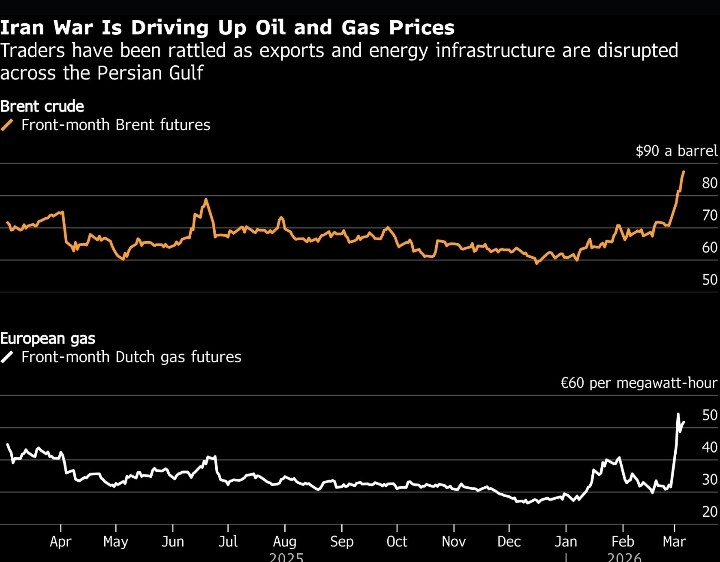
The chart above illustrates the immediate economic impact: prices for Brent Crude have surged toward $90 per barrel, while European natural gas futures have jumped dramatically, rising from roughly €30 to nearly €50 per megawatt-hour in a matter of days. Traders say the sudden volatility reflects growing fears that the conflict could disrupt critical global energy routes.
Iran Signals Hardline Terms
In a statement that quickly circulated across diplomatic and financial circles, Ali Larijani — secretary of Iran’s Supreme National Security Council — indicated that Tehran sees the conflict ending only under strict conditions.
According to Larijani, the war will conclude only when Iran’s adversaries recognize what he described as violations of Iranian territory and agree to compensate Iran for damages caused.
Analysts interpret the message not as a negotiation opening, but as a signal that Tehran is preparing for a prolonged standoff rather than a rapid diplomatic settlement.
The Strategic Chokepoint: Strait of Hormuz
At the center of global concern is the Strait of Hormuz — the narrow waterway through which around 20% of the world’s oil supply passes each day.
Any sustained disruption there can ripple across the global economy.
Key fears in energy markets include:
Restricted tanker traffic through the strait
Rising insurance costs for shipping companies
Potential attacks on energy infrastructure across the Persian Gulf
Even a partial closure could dramatically reduce available global oil supply, pushing prices sharply higher.
Energy Markets Already Reacting
The market reaction has been swift:
Oil
Brent futures nearing $90 per barrel
Weekend spot trades reportedly approaching $96
European Gas
Dutch front-month gas futures jumped from roughly €30 to nearly €50/MWh
Energy analysts warn that if the Hormuz route remains disrupted, oil could break past $100 quickly. Some worst-case forecasts project $150–$200 per barrel if supply losses persist.
The Asymmetric Warfare Factor
Military strategists note that Iran does not necessarily need conventional battlefield victories to exert pressure.
Instead, analysts point to asymmetric warfare dynamics, including:
Low-cost drones targeting high-value defenses
Decentralized drone manufacturing facilities
Surviving missile and drone arsenals despite strikes
In such conflicts, relatively inexpensive weapons can force adversaries to spend vastly more on interceptors and missile defense systems — creating a financial war of attrition.
Market Fallout
The geopolitical shock has already begun to ripple across global financial markets.
Investors are reacting to several risk factors simultaneously:
Potential energy supply shocks
Rising military expenditures
Growing uncertainty in global trade routes
Inflation risks tied to higher fuel prices
When oil spikes rapidly, it often feeds into transport costs, manufacturing prices, and consumer inflation, which can force central banks to delay interest-rate cuts.
What Markets Are Watching Next
As trading desks prepare for the next market opening, several indicators will determine the direction of global markets:
Status of shipping through the Strait of Hormuz
Escalation or de-escalation signals from Tehran, Washington, or Tel Aviv
Energy inventory levels in Europe and Asia
Military developments affecting Gulf infrastructure
For now, energy traders are pricing in risk rather than certainty — but the speed of the recent price moves shows just how sensitive the global economy remains to disruptions in the Persian Gulf.
✅ Bottom line:
The geopolitical confrontation is no longer just a regional security issue — it has become a global energy market shock. If tensions escalate further or the Strait of Hormuz remains constrained, oil and gas prices could become the central economic story of the coming weeks.
👍👍👍 Please follow me, repost, like this post and comment. If you follow me then you will get back 💯% 👍👍👍