
# The Possible Endgame of the Iran Conflict: A Step-by-Step Scenario
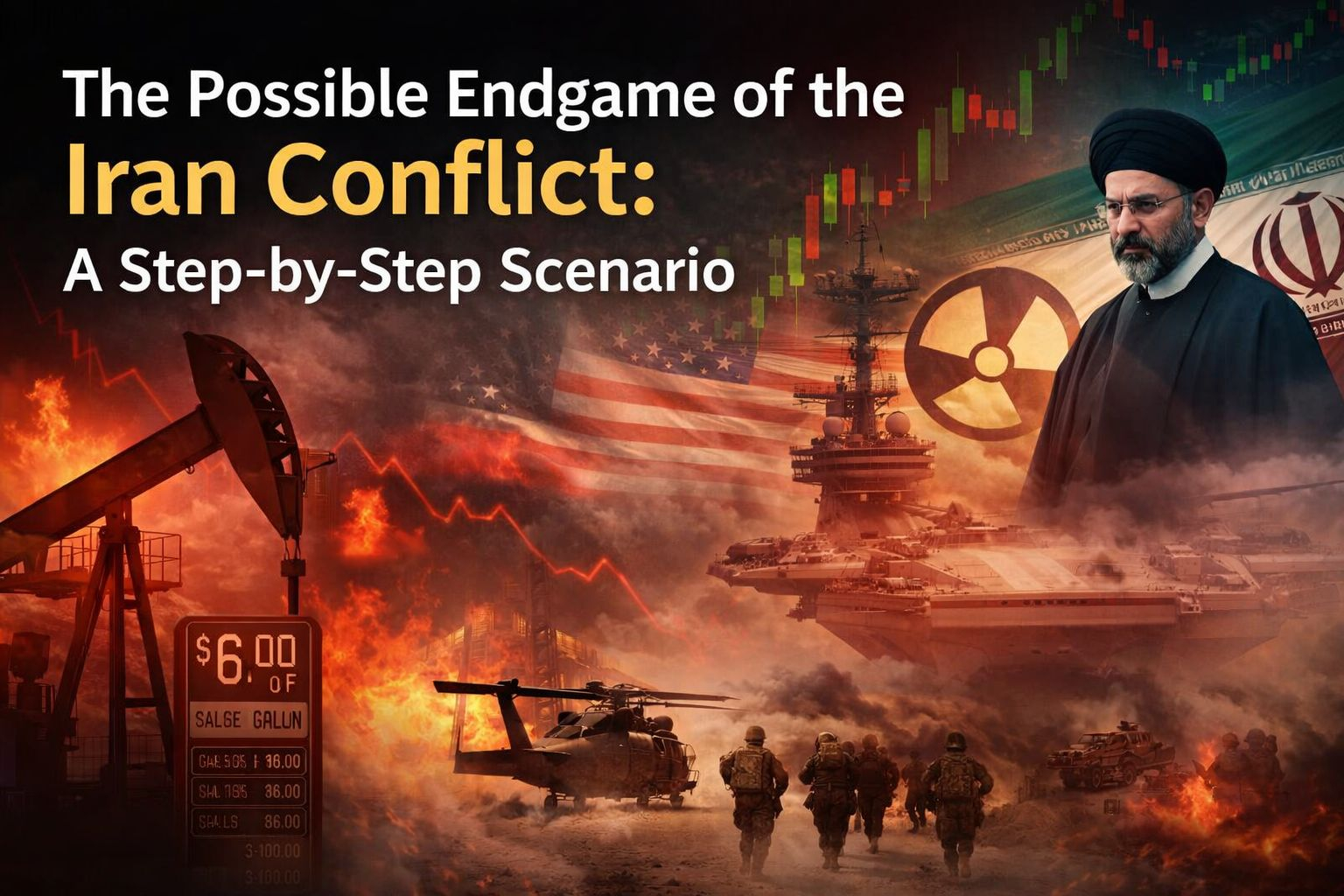
In times of war, governments often present victory narratives quickly. But beneath the headlines, larger geopolitical and economic patterns can reveal a very different trajectory. If current trends continue, the outcome of this conflict may follow a predictable sequence of political, economic, and strategic consequences.
Below is a possible step-by-step scenario of how the situation could unfold.
## 1. Oil Prices Trigger Economic Pressure
The first visible signal would be sustained high oil prices. If global crude prices remain above $100 per barrel for several days, gasoline costs could surge across the United States.
At that point, public discussion shifts rapidly. Instead of focusing on military operations or geopolitical strategy, headlines begin to revolve around the economic impact on everyday Americans—especially the price at the gas pump.
When economic pressure reaches households directly, public sentiment toward foreign conflicts often changes quickly.
## 2. Political Support Weakens
Historically, wars lose support when economic costs rise. Polling could reflect that trend. If only a minority of Americans already support the conflict, rising fuel prices may push approval even lower.
Public frustration would likely move from foreign policy concerns to domestic financial pressure.
## 3. A Declaration of “Victory”
At some stage, leadership may attempt to frame the mission as successful. Political messaging might highlight destroyed military infrastructure, weakened enemy capabilities, or completed objectives.
In modern warfare, narrative often becomes as important as battlefield results.
## 4. Quiet Military Withdrawal
Once victory is declared, troop movements may begin. However, such movements are rarely described as retreats.
Terms such as “redeployment,” “strategic repositioning,” or “mission transition” are often used instead.
The shift allows policymakers to reduce military presence while maintaining the appearance of a successful operation.
## 5. Political Consolidation in Iran
While military targets may suffer damage, internal political power structures often react differently.
A new leadership figure—particularly one with hardline credentials—could consolidate authority quickly. If the transition occurs during wartime, it can strengthen nationalist sentiment and solidify long-term control.
Rather than destabilizing the regime, conflict can sometimes reinforce it.
## 6. The Strategic Balance Changes
Even if certain military capabilities are destroyed, deeper strategic questions remain.
Key concerns may include:
* The fate of enriched nuclear material
* The survival of political leadership structures
* The emergence of more hardline decision-makers
In many conflicts, eliminating infrastructure does not necessarily eliminate the underlying political system.
## 7. Prolonged Energy Market Disruption
Even after active hostilities slow, global energy markets rarely stabilize immediately.
Critical infrastructure such as pipelines, export terminals, and storage facilities require time to restart operations. Strategic waterways, particularly in the Persian Gulf region, also play a major role in global oil transportation.
As a result, elevated oil prices could persist for months rather than days.
## 8. The Global Economic Impact
Finally, the cumulative economic effects appear.
Large-scale military operations require expensive defense systems, interceptors, logistics, and support infrastructure. At the same time, financial markets often react sharply to geopolitical instability.
If global energy supplies remain disrupted, the ripple effects could include:
* Market volatility and investment losses
* Supply chain disruptions
* Slower economic growth across major economies
Under these conditions, a global economic slowdown—or even recession—could become a real possibility.
## A Complicated Definition of Victory
Wars are often measured in destroyed equipment, captured territory, or military success. But history shows that the long-term consequences frequently look different from the short-term battlefield outcomes.
A country’s military capacity might be weakened while its political leadership becomes stronger or more entrenched.
Economic costs may also outlast the conflict itself.
In the end, the true measure of victory may not be determined by the first speech declaring success, but by the geopolitical and economic landscape that emerges in the years that follow.
👍👍👍 Please follow me, repost, like this post and comment. If you follow me then you will get back 💯% 👍👍👍