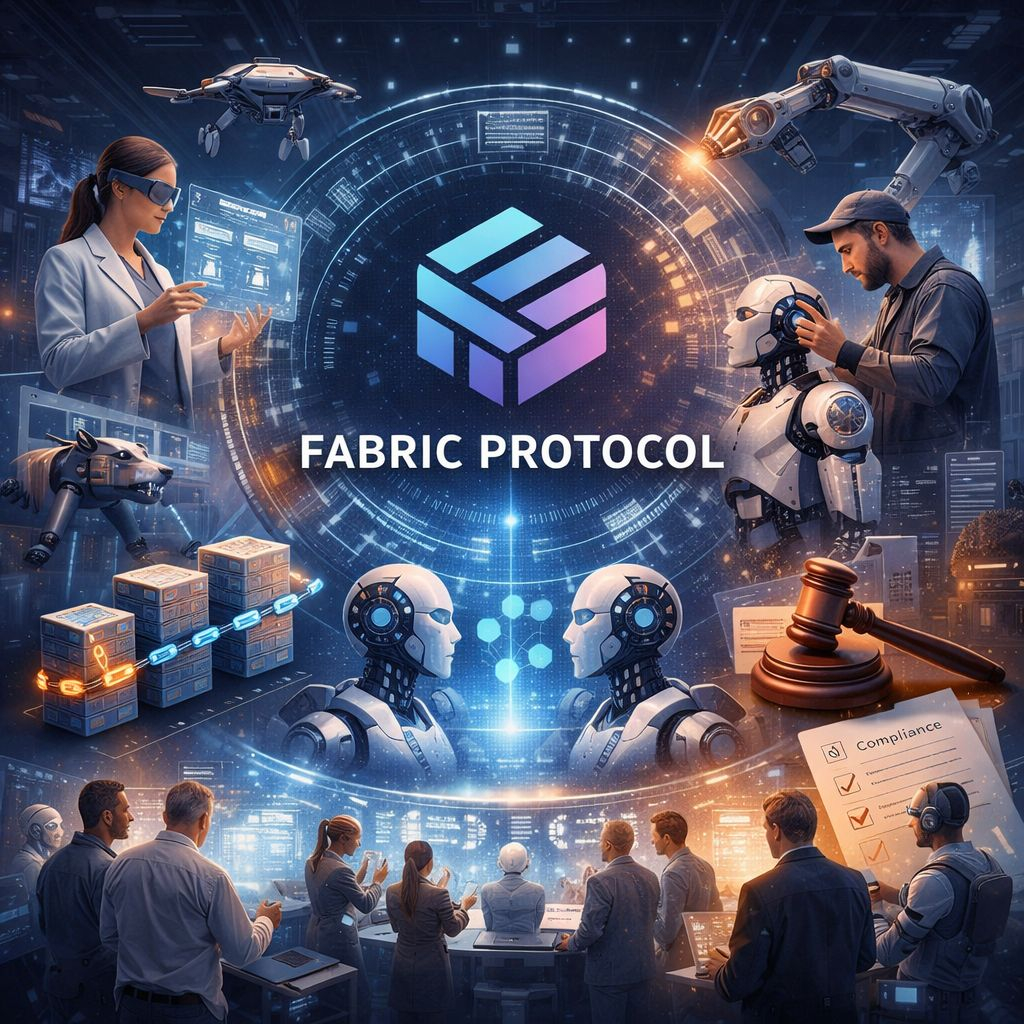
The next technological revolution will not just be powered by artificial intelligence—it will be driven by autonomous agents and robots collaborating with humans. At the center of this transformation is Fabric Protocol, a global open network designed to support the development, governance, and evolution of general-purpose robots.
Supported by the Fabric Foundation, a non-profit organization, Fabric Protocol aims to create a decentralized infrastructure where robots, AI agents, and humans can interact safely, transparently, and efficiently.
The Vision Behind Fabric Protocol
Traditional robotics systems are often closed, centralized, and controlled by a few corporations. This creates limitations in scalability, collaboration, and innovation.
Fabric Protocol introduces a new paradigm: an open, decentralized ecosystem where developers, organizations, and communities can build and coordinate intelligent machines together.
The goal is simple yet ambitious:
Enable a global network where robots can be built, governed, and improved collaboratively.
By combining blockchain infrastructure, verifiable computing, and agent-native systems, Fabric Protocol provides the foundation for trustworthy human-machine collaboration.
Key Components of Fabric Protocol
1. Verifiable Computing
One of the biggest challenges in robotics and AI is trust. How can we ensure that autonomous systems behave correctly?
Fabric Protocol addresses this through verifiable computing, allowing systems to prove that their computations were performed accurately and securely. This ensures transparency and accountability in robotic operations.
2. Agent-Native Infrastructure
Fabric Protocol is built with AI agents and autonomous robots in mind.
The infrastructure allows agents to:
Communicate with each other
Coordinate tasks
Execute actions autonomously
Share data securely
This creates a true machine-native internet, where robots and AI systems can operate independently while still being governed by transparent protocols.
3. Public Ledger Coordination
At the core of Fabric Protocol is a public ledger that records key operations and interactions across the network.
This ledger helps coordinate:
Data sharing
Computational tasks
Governance rules
Regulatory compliance
By leveraging blockchain principles, the protocol ensures immutability, transparency, and decentralized control.
4. Modular Infrastructure
Fabric Protocol uses a modular architecture, allowing developers to build specialized components without rebuilding entire systems.
Modules may include:
Data layers
Compute layers
Governance frameworks
Safety and compliance mechanisms
This modular approach accelerates innovation and enables flexible system design.
Governance and Collaborative Evolution
Unlike traditional robotics platforms controlled by a single entity, Fabric Protocol promotes community-driven governance.
Developers, researchers, and stakeholders can participate in shaping the protocol’s evolution. This ensures the system remains adaptable, transparent, and aligned with human interests.
Through decentralized governance mechanisms, the network can update rules, improve infrastructure, and introduce new capabilities while maintaining security and stability.
Enabling Safe Human-Machine Collaboration
As robots become more integrated into daily life—from logistics and healthcare to manufacturing and smart cities—safety and coordination become critical.
Fabric Protocol helps ensure that:
Robots follow verifiable rules
AI agents operate transparently
Human oversight remains possible
Systems remain secure and accountable
By coordinating regulation, computation, and data within a unified network, Fabric Protocol enables responsible and scalable human-machine collaboration.
The Future of Robotics Infrastructure
The world is entering an era where robots and AI agents will operate alongside humans at global scale. To support this future, we need infrastructure that is open, trustworthy, and collaborative.
Fabric Protocol represents a step toward that vision—a decentralized network designed to power the next generation of intelligent machines.
By combining verifiable computing, agent-native infrastructure, and public ledger coordination, Fabric Protocol lays the foundation for a world where humans and robots can work together safely and efficiently.
If you want, I can also create:
A viral Twitter/X thread version
A Medium-optimized long article
A short LinkedIn post
A Web3/AI viral marketing article (very engaging style).
@Fabric Foundation #ROBO $ROBO