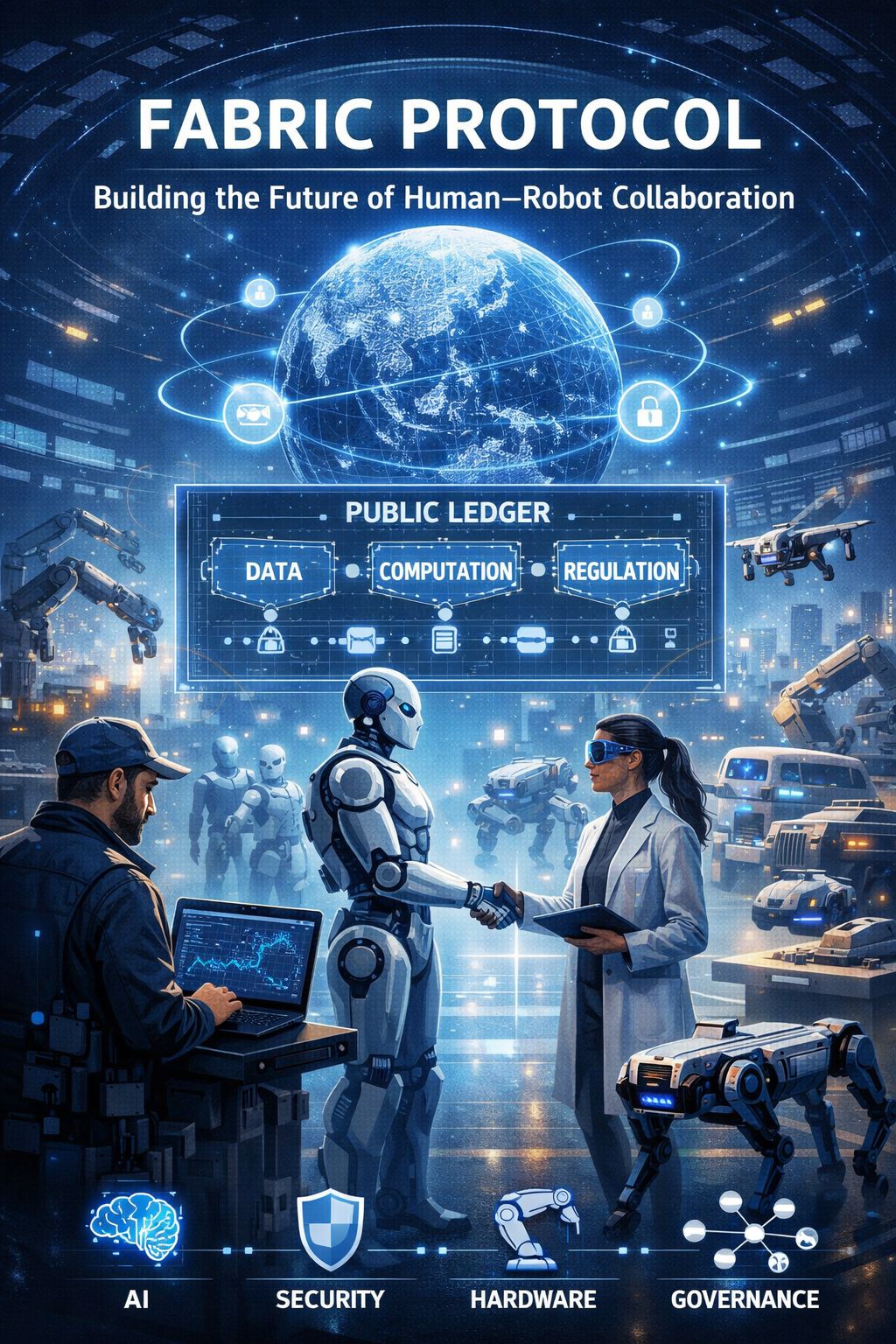
In the coming decades, robots and autonomous agents will play an increasingly important role in our daily lives—assisting in industries, healthcare, logistics, and even personal tasks. However, building a global ecosystem where robots can safely collaborate with humans and each other requires a secure, transparent, and scalable infrastructure. Fabric Protocol is designed to meet this challenge.
What is Fabric Protocol?
Fabric Protocol is a global open network supported by the Fabric Foundation, a non-profit organization focused on advancing responsible robotics infrastructure. The protocol enables developers, organizations, and communities to build, govern, and evolve general-purpose robots using a decentralized and verifiable system.
Unlike traditional robotic platforms that rely on centralized control, Fabric Protocol uses verifiable computing and agent-native infrastructure. This means that every action performed by robotic agents can be verified, audited, and trusted within the network.
A Public Ledger for Robotics
At the heart of Fabric Protocol is a public ledger that coordinates three critical elements:
Data – Shared datasets that help robots learn and improve.
Computation – Verifiable processes that ensure tasks are executed correctly.
Regulation – Transparent rules and governance mechanisms to maintain safety and compliance.
This ledger creates a trusted environment where different robots, organizations, and developers can collaborate without relying on a single controlling authority.
Modular Infrastructure for Scalable Innovation
Fabric Protocol is built with modular infrastructure, allowing developers to plug in new capabilities as the ecosystem grows. This modular design supports:
Robotics hardware integration
AI and machine learning agents
Security and verification layers
Governance frameworks
By enabling flexible development, the protocol encourages innovation while maintaining strong safeguards.
Enabling Safe Human–Machine Collaboration
Safety and trust are central to the vision of Fabric Protocol. Through verifiable computing and transparent governance, the network ensures that robotic systems operate predictably, securely, and ethically.
This approach allows humans and machines to collaborate in environments such as:
Smart manufacturing
Healthcare robotics
Autonomous logistics
Smart cities and infrastructure
Research and exploration
The Future of Robotics Networks
Fabric Protocol represents a shift toward open, decentralized robotic ecosystems. By combining blockchain-style public ledgers, verifiable computation, and modular architecture, the protocol creates a foundation where robots can evolve collaboratively and responsibly.
As robotics technology advances, platforms like Fabric Protocol may become essential infrastructure—helping humanity unlock the full potential of intelligent machines while ensuring safety, transparency, and shared governance.
@Fabric Foundation #ROBO $ROBO