

@MidnightNetwork I think Midnight Network is getting attention right now because it is trying to solve one of blockchain’s oldest trade-offs without acting as if the trade-off never existed in the first place. Most chains still force me to choose between usefulness and privacy. If I want full transparency then I get clean on-chain logic but I also expose far more than I should. If I want real secrecy then I usually give up the shared state that makes blockchains useful. Midnight takes a different route by keeping sensitive data off-chain while placing only the public effects on-chain and using zero-knowledge proofs to show that the hidden parts still followed the rules. That feels especially relevant in March 2026 because the project is moving toward a late March mainnet launch after the official NIGHT token launch in December 2025 which means the conversation has shifted from theory to live rollout.
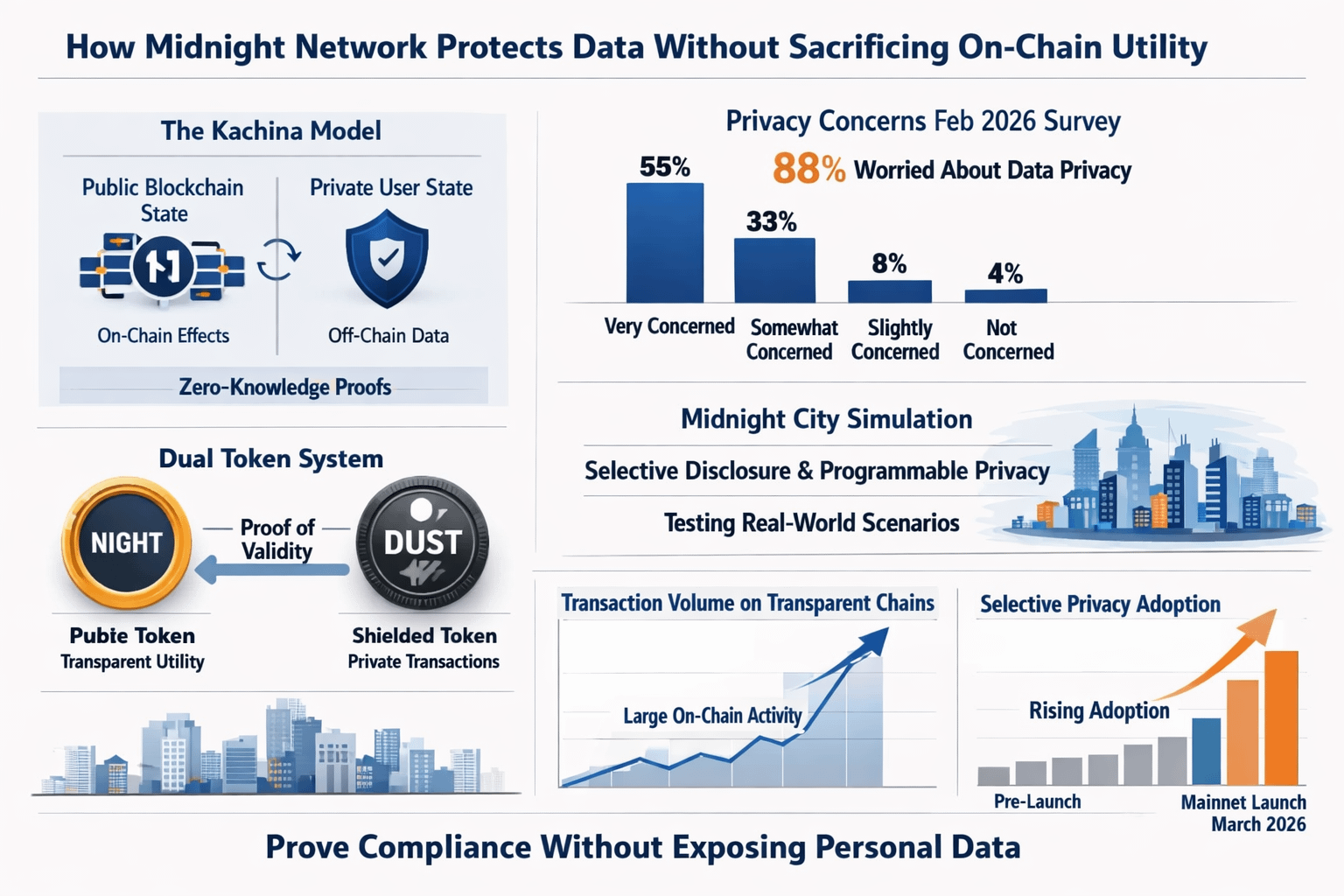
What I find most interesting is the way Midnight splits the system into two connected states instead of forcing everything into one public record. In its Kachina model the public state lives on the blockchain while the private state stays with the user. A transaction connects those two worlds through a proof so the chain does not need my raw personal data and only needs evidence that my change to the public state is valid. The idea is straightforward even if the underlying math is not. The network can verify that the rules were followed without learning everything about me. For anyone who has watched transparent ledgers turn ordinary activity into a form of permanent exposure that feels less like a luxury and more like a necessary correction.
Midnight also avoids the usual privacy-chain problem of becoming opaque in the wrong way. Its smart contract model is built so that transactions include a public transcript together with a zero-knowledge proof that the transcript is valid. On-chain contracts store verifier material rather than the private computation itself which allows the network to check correctness and update shared state without revealing the private inputs behind the action. That distinction matters to me because useful blockchains still need state changes that others can trust. Midnight is not trying to hide the fact that something happened. It is trying to hide only the data that never needed to be public.
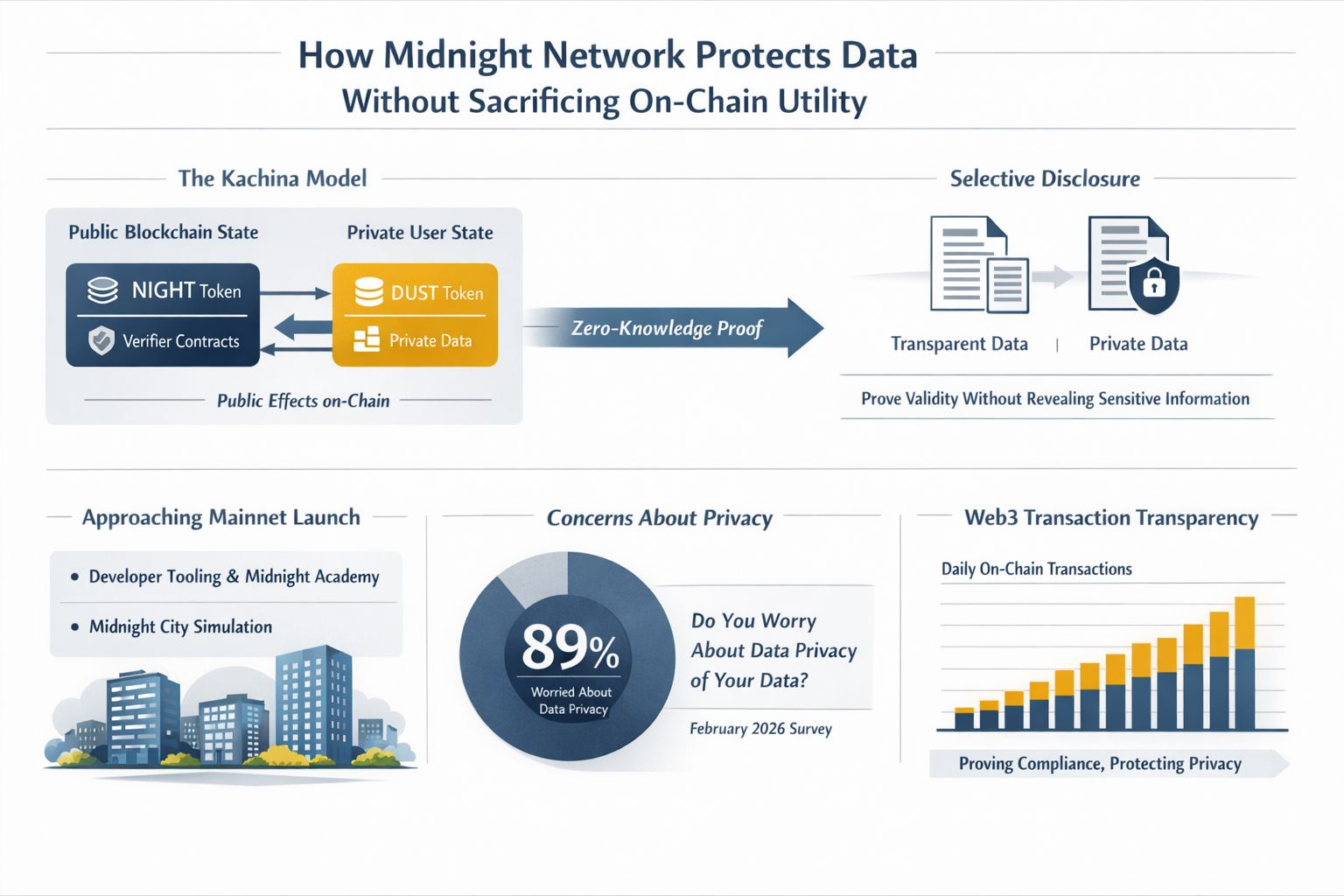
I also think Midnight feels more practical than a lot of privacy talk because it makes room for selective disclosure instead of treating privacy as an all or nothing condition. The network uses a dual model in which NIGHT is the public and unshielded native token while DUST is the shielded resource used to pay for transaction fees and execute smart contracts. That choice says a lot about the design philosophy. It suggests the team wants visibility where shared coordination helps and protection where personal or business data would otherwise be exposed. To me that is a more grounded approach than the older idea that privacy systems must hide everything all the time to matter.
The reason this discussion feels timely now is that Midnight has started showing its work in public in a way that is easier to evaluate. The project says mainnet is coming in late March 2026 and it has spent the weeks leading up to launch pushing developer readiness through updated preprod tooling refreshed documentation and Midnight Academy resources. It has also used the Midnight City simulation to show how selective disclosure and programmable privacy can function under more realistic network activity. I see that as a meaningful step because privacy systems are hard to trust when they remain too abstract. At some point people need to see how the model behaves in practice and not just read about it in technical language.
What ties it all together for me is the broader mood around privacy itself. Midnight’s February 2026 survey says nearly 90 percent of respondents are concerned about the privacy of their data and frames that concern against a web3 landscape where large transaction volumes still move across transparent rails. That helps explain why Midnight is landing differently now. People are no longer treating privacy as an abstract principle that sounds nice in theory. They are starting to feel the cost of exposure much more directly across payments identity and digital participation. Midnight’s real test will come after launch when elegant architecture runs into messy real-world usage but the central idea already feels important to me. I should be able to prove that I followed the rules without handing over my entire digital life just to participate on-chain.