
I’m always watching for the moments when blockchain technology quietly shifts direction. Not the loud hype cycles. Not the trending tokens. The deeper changes in infrastructure that signal where the next phase of the industry is heading. Midnight Network ($NIGHT) feels like one of those moments. The kind that doesn’t rely on noise, but instead introduces a technical shift that could reshape how decentralized systems handle something the industry has struggled with for years: privacy.
For most of blockchain’s history, transparency has been the defining rule. Every transaction visible. Every wallet traceable. Every smart contract operating in full view of the network. This radical openness built trust in decentralized systems because anyone could verify what was happening. But the same design that created transparency also introduced a serious limitation. When everything is visible, many real-world systems simply cannot operate on-chain.
Think about it from a practical perspective. Businesses cannot run financial agreements if competitors can see every payment. Individuals cannot manage identity or sensitive data if their activity becomes permanently public. Institutions cannot execute confidential contracts if the entire network can inspect the details. The industry built powerful infrastructure for trust, but it often sacrificed privacy to achieve it.
Midnight Network approaches the problem from a completely different angle.
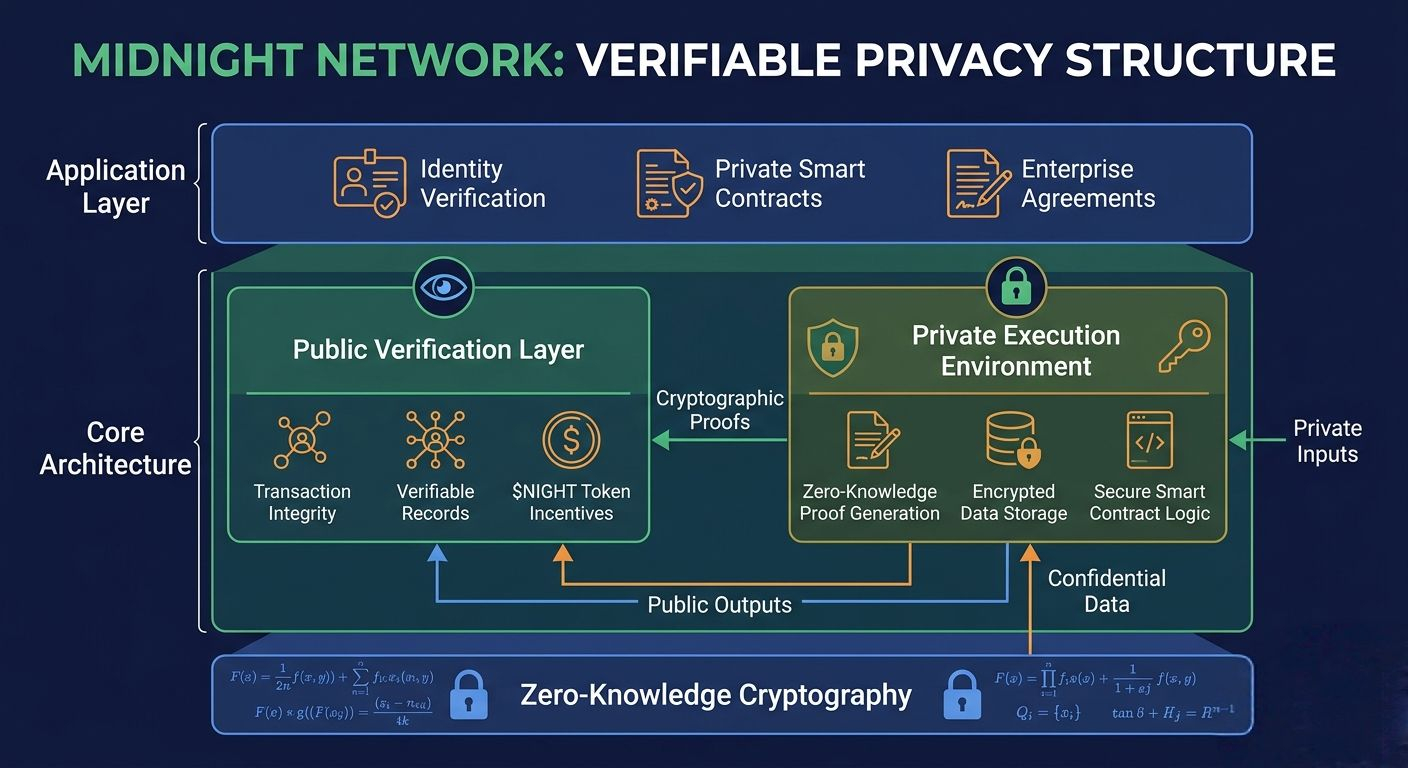
Instead of requiring information to be revealed in order to verify a transaction, the network uses zero-knowledge cryptography to prove validity without exposing the underlying data. A transaction can be confirmed without showing the contents. A contract can execute without revealing private inputs. The network verifies that something is true without needing to see the information itself.
This is the core idea behind zero-knowledge proofs, and it represents one of the most important cryptographic breakthroughs shaping the next generation of blockchain infrastructure.
When applied to smart contracts, the implications become even more powerful. Traditional smart contracts operate like glass boxes. Every variable, every input, every output visible to anyone observing the chain. Midnight introduces a different model where contracts can process confidential data while still remaining verifiable on a decentralized network. The logic runs securely, the results are confirmed by the system, and sensitive information remains protected.
For developers, this opens an entirely new design space. Applications no longer have to choose between decentralization and privacy. Both can exist at the same time.
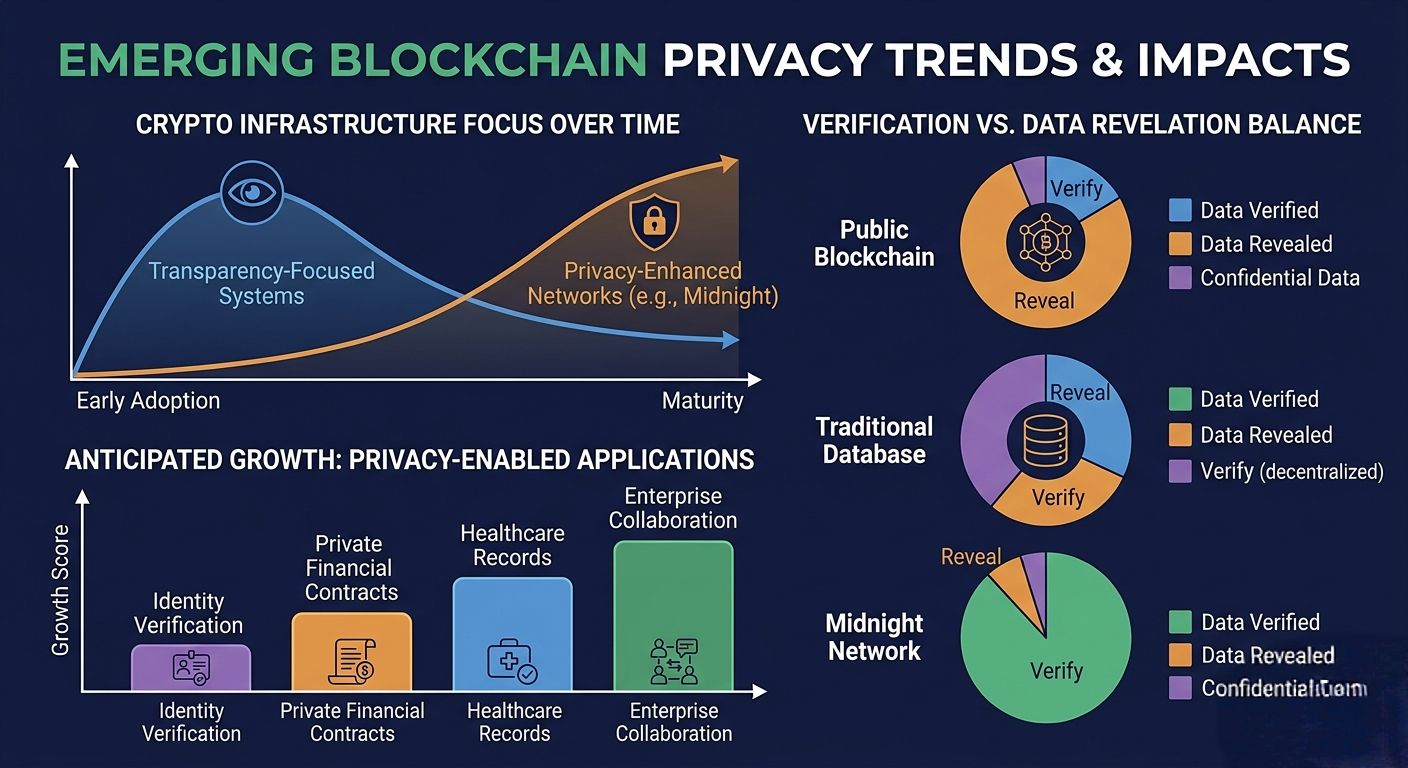
This shift also helps address one of the quiet barriers preventing blockchain from expanding into larger institutional and enterprise environments. Many organizations have explored decentralized infrastructure, but the transparency of traditional blockchains creates friction with regulations, business confidentiality, and data protection laws. Midnight’s architecture provides a way for systems to remain verifiable while keeping sensitive information private.
The implications stretch far beyond financial transactions. Identity systems could allow individuals to prove credentials without exposing personal data. Enterprises could execute complex agreements without revealing internal financial structures. Healthcare networks could verify sensitive records while preserving strict privacy standards. Even regulatory frameworks could evolve to verify compliance through cryptographic proof rather than full data exposure.
At the center of this ecosystem sits the $NIGHT token, which functions as the economic layer supporting the network. Decentralized systems require incentives for computation, validation, and coordination. The token helps power the verification environment where zero-knowledge proofs are processed and confirmed, aligning participants who contribute resources to maintaining the network.
What makes Midnight particularly interesting is the broader signal it sends about where blockchain technology is going. The early phase of crypto focused on radical transparency as the solution to trust. But the next phase appears to be moving toward balance. Systems that combine public verification with selective confidentiality.
Trust does not always require total exposure. Sometimes trust is stronger when systems can prove integrity without forcing participants to reveal everything.
That realization is beginning to shape the architecture of the next generation of decentralized networks. Zero-knowledge technology is moving from theory into real infrastructure, and projects building around it are quietly redefining what blockchains are capable of supporting.
Midnight Network sits directly within that transformation. It’s not just another chain competing for speed or throughput. It’s an attempt to redesign how verification itself works on decentralized systems.
If that model continues to mature, the result could be a blockchain environment where privacy and trust are no longer competing forces, but complementary ones. And that shift has the potential to unlock an entirely new wave of decentralized applications that were simply impossible before.
@MidnightNetwork #night $NIGHT
