
The shoulder servo was still spinning down when the window slammed shut. That was the violence of it. Not mechanical failure, the actuator had completed its arc, the towel lay folded, but the Fabric's OM1 runtime segmentation had sliced the motion mid-deceleration, capturing the arm at 0.3 radians per second in one runtime state checkpoint and zero in the next, with no frame for the exponential decay between.
My thumb bled. I had been picking at a hangnail without noticing, the sting arriving only when the dashboard flashed COMPLETE. The robot task boundaries had formed around a moment that didn't exist in physics, creating a deterministic robot event on Fabric where the motor current was still spiking from momentum, where the heat signature hadn't flattened, where the towel was still settling from the impact.
"Finished" was the word I typed. Deleted it immediately. The machine execution windows don't finish things. They truncate them. They force the continuous—the fluid, the breathing, the settling—into autonomous system event framing that pretends motion has edges.
The runtime state packaging gathered the actuator trace, the environmental LIDAR sweep, the thermal snapshot of the gripper housing. Block 789403. A machine runtime record born from the actuator trace capture, immutable, signed by the Fabric's TEE. It claimed the task occurred between timestamp 14:23:07.000 and 14:23:07.800. Eight hundred milliseconds of discrete existence.
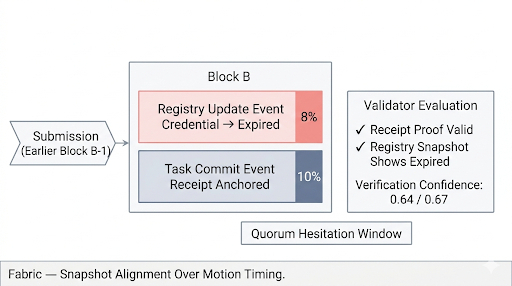
But the arm was still vibrating at 14:23:08.200. I could see it, the harmonic shiver of aluminum finding its rest, the towel fibers still compressing from the grip release. The runtime state snapshots had missed the echo. The deterministic robot events were lying by omission, presenting a finality that hadn't arrived in the physical world.
Or whatever you want to call it, the OM1 runtime segmentation was winning against continuity.
My vision blurred. I had been staring at the gap between the video feed and the state log, the dry air of the server room sucking moisture from my corneas. The runtime state checkpoints continued their march. Block 789404. Another boundary formed. Another motion—reaching for the next towel—packaged into a machine execution window before the reach had actually completed, the hand still opening, fingers not yet extended, the actuator trace capture grabbing telemetry from a grasp that hadn't closed.
The protocol required deterministic robot events. It needed discrete packets of being to feed the autonomous system event framing, to generate the proofs, to mint the attestations. But the robot moved in flows. In currents. In the slow exhale of hydraulic pressure bleeding off into the manifold.
I watched the runtime state packaging happen again. The boundary cut. The snapshot froze. Fabric's machine runtime record sealed. And the arm continued its motion for another four hundred milliseconds, ghosting through the space the ledger claimed was already complete, executing the future that the runtime state checkpoints insisted was past.
The gap stayed open. Not a lag. Not a delay. A fundamental disagreement between the curve and the point, the wave and the sample, the continuous shoulder servo and the robot task boundaries that kept slamming shut too early, packaging motion into blocks that fit the blockchain but missed the physics.
The arm kept moving. The ledger kept sealing. My thumb kept bleeding.
The Fabric's OM1 runtime segmentation achieved perfect determinism. The towe
l was still settling.