
At some point people realized something slightly uncomfortable about blockchains: they were built like glass houses.
Open a block explorer and you can watch the entire system breathe. Money moves from one wallet to another, contracts trigger, balances update, and every step leaves a permanent footprint. Anyone curious enough can follow the trail backward through years of activity. That level of openness was intentional. The original philosophy was simple—if everything is visible, nobody has to trust anyone.
But reality has a habit of complicating clean ideas.
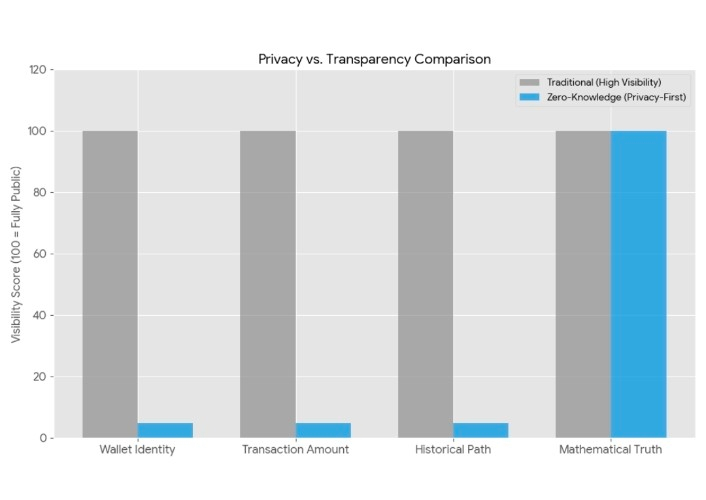
Transparency works beautifully in theory. In practice, it’s awkward. Imagine if every bank transfer you made could be inspected by strangers with enough patience. Or if your salary payments were traceable through a public ledger that never forgets. The system remains secure, yes, but the social experience becomes… strange.
That discomfort quietly pushed developers to look for a different approach. Not less verification—blockchains live or die by verification—but a smarter form of it.
That’s where zero-knowledge proofs enter the picture.
The phrase sounds intimidating, like something buried in a graduate-level math paper, but the basic idea is surprisingly human. It’s the ability to prove something is true without revealing the information that makes it true.
Imagine telling someone you know the password to a locked device. Normally you’d have to type the password in front of them to prove it. A zero-knowledge proof is closer to unlocking the device while they watch, without ever letting them see the password itself. They become convinced you know it, yet the secret never leaves your head.
That tiny shift—proof without disclosure—turns out to be incredibly powerful when applied to blockchains.
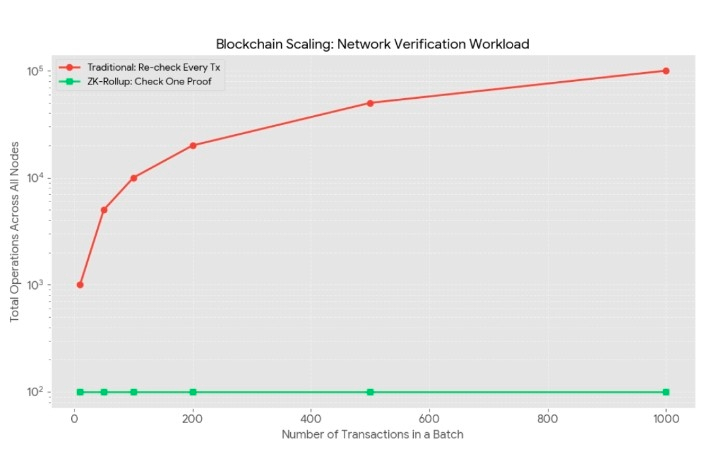
Traditional blockchains verify transactions by repeating them. If a thousand transfers happen, thousands of computers across the network independently check those transfers to make sure every rule was followed. It’s thorough, but it’s also inefficient. Everyone is doing the same work again and again just to reach the same conclusion.
Zero-knowledge systems change that routine.
Instead of every computer redoing the work, one system processes the transactions and produces a mathematical proof that everything was handled correctly. The network doesn’t need to replay the steps. It simply checks the proof.
If the proof holds up, the transactions are accepted.
This means thousands of operations can shrink into one compact piece of cryptographic evidence.
To the blockchain, it looks like someone walked in, placed a sealed envelope on the table, and said, “Here’s proof everything inside follows the rules.” The network opens the envelope, checks the math, and moves forward.
This mechanism gave birth to something called ZK rollups, which quietly became one of the most important scaling ideas in the blockchain world.
Instead of pushing every transaction directly onto a base chain like Ethereum, transactions are collected in batches somewhere else. The system processes them together and generates a proof showing the batch obeyed all protocol rules. That proof, along with minimal data, is posted back to the blockchain.
Ethereum doesn’t need to inspect every individual action inside that batch. It verifies the proof and accepts the result.
Thousands of transactions reduced to a single verification.
It’s a bit like a judge reviewing a certified report instead of investigating every detail of a case personally. The report contains the necessary proof that procedures were followed correctly.
But efficiency is only half the story.
The other half is privacy.
Once proofs replace raw data, the blockchain doesn’t necessarily need to see the underlying information anymore. Someone could prove a transaction is valid without exposing every detail attached to it. A user could prove they meet certain conditions without revealing personal information.
Developers quickly realized the implications stretch far beyond payments.
A voting system could count ballots privately while still proving the final result is accurate. No one sees individual votes, but everyone can trust the tally.
An identity system could confirm that someone is legally an adult without exposing their birthdate, name, or address. The proof simply confirms the condition is satisfied.
A company could prove it holds enough assets to cover customer deposits without publishing its entire financial ledger.
In each case, the blockchain isn’t storing sensitive information. It’s verifying mathematical evidence that certain statements are true.
That distinction changes the role of the blockchain itself.
Instead of being a giant public record of everything that happens, it becomes more like a global verification machine—something that checks proofs rather than collecting data.
Some projects have pushed this concept even further.
One particularly fascinating example compresses an entire blockchain into a tiny cryptographic proof. Instead of downloading years of historical data to join the network, a new participant verifies a small proof representing the entire chain’s validity. The system essentially says, “Here is mathematical evidence that every step in this history followed the rules.”
The node checks the proof, and that’s enough.
History itself becomes something that can be summarized with mathematics.
Of course, there’s a catch.
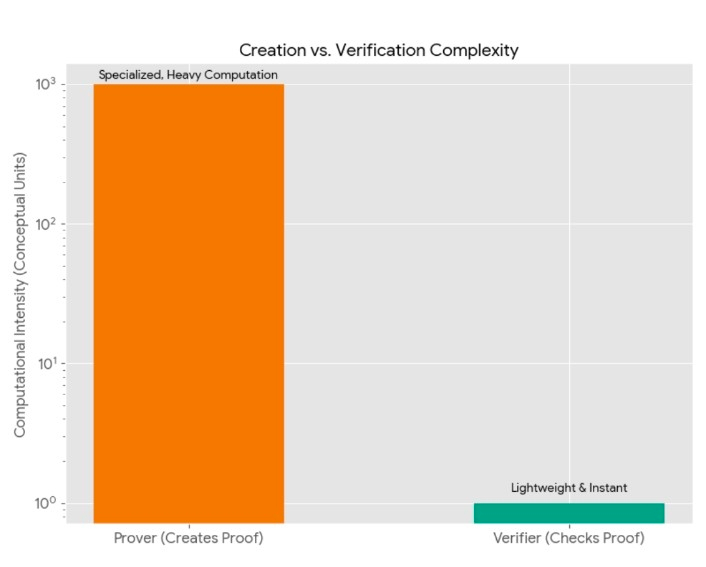
Checking a proof is easy. Creating one is hard.
Generating zero-knowledge proofs requires significant computational work. Engineers translate programs and transactions into complex mathematical circuits that specialized machines can process. These machines—often called provers—perform the heavy lifting that produces the final cryptographic proof.
Entire infrastructures are beginning to form around these provers, similar to how mining networks once grew around proof-of-work blockchains.
While the blockchain itself stays lightweight, somewhere behind the scenes powerful machines are busy turning computations into mathematical evidence.
And things get even more interesting with recursive proofs. A proof can verify another proof, which might verify thousands of transactions. Stack these layers together and enormous amounts of activity collapse into a single statement the blockchain can check in seconds.
The chain only needs to answer one question: does the proof check out?
If it does, everything behind it is accepted.
What’s quietly unfolding here isn’t just a technical upgrade. It’s a shift in how digital systems establish trust.
Early blockchain thinking assumed transparency was the solution. Make everything visible. Let anyone inspect every detail.
Zero-knowledge technology introduces a more subtle idea.
Truth doesn’t always require exposure.
A system can prove it followed the rules without revealing the process that produced the result. Verification can exist without surveillance. Trust can come from mathematics rather than visibility.
Once that idea spreads into finance, identity systems, data platforms, and even artificial intelligence, blockchains stop behaving like public notebooks.
They start behaving more like courts of mathematics—places where claims are presented, proofs are examined, and the network delivers a quiet verdict.
Valid.