

@MidnightNetwork I keep coming back to one simple thought. Blockchains became popular because they made trust visible, yet in doing so they also made people far too visible. That is why Midnight Network feels relevant right now. The project is no longer speaking about privacy as a distant idea. It is moving toward a late March 2026 mainnet launch, it is pushing developers to get ready for that shift, and it is using a simulation called Midnight City to show how privacy preserving transactions could work under real conditions. That mix of timing, preparation, and visible progress is a big reason the conversation has become louder.
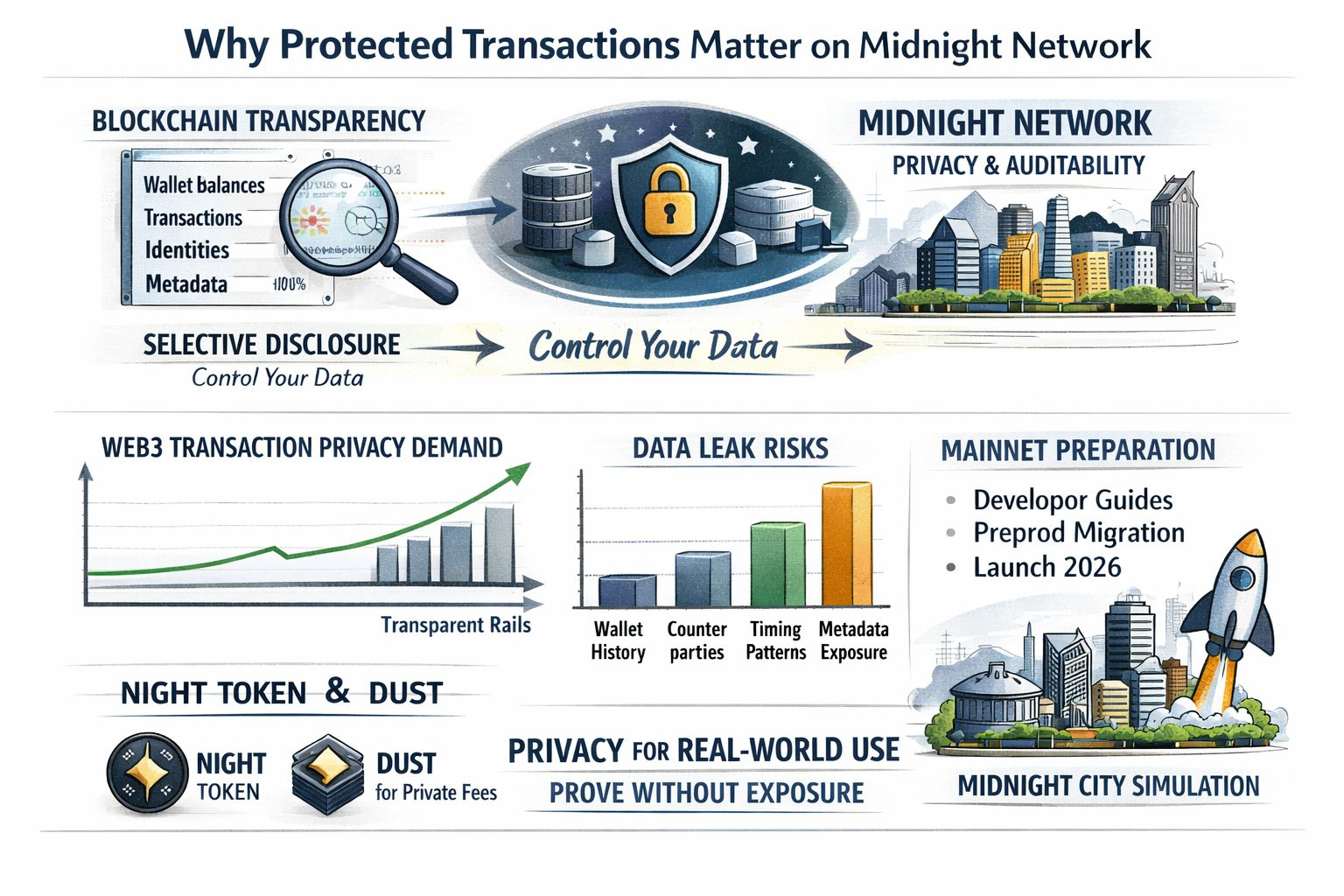
What interests me most is that Midnight does not present protected transactions as total secrecy. Its documentation describes a system built around selective disclosure, which in plain language means I can prove that something is true or valid without placing all of my personal or business data on a public ledger forever. Midnight says it keeps a public state on chain for what needs to be visible while private state remains in local encrypted storage controlled by users. To me, that feels less like a rejection of transparency and more like a correction to the way public chains pushed transparency too far.
That matters because on most transparent chains the real leak is not only the balance. It is the pattern that forms around it over time. Wallet history, counterparties, timing, and transaction details can reveal strategy, identity, and behavior in ways many people still underestimate. Midnight’s own materials are clear that public chains expose not only balances and actions but also metadata, and that is exactly where the privacy problem becomes more serious for ordinary users and for sectors such as healthcare, finance, and government services. The project’s recent survey language also sharpens the point by arguing that most Web3 value still moves on transparent rails while demand for stronger data protection keeps growing.
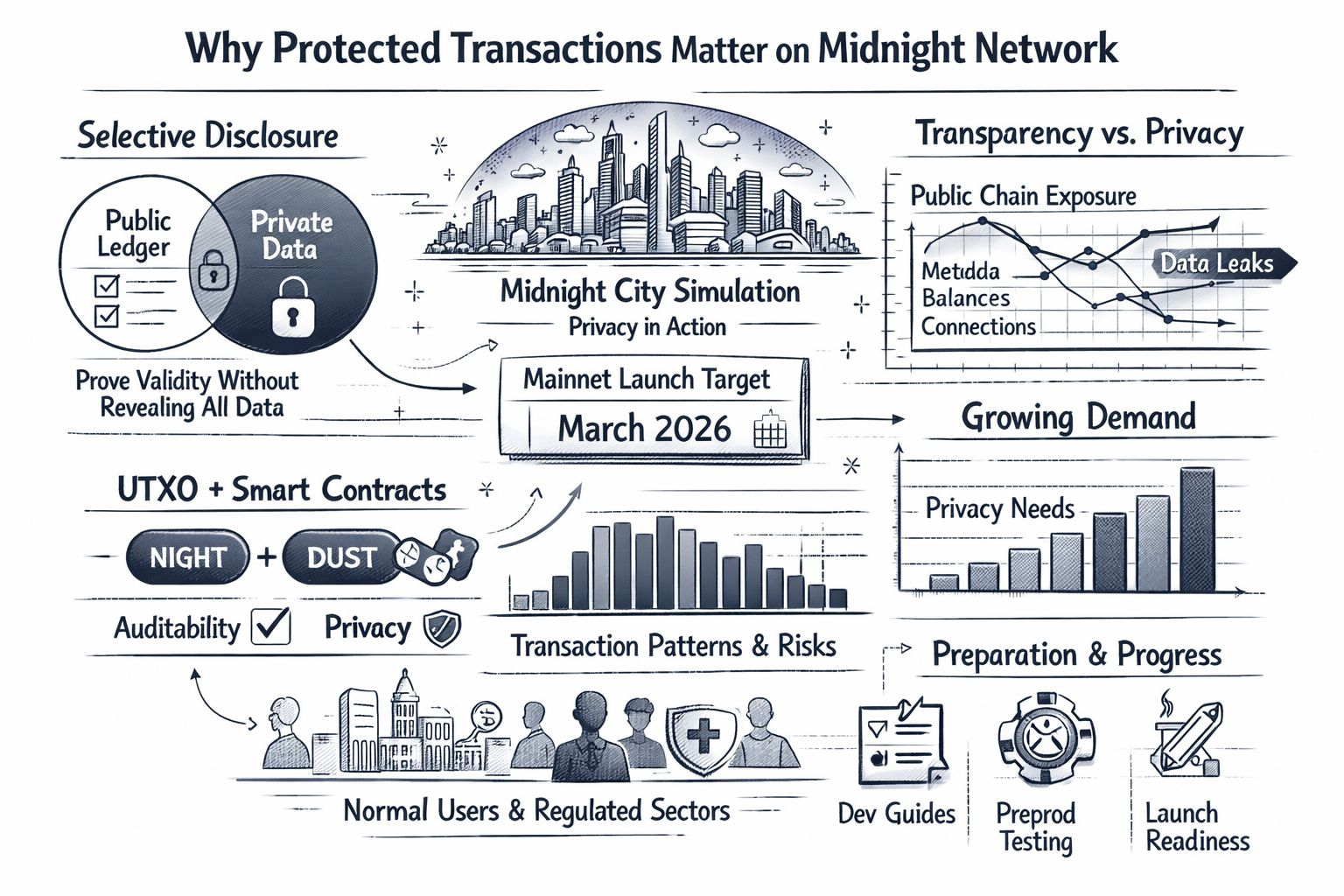
I also find Midnight’s architecture more interesting than the usual privacy chain pitch because it is trying to make protected transactions practical instead of making them sound mysterious. The network combines a UTXO foundation with account based smart contract patterns. Its native NIGHT token generates DUST, which is a renewable shielded resource used for transaction fees. That may sound technical at first, but the larger point is simple enough. Midnight is trying to build a system where privacy is part of normal use rather than a rare feature that only specialists understand. Its documentation explains that people compute on private data locally and then submit proofs that can be verified on chain without exposing the underlying information. For me, that is where the idea starts to feel useful in the hands of real builders.
The timing matters too because Midnight has recently shifted from broad vision to visible preparation. Its developer documentation was updated in early March 2026, and the project published a developer guide on March 9 focused on getting applications ready for mainnet. Around the same period, the February network update pointed to ecosystem growth, preprod migration, and federated launch preparation as central parts of the next step. I do not treat that as proof of success, because no project earns that in advance, but I do see it as proof that Midnight is moving beyond concept stage language. There is real infrastructure and real coordination being assembled around the launch.
My view is pretty simple. The value of protected transactions is not that they make blockchain mysterious. It is that they make blockchain usable for normal people, normal firms, and regulated environments that cannot place every detail in public view. Midnight seems to understand that privacy without auditability will always run into resistance, while auditability without privacy turns the ledger into something closer to surveillance than trust. That tension is why the project is getting attention now. Whether Midnight fully delivers will depend on execution, adoption, and whether these tools feel natural once people actually use them, yet I think it is asking one of the most serious questions in crypto today, which is not whether transactions can be hidden, but what should ever have been exposed in the first place.