
I want to believe in what Midnight is building. I genuinely do. The problem it is pointing at is real, and the more I think about where blockchain infrastructure is actually heading, the harder it becomes to ignore that. Public ledgers are great at verification. They are much less convincing when the activity on top of them starts involving sensitive data, commercial logic, identity, or institutions that cannot operate with everything exposed by default. Midnight looks at that gap and offers a serious answer. Zero-knowledge proofs, selective disclosure, privacy built into smart contract design, and tooling that tries to make all of this usable instead of purely theoretical. On paper, the case is strong.
But the more I sit with it, the more I feel the hardest issue here may not be technical at all.
It may be what happens when privacy and accountability stop pulling in the same direction.
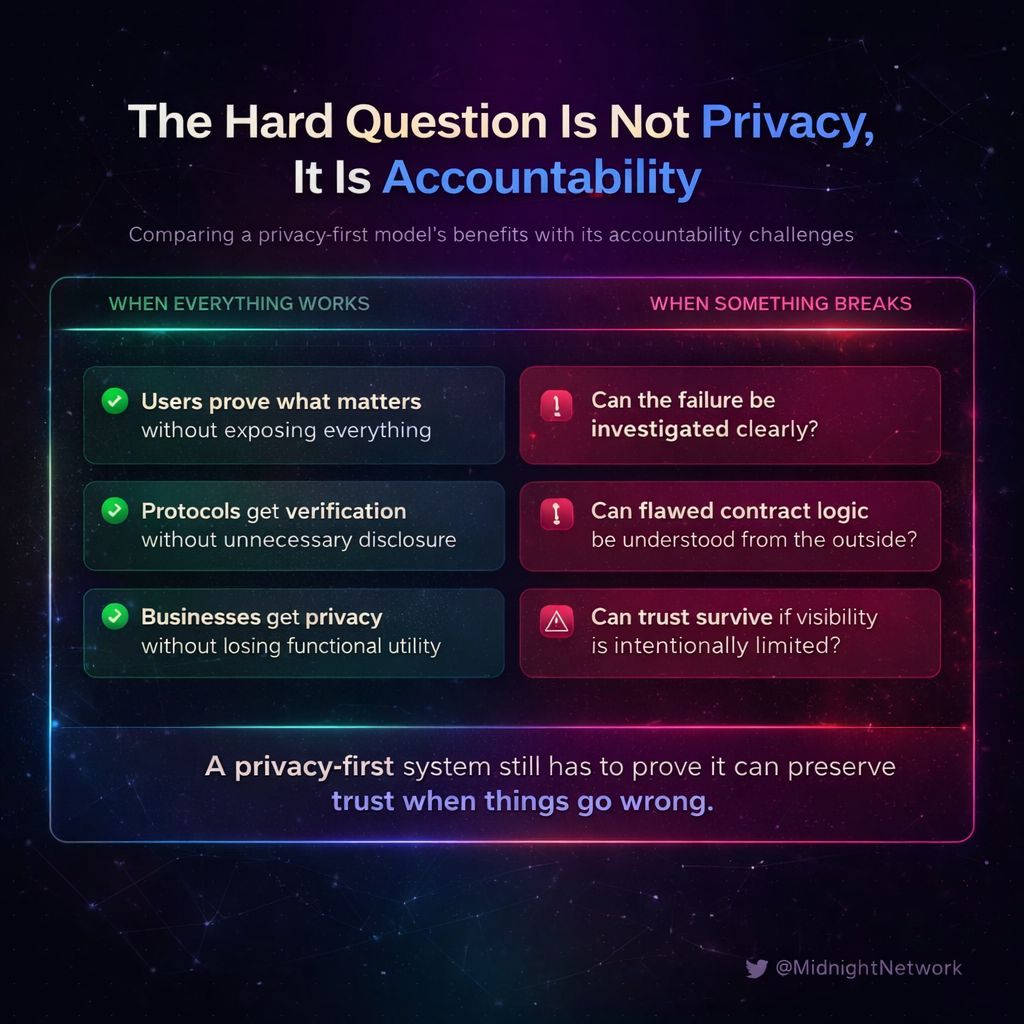
That is the tension I keep coming back to.
It is easy to understand the appeal of Midnight’s model when everything works as intended. A user proves something without revealing the full data behind it. A protocol gets verification without unnecessary exposure. A business gets confidentiality without giving up the ability to prove compliance. That is clean. It is also the kind of design direction blockchain probably needs if it wants to move beyond speculation and into more serious environments.
But systems are not only judged by how they work when everything goes right.
They are judged by what happens when something breaks.
Imagine a financial application built on Midnight. A user submits proof, a contract accepts it, and the system behaves exactly as designed. That is the optimistic case. Now imagine the opposite. Maybe the contract logic contains an edge case the developers did not anticipate. Maybe the proof system verifies something valid, but the rule it was verifying was flawed from the start. Maybe funds move in a way that harms users, and suddenly the network has to answer a very uncomfortable question: how do you investigate a failure inside a system designed to reveal less by default?
That is not a minor concern to me. It feels central.
Traditional blockchains are messy when they fail, but at least their failures are public. Analysts can trace activity, reconstruct exploits, study state changes, and learn from visible evidence. Privacy-preserving systems do not offer that same level of open reconstruction so easily. The same design that protects users in normal conditions can become a barrier to understanding what happened when the system behaves unexpectedly.
And that is where I think the conversation around Midnight still needs more honesty.
Proof systems can verify what they are programmed to verify. They cannot automatically protect against weak assumptions, flawed contract design, or logic that looked correct until real users started interacting with it. Verification is not the same thing as perfect accountability. And if explaining failure depends too heavily on developer cooperation rather than public inspectability, then some part of the trust model may quietly move back toward people instead of code.
That does not make Midnight weak. If anything, it makes it more serious.
Weak projects do not force these kinds of questions. Serious ones do.
That is why I keep watching Midnight closely. I think it is trying to solve something that actually matters. I also think the market is right to pay attention. But the question that stays with me is not whether privacy can be built into blockchain systems. The harder question is whether a privacy-first system can still preserve trust, accountability, and credible investigation when things stop going according to plan.
That is where I think the real test begins.