
What the Data Really Shows
Bitcoin cycles have a rhythm. For years, traders and analysts have watched its four-year heartbeat, timing peaks, corrections, and bear markets. But lately, a narrative has emerged across Twitter and YouTube: the four-year cycle is dead. According to some, the market didn’t feel as euphoric, altcoins didn’t rally, and therefore, the established rhythm is supposedly broken.
Is it really? Let’s dig into the data, historical trends, and market structure to separate narrative from reality.
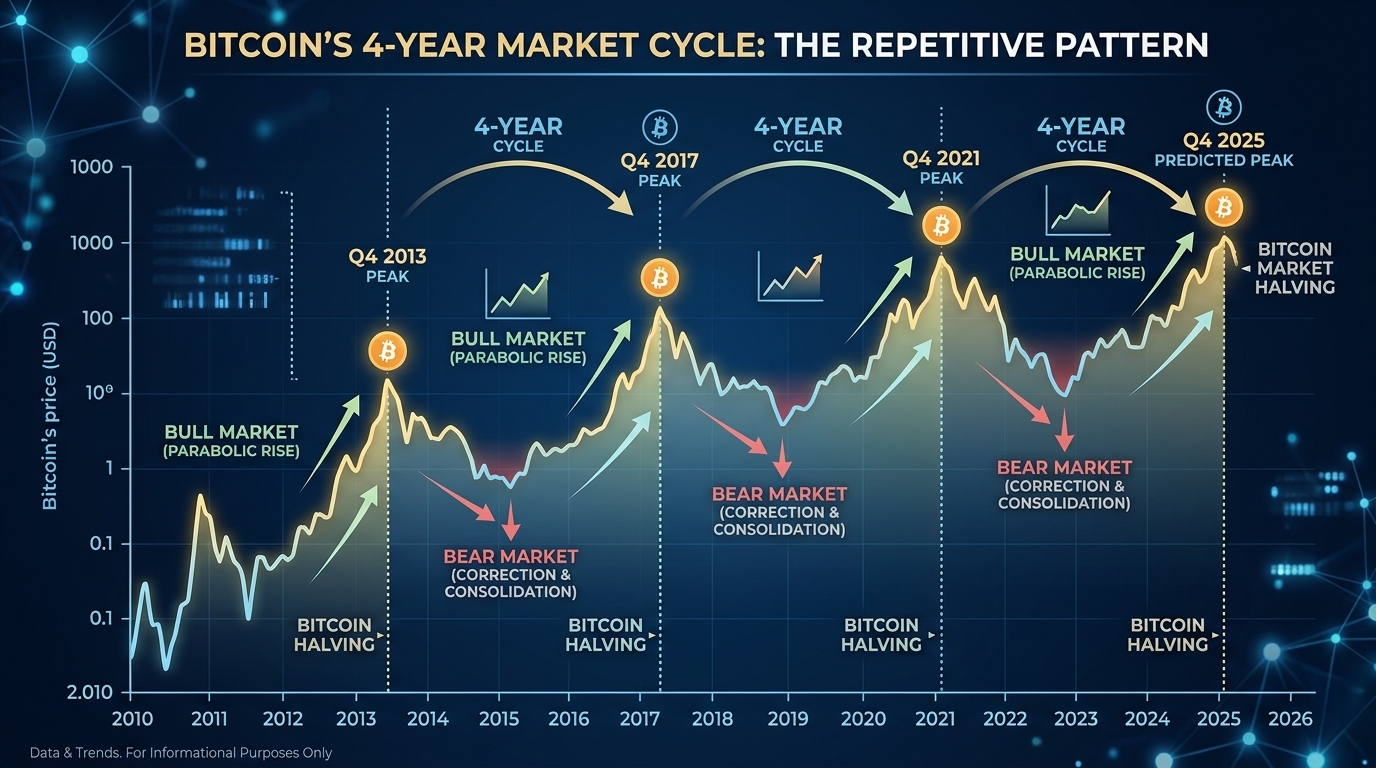
The History Speaks: Peaks in the Fourth Quarter
The four-year cycle is rooted in history. If we examine previous market tops, a clear pattern emerges. Bitcoin’s cycle peaks occurred in:
Q4 2013
Q4 2017
Q4 2021
Q4 2025
Notice the consistency. Despite differing market conditions, Bitcoin topped when it historically does. This isn’t luck—it’s pattern recognition. Claims that the cycle is broken often rely on altcoins underperforming or personal expectations of price surges, neither of which invalidate Bitcoin’s historic rhythm.
A deeper look at returns on investment (ROI) from the cycle lows to peaks confirms this. The 2025 cycle topped on day 162, just three days off the prior cycle’s peak and six days earlier than the one before that. That’s remarkably close alignment.
Bear Market Dynamics: Why the Noise Confuses Traders
Bear markets have a structure that confuses many. In bull markets, Bitcoin often trends down before explosive moves upward. In bear markets, the opposite happens: it can trend up for weeks or months before a sharp breakdown.
This explains why midterm-year rallies in 2026 may feel counterintuitive. Bitcoin found a low in February and rallied into March, mirroring prior midterm-year patterns in 2014, 2018, and 2022. These upward movements often lull bulls into a false sense of security, only for the market to break lower quickly.
The takeaway: short-term trends during bear markets don’t negate the larger cycle.
Indicators and the Search for the Bottom
Many traders want certainty—signals that the bear market has ended. There are several metrics often cited:
Historical balance price: Bitcoin has historically bottomed below this mark. Today’s price sits well above it.
Supply in profit vs. loss: Bear market lows typically occur after these metrics cross. They haven’t yet.
MVRV Z-Score: Historically bottoms below zero in bear markets. Currently above zero.
There’s no single metric that guarantees a bottom. For every indicator suggesting support, there’s another pointing to more downside. Recognizing this duality is crucial. Premature “bottom calls” often come from those who missed the initial bear market prediction, incentivizing them to justify why the low is in now.
Narratives vs. Data
Bitcoin is notorious for narratives. Every rise and dip is explained by institutions, macro trends, or supposed “super cycles.” Yet these explanations often fail to predict actual market behavior.
In bear markets, trends can appear bullish before collapsing. In bull markets, trends can look bearish before sudden breakouts. Understanding these patterns is key. Bitcoin’s behavior is not random—it follows structural tendencies that repeat with remarkable consistency.
Midterm Year Patterns: February Lows and March Rallies
Zooming in on midterm years offers another perspective. Each cycle shows a recurring pattern: a low in February, followed by a rally in March, then a gradual decline. 2026 follows this template. The question isn’t whether the four-year cycle is broken—it’s about timing the lower highs that define the rest of the bear market.
Traders asking “is the bottom in?” must consider history: midterm years rarely see definitive lows this early. Watching for lower highs in late March or early April aligns with decades of data.
Why Expectations Skew Perception
Many analysts are influenced by high expectations. When predicted altcoin rallies or price surges fail to materialize, the natural reaction is to assume something broke. But history shows Bitcoin consistently peaks and enters bear markets within predictable windows.
Overestimating the intensity of a bull run doesn’t invalidate the cycle. It merely reflects human bias. The four-year rhythm remains intact, regardless of hype or disappointment.
Key Takeaways for Traders
The four-year cycle is alive – Bitcoin continues to follow historical timing patterns.
Bear markets have counterintuitive trends – Upward trends can precede sharp declines.
Indicators are not absolute – Balance price, MVRV Z-Score, and supply in profit/loss are helpful, but not guarantees.
Expect volatility, not perfection – Patterns repeat, but market emotions and narratives create noise.
Midterm years are predictable – February lows, March rallies, and subsequent declines are historically consistent.
How does your trading strategy account for historical cycles versus short-term narratives?
Are you relying on a single indicator, or multiple metrics, before calling a bottom?
How do you separate hype-driven price action from structural market trends?
Bitcoin’s four-year cycle is more than just a number—it’s a reflection of behavioral and economic rhythms. Ignoring it invites unnecessary risk. Understanding it gives context to price swings, rallies, and the quiet periods between them.
Cycles repeat not because markets are static, but because human behavior and macro patterns persist. Pretending this time is different may be tempting, but the data tells a simpler story: the four-year cycle remains unbroken, guiding Bitcoin through peaks, troughs, and everything in between.