Introduction
Robotics is entering a new era. Advances in artificial intelligence, sensor technology, and automation are rapidly expanding what machines can do in the physical world. However, one major challenge remains: how to coordinate robots, data, computation, and governance in a trustworthy and scalable way.
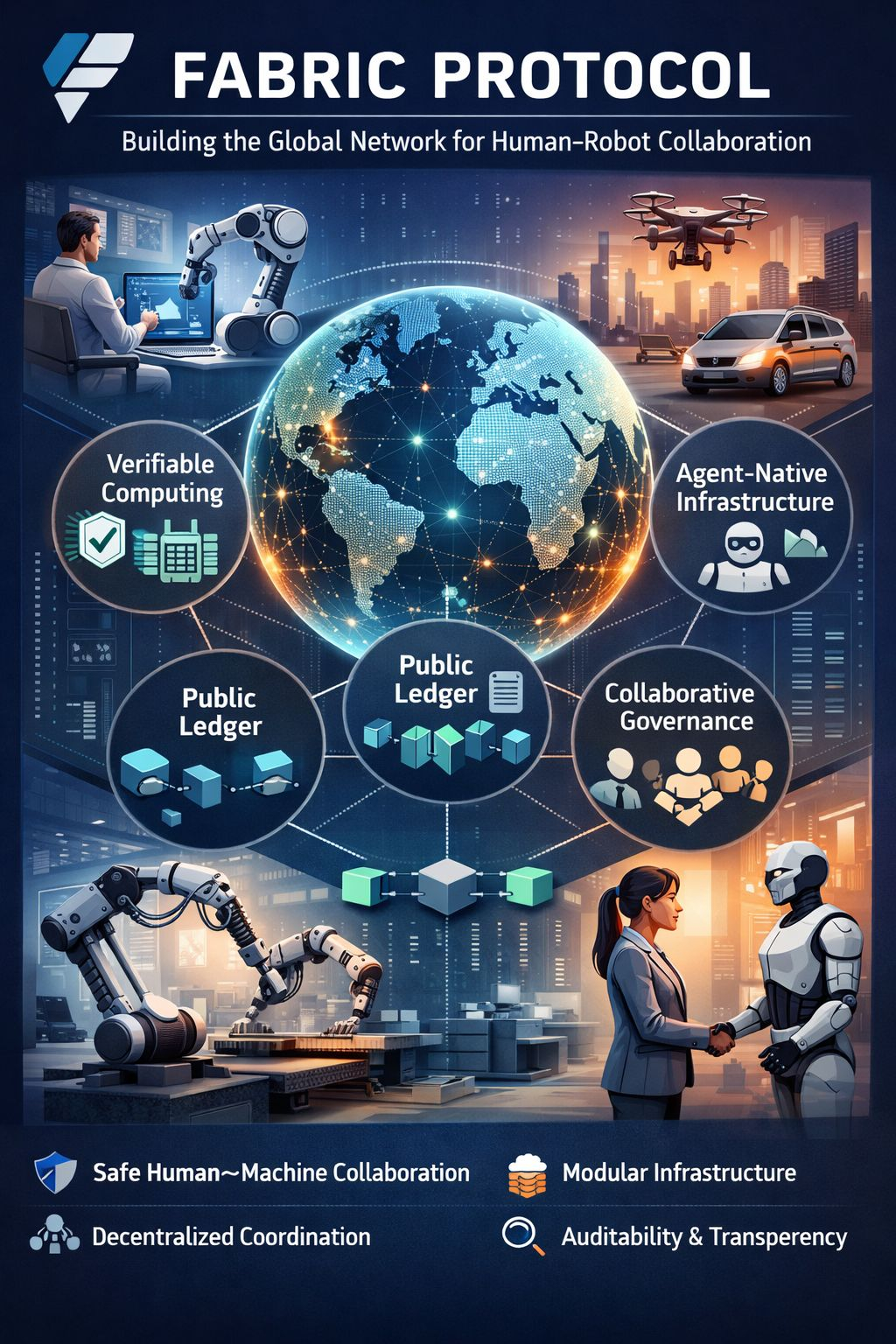
Fabric Protocol addresses this challenge by introducing a global open network for robotics, supported by the non-profit Fabric Foundation. The protocol creates a decentralized infrastructure that allows developers, organizations, and communities to build, govern, and evolve general-purpose robots using verifiable computing and agent-native systems.
By combining a public ledger, modular infrastructure, and collaborative governance, Fabric Protocol aims to make robots safer, more transparent, and easier to integrate into society.
The Vision Behind Fabric Protocol
The central idea behind Fabric Protocol is simple yet powerful:
Robots should not operate as isolated machines but as participants in a shared, trustworthy digital ecosystem.
Traditional robotic systems are typically closed environments controlled by a single company or institution. This model limits transparency, collaboration, and innovation. Fabric Protocol instead proposes an open network where robots can interact with shared resources and follow transparent rules.
The vision includes:
Open robotics infrastructure
Verifiable and auditable computation
Decentralized governance
Safe human-machine collaboration
Global coordination of robotic agents
In essence, Fabric Protocol acts as the internet layer for intelligent robots.
Core Components of Fabric Protocol
1. Verifiable Computing
At the heart of Fabric Protocol lies verifiable computing, which ensures that robotic decisions and computations can be independently validated.
This capability is essential for safety-critical environments such as:
Healthcare robotics
Autonomous vehicles
Industrial automation
Public infrastructure
Verifiable computation ensures that robotic actions are transparent, trustworthy, and provably correct, reducing the risk of malfunction or manipulation.
2. Agent-Native Infrastructure
Fabric Protocol introduces an agent-native infrastructure, designed specifically for autonomous agents such as robots, AI systems, and smart machines.
Unlike traditional networks designed for human interaction, agent-native systems allow machines to:
Communicate directly with each other
Coordinate tasks autonomously
Access shared computation resources
Execute collaborative workflows
This infrastructure enables machine-to-machine cooperation at a global scale.
3. Public Ledger Coordination
Fabric Protocol coordinates activity through a public ledger, which acts as the backbone of the network.
The ledger records:
Data contributions
Computation results
Governance decisions
Resource allocation
Robot activity logs
Because the ledger is transparent and immutable, it creates a shared source of truth across the ecosystem.
This system allows organizations, regulators, and developers to verify how robots behave and interact with humans.
4. Modular Infrastructure
Fabric Protocol is designed as a modular stack, meaning developers can build systems using independent components that integrate seamlessly.
These modules may include:
Data marketplaces
Compute networks
Robot control frameworks
Governance mechanisms
Security verification layers
The modular approach allows teams to build customized robotics solutions while remaining compatible with the broader network.
5. Collaborative Governance
Robotics raises complex questions about safety, ethics, and regulation. Fabric Protocol addresses this by embedding governance mechanisms directly into the network.
Through collaborative governance:
Stakeholders can propose updates
Communities can vote on protocol changes
Safety standards can evolve over time
This model ensures that robotics infrastructure evolves collectively rather than being controlled by a single entity.
Enabling Safe Human–Machine Collaboration
One of the most important goals of Fabric Protocol is safe human-machine collaboration.
As robots move into workplaces, homes, and public environments, safety and trust become critical. Fabric Protocol helps address these concerns by enabling:
Auditability: All robotic actions can be traced.
Transparency: Algorithms and computations can be verified.
Accountability: Governance mechanisms define responsibility.
Interoperability: Robots from different manufacturers can collaborate.
This approach ensures that robots operate as cooperative partners rather than opaque machines.
Potential Applications
Fabric Protocol could support a wide range of real-world applications.
Smart Cities
Robots could coordinate logistics, infrastructure maintenance, and public services using shared data and governance systems.
Healthcare Robotics
Medical robots could securely share verified data and computational results, improving safety and regulatory compliance.
Industrial Automation
Factories could deploy collaborative robots that coordinate tasks transparently across supply chains.
Autonomous Logistics
Delivery robots, drones, and transport systems could collaborate through a shared network, improving efficiency and safety.
Why Fabric Protocol Matters
The future will likely include billions of autonomous machines operating across industries. Without shared standards and infrastructure, this ecosystem risks becoming fragmented and difficult to regulate.
Fabric Protocol provides a solution by offering:
Open standards for robotics networks
Transparent computation verification
Decentralized coordination mechanisms
Built-in governance frameworks
In doing so, it lays the foundation for a trustworthy global robotics infrastructure.
The Road Ahead
While still an emerging concept, Fabric Protocol represents a major step toward integrating robotics with decentralized technologies.
If successfully adopted, the protocol could:
Accelerate robotics innovation
Improve safety and transparency
Enable large-scale collaboration between humans and machines
Ultimately, Fabric Protocol seeks to create a world where robots are reliable, accountable, and integrated into a shared digital fabric of trust.
Conclusion
Fabric Protocol introduces a bold vision for the future of robotics: an open, verifiable, and collaboratively governed network where robots and humans can safely work together.
By combining verifiable computing, agent-native infrastructure, public ledger coordination, and modular design, the protocol provides the technical and organizational foundation needed to support the next generation of intelligent machines.
As robotics continues to expand into every sector of society, systems like Fabric Protocol may become essential to ensuring that automation evolves responsibly, transparently, and for the benefit of humanity.
@Fabric Foundation #robo $ROBO