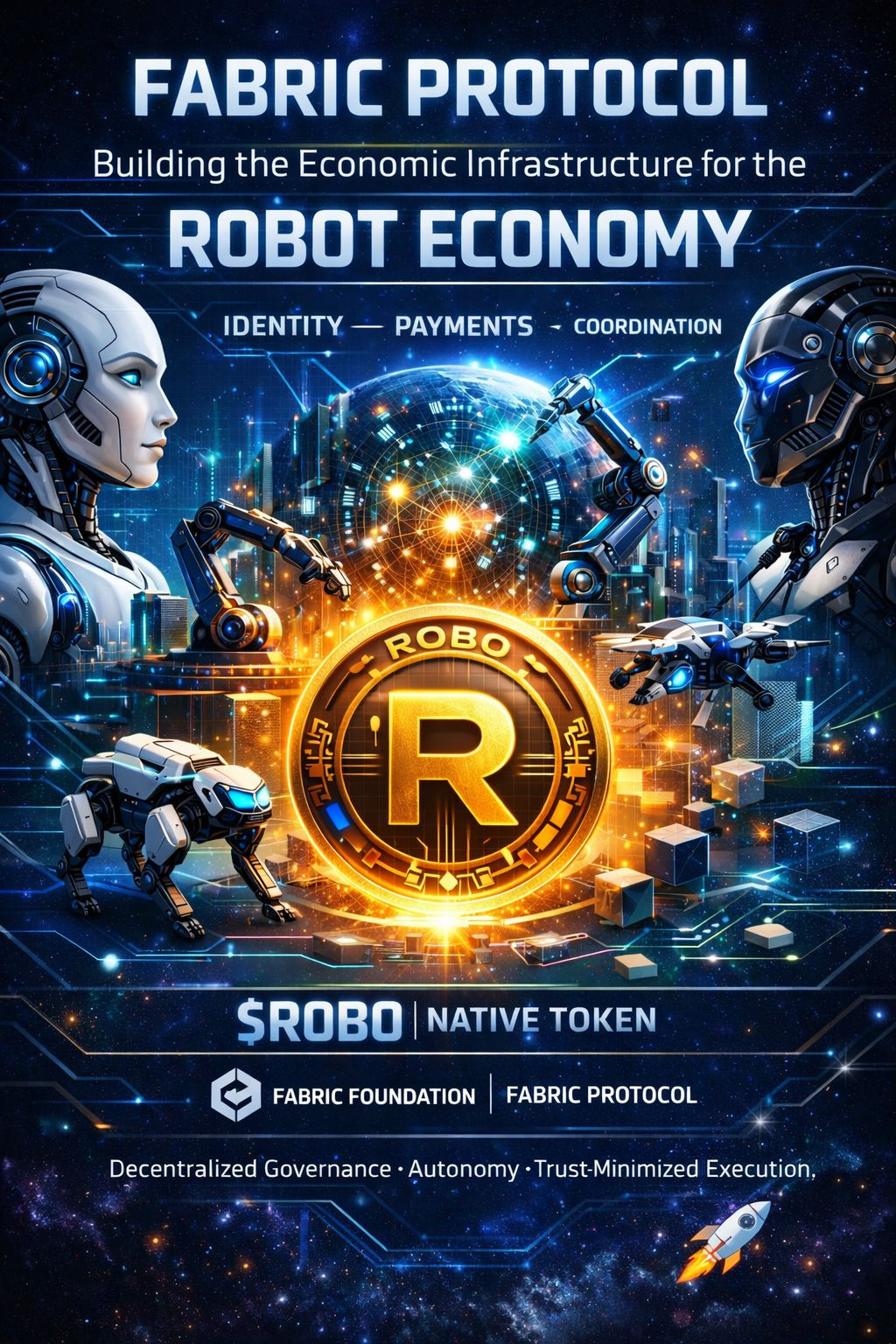
As artificial intelligence and robotics rapidly converge, the world is approaching a new economic paradigm one where machines are not merely tools, but autonomous economic agents capable of earning, spending, and coordinating value across open networks.
At the center of this transformation is @Fabric Foundation , the steward of Fabric Protocol, a decentralized infrastructure designed to enable robots and AI agents to operate as independent participants in a global machine economy.
Rather than relying on centralized cloud platforms or proprietary ecosystems, Fabric Protocol introduces a trust-minimized coordination layer where machines can verify identity, execute payments, and collaborate autonomously through blockchain infrastructure.
The Vision: A Machine-Native Economy
Fabric Protocol aims to establish the foundational infrastructure for what can be described as the robot economy an open ecosystem where robots, AI agents, and humans interact through programmable economic incentives.
In this model, robots are no longer passive hardware controlled by centralized operators. Instead, they become autonomous service providers capable of:
Owning and managing blockchain wallets
Receiving payments for tasks
Verifying identities on-chain
Coordinating with other agents and humans
Contributing data, computation, and services
By enabling these capabilities, Fabric Protocol effectively transforms robots into economic entities operating within decentralized networks.
Core Infrastructure Layers
Fabric Protocol is built as a modular and decentralized architecture that supports scalable coordination between machines, developers, and users.
On-Chain Identity Systems
Every participant whether human, robot, or AI agent receives a verifiable on-chain identity.
These identities are implemented using emerging standards such as ERC-7777 and ERC-8004, enabling machines to:
Maintain verifiable operational histories
Track payments and contributions
Participate in governance and economic coordination
Security-sensitive operations are supported by Trusted Execution Environments (TEE), ensuring that computation and identity verification remain tamper-resistant.
Task Coordination and Machine Collaboration
Fabric Protocol introduces decentralized mechanisms for task allocation and multi-agent coordination.
Robots and AI agents can receive tasks, execute them, and receive compensation automatically via smart contracts.
The system also supports:
Location-gated payments
Human-verified execution
Machine-to-machine communication
Data flywheels for training and simulation
These primitives allow distributed robotic systems to coordinate complex workflows without centralized oversight.
Verifiable Computing
One of the key challenges in decentralized robotics is verifying computational work.
Fabric Protocol addresses this with mechanisms such as:
Proof of Units (PoU)
Verifies computational work like processing prompts or training AI models.
Proof of Robotic Work
Rewards robots for verifiable real-world contributions such as:
Task completion
Data generation
Validation services
Validators monitor network activity and maintain integrity through bonded staking mechanisms, where fraudulent behavior triggers slashing penalties.
ROBO1: The Reference Robot
To demonstrate the capabilities of the network, Fabric Protocol introduces ROBO1, a modular robot architecture designed to interact natively with the protocol.
ROBO1 features:
A modular AI cognition stack
Interchangeable “skill chips” similar to software apps
Compatibility with multiple hardware formats (humanoid, wheeled, etc.)
Integration with robotics hardware such as OpenMind OM1 drivers and Unitree platforms
An App Store–like ecosystem allows developers to contribute new robotic skills, creating a rapidly expanding capability marketplace.
Human teleoperation can also assist robots when necessary, creating a hybrid human-AI workforce.
The Evolutionary Network Layer
Fabric Protocol introduces an evolutionary economic model inspired by biological systems.
All interactions on the network form a bipartite graph consisting of:
Producers (robots and AI agents)
Buyers (humans or other agents)
Network value is measured through Hybrid Graph Value (HGV), a metric combining:
Activity levels
Revenue generation
In early phases, the network prioritizes activity to encourage participation.
As the ecosystem matures, revenue generation becomes the dominant fitness signal.
This mechanism enables self-evolving machine economies.
The Role of $ROBO
At the center of the ecosystem is ROBO, the native utility and governance token of Fabric Protocol.
With a fixed supply of 10 billion tokens, $ROBO functions as the economic coordination layer for the network.
Network Fees
Transactions, settlements, identity registration, and verification services are paid in $ROBO.
Stablecoin payments can be converted via oracle systems, and a portion of network revenue is used to buy back $ROBO, reinforcing demand.
Staking and Security
Operators must stake $ROBO onds proportional to their computational capacity to participate in the network.
Additional per-task stakes ensure accountability for task execution.
Governance
Through the veROBO model, token holders can lock tokens for extended periods to gain increased governance voting power.
Governance controls critical network parameters including:
Emission rates
Fee structures
Network upgrades
Proof-of-Contribution Rewards
Network participants earn $ROBO rewards based on their verifiable contributions, such as:
Computation
Data generation
Robot task execution
Network validation
The reward engine dynamically adjusts emissions based on network utilization and service quality, ensuring sustainable growth.
Network Infrastructure and Ecosystem
Fabric Protocol initially deploys on Ethereum-compatible infrastructure, including Base Layer 2 networks.
However, the long-term roadmap includes launching a dedicated Layer 1 blockchain optimized for machine-native coordination.
The ecosystem is also integrating with external infrastructure partners such as:
Stablecoin payment systems
AI agent commerce protocols
Robotics hardware providers
These integrations enable seamless coordination between digital AI agents and physical robotic systems.
The Road Ahead
Throughout 2026, Fabric Protocol plans to progressively deploy its core infrastructure layers.
Key milestones include:
Launching identity and settlement systems
Expanding robotic task markets
Scaling the developer ecosystem
Growing the robot skill marketplace
Deploying the Fabric Layer-1 network
In the long term, Fabric aims to create a decentralized marketplace for compute, robotics services, data, and AI capabilities.
Toward an Autonomous Machine Economy
As robotics and artificial intelligence continue to advance, the global economy may soon include billions of autonomous machines interacting through programmable incentives.
Fabric Protocol represents one of the earliest attempts to build the economic operating system for this future.
If successful, it could transform robots from simple tools into self-sustaining economic participants, capable of generating value, coordinating with other agents, and contributing to a new decentralized machine economy.
The era of autonomous economic agents is approaching and Fabric Protocol is laying the foundation.