
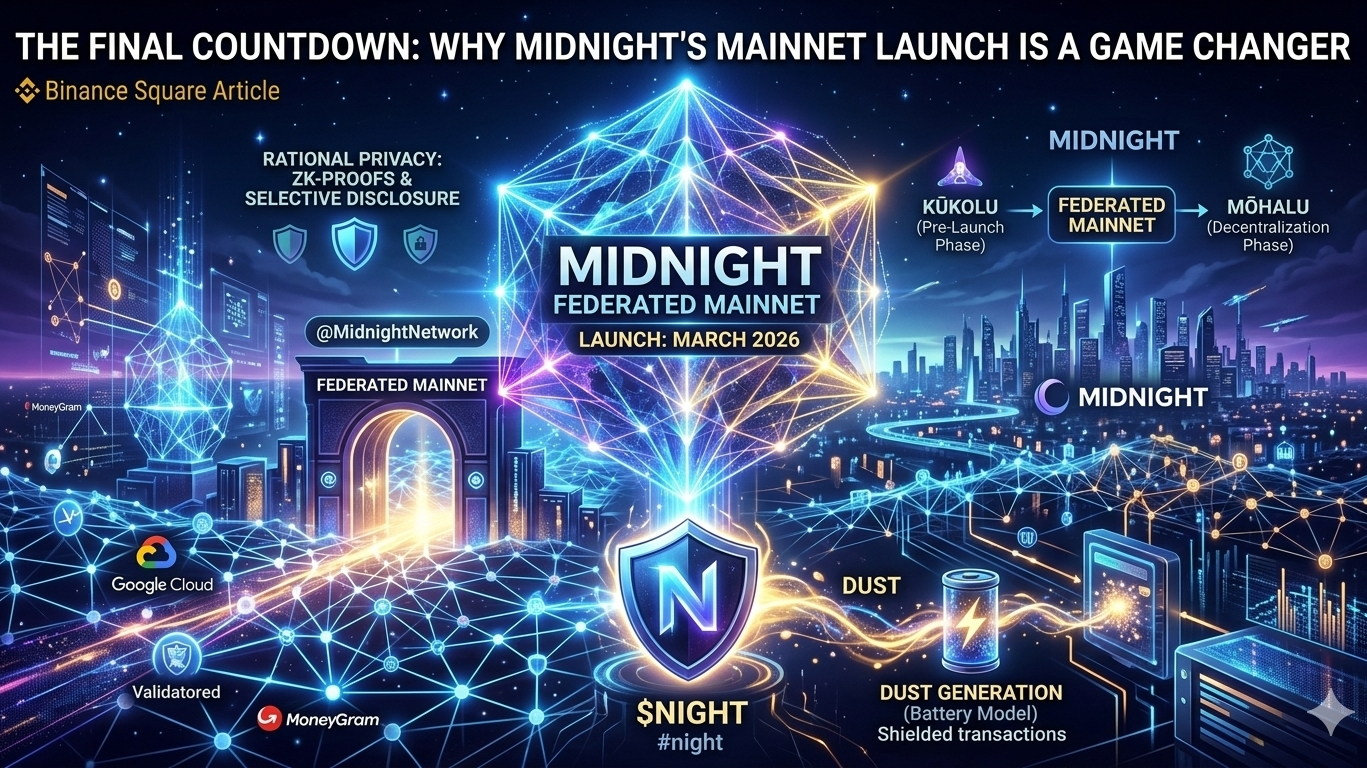
As we enter the third week of March 2026, the excitement in the crypto space is reaching a fever pitch for one specific project: @MidnightNetwork . With the Federated Mainnet launch officially scheduled for the final week of this month, we are witnessing the transition of "Rational Privacy" from a visionary concept into a live, production-ready reality.
What makes $NIGHT stand out in a sea of Layer 1 tokens? It’s all about the architecture. Unlike traditional privacy coins that operate on a simple "on/off" switch for anonymity, Midnight utilizes advanced Zero-Knowledge (ZK) proofs to allow for selective disclosure. This means developers can build applications that are private by default but remain regulatory compliant—a "must-have" for institutional adoption and real-world finance in 2026.
One of the most innovative features of the ecosystem is the dual-token "Battery Model." As a holder of $NIGHT , your tokens continuously generate DUST. DUST is the shielded, non-transferable resource used to pay for transaction fees. Think of it like a rechargeable battery: you use the power (DUST) to run your apps and shield your data, and it replenishes over time simply because you hold $NIGHT. This effectively decouples the cost of using the network from the market volatility of the token itself, providing businesses with the operational predictability they have been dreaming of.
The network’s credibility is further bolstered by its heavyweight node operators. Seeing giants like Google Cloud and MoneyGram step up as founding federated validators proves that the industry is ready for programmable privacy. As we move from the current Kūkolu phase toward the decentralized Mōhalu phase later this year, the utility of $NIGHT as a governance and security asset will only continue to expand.
The successful public opening of the Midnight City Simulation last month proved the tech is battle-hardened. Now, with the mainnet genesis block just days away, the era of compliant confidentiality is finally here.