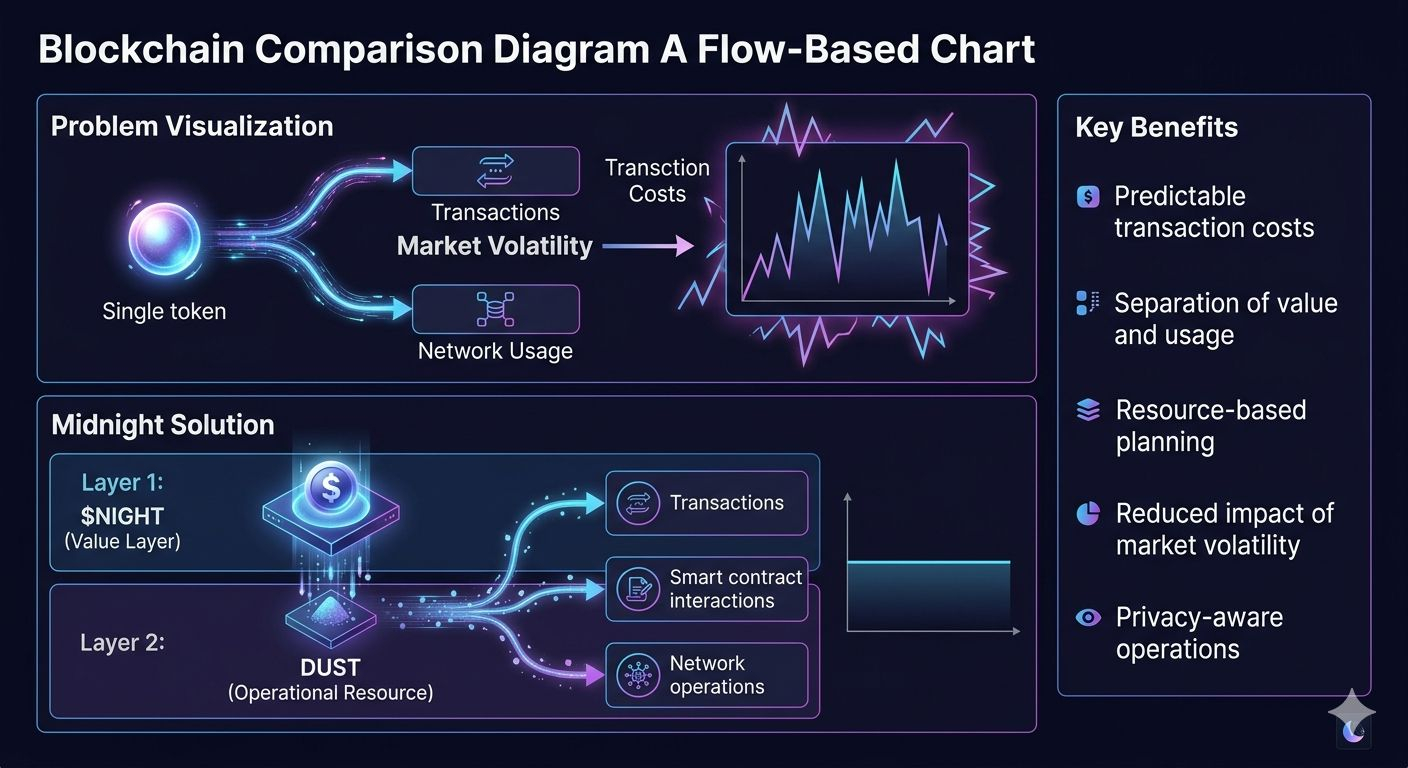
When I look at how most blockchain networks operate today, one issue keeps showing up in different forms. The cost of using the network is directly tied to the price of its native token. It sounds logical at first, but in practice it creates a system where usability depends on market conditions.
When prices rise, transaction costs often rise with them. When volatility increases, planning becomes harder. For developers building applications and users interacting with them, this unpredictability can quietly become a serious limitation.
Midnight approaches this problem from a different angle.
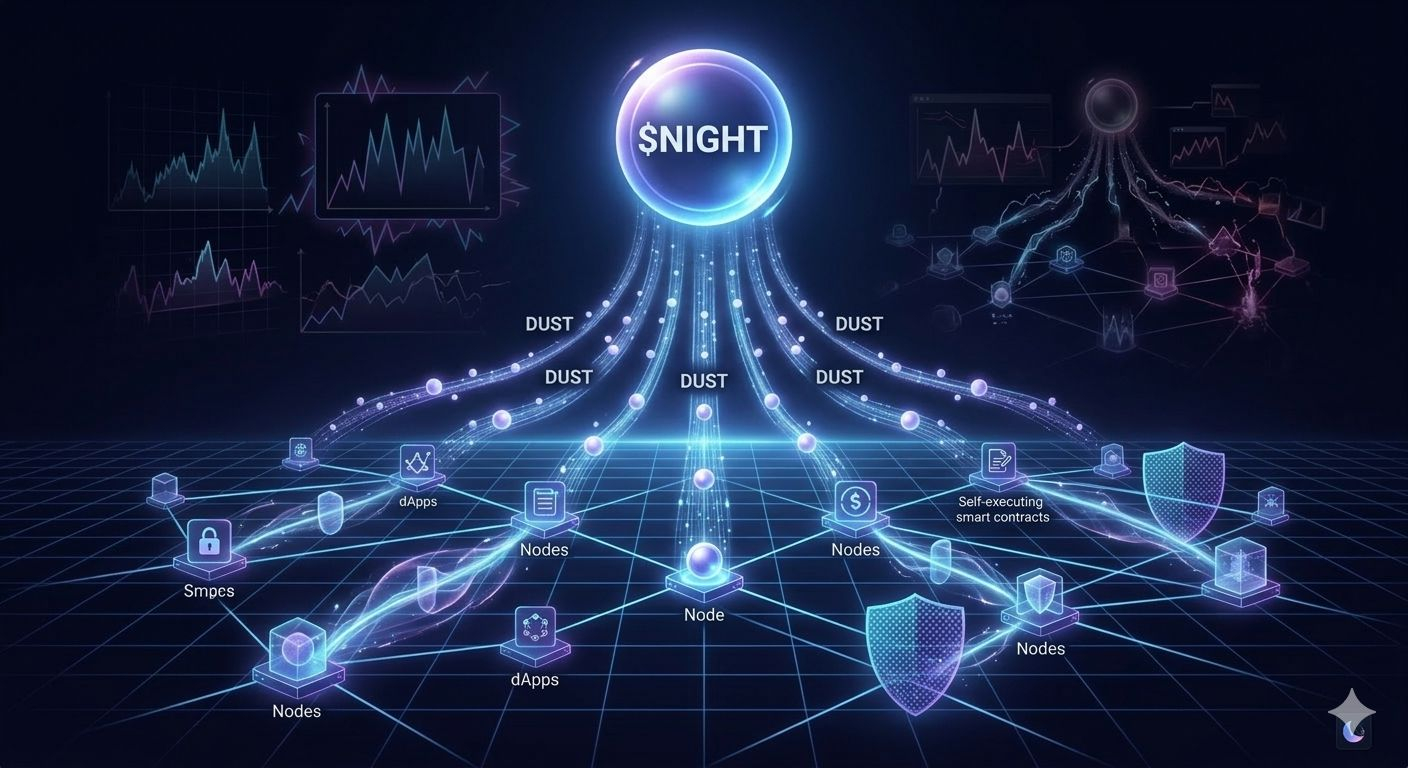
Instead of relying on a single token for everything, the network introduces a dual-layer economic structure built around $NIGHT and DUST. In this system, $NIGHT serves as the core utility token, but it is not directly spent to execute transactions. Its main role is to generate DUST over time.
DUST then acts as the operational resource that powers transactions and on-chain interactions.
What I find interesting about this design is how it separates value from usage. Holding $NIGHT allows participants to produce DUST, which can then be used to interact with the network. This means that the day-to-day cost of operating on the network is not constantly reacting to market price fluctuations.
From a practical perspective, this could change how blockchain costs are experienced. Developers can think in terms of resource generation and capacity planning rather than constantly adjusting to token volatility. Applications can be designed with more predictable operating models, which is something many current networks struggle to offer.
There is also a deeper layer to this model. Because DUST functions as a shielded resource, interactions on the network can happen without exposing unnecessary transaction metadata. This aligns with Midnight’s broader idea of rational privacy, where actions remain verifiable without revealing more data than necessary.
In my view, the significance of this dual-layer system goes beyond cost management. It represents an attempt to make blockchain infrastructure more stable and usable over time. By separating the asset that holds value from the resource that powers activity, Midnight introduces a structure that feels closer to how real-world systems manage resources.
Whether this model becomes widely adopted will depend on real usage and developer adoption. But as an idea, Midnight’s dual-layer economy offers a thoughtful way to reduce one of the most persistent frictions in blockchain systems: unpredictable costs.
$NIGHT #night @MidnightNetwork