
As we witness the rapid convergence of artificial intelligence and physical robotics, a fundamental structural problem has emerged: robots lack the "financial identity" required to operate independently in a digital economy. Traditional banking and legal systems are built for humans, leaving autonomous agents siloed within proprietary corporate walls. This is where @FabricFND (The Fabric Foundation) is stepping in to build the foundational infrastructure for a truly decentralized "Machine Economy."
The Problem of Robotic Isolation
In the current landscape, robots are often treated as mere hardware tools. They cannot own assets, pay for their own maintenance, or verify their work without a central intermediary. The Fabric Protocol aims to solve this "Isolation Problem" by providing a standardized layer where a robot’s AI can interface directly with a secure blockchain wallet. This allows machines to hold cryptographic keys, sign contracts, and participate in economic transactions on-chain.
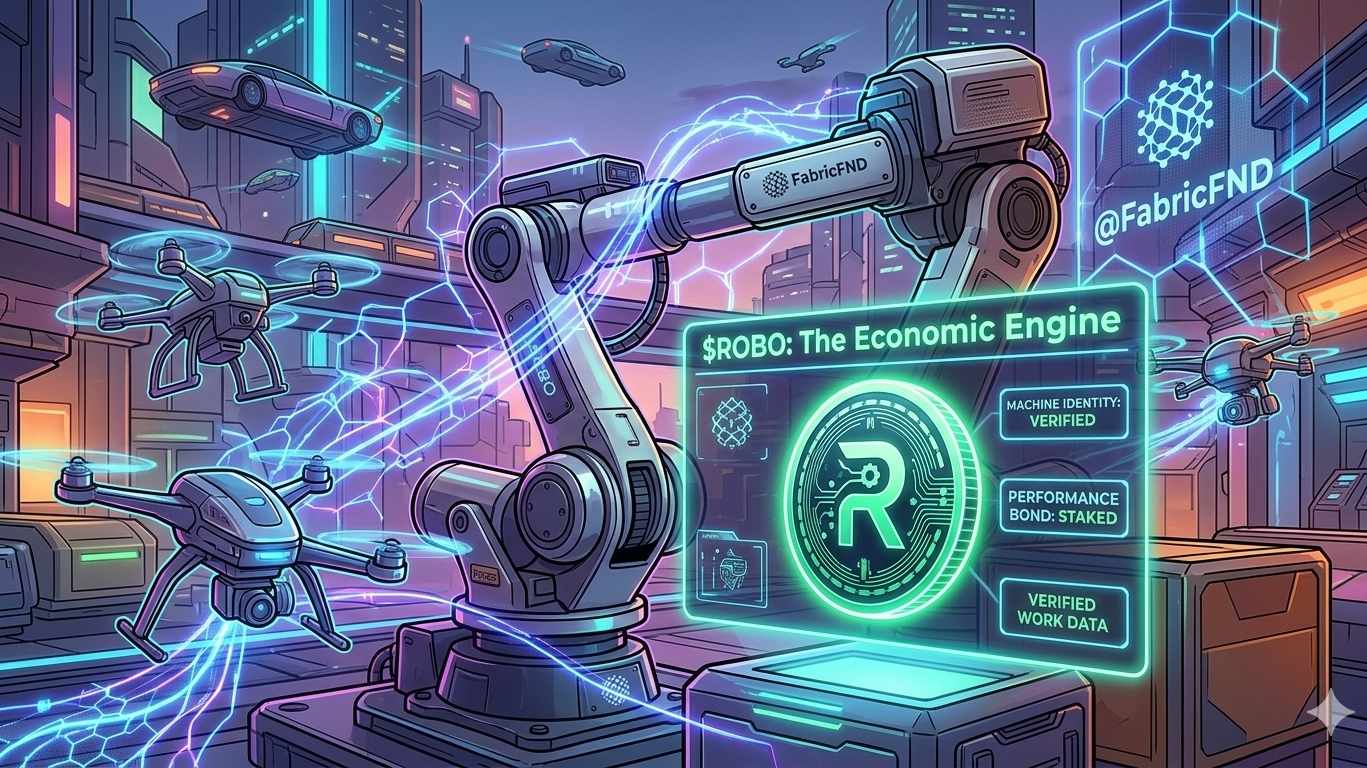
$ROBO: The Economic Engine
At the heart of this ecosystem is the $ROBO token. Unlike traditional tokens that focus on passive rewards, $ROBO is a high-utility asset designed to coordinate complex interactions between humans and machines. Its primary functions include:
On-Chain Identity & Verification: $ROBO is used to pay for network fees related to establishing sovereign identities for autonomous agents.
Performance Bonds: To ensure reliability, robot operators must stake $ROBO as a performance bond. This "skin in the game" creates a layer of accountability—if a machine fails to perform its task, the bond can be slashed, protecting the integrity of the network.
Verified Work Rewards: Rewards in the ecosystem are tied to "verified work" rather than simple staking, encouraging genuine productivity and data contribution from the hardware layer.
A Future Built on Human-Machine Alignment
The mission of @Fabric Foundation extends beyond just technology; it is about governance. By moving toward a decentralized Layer 1 (L1) mainnet, the project ensures that the rules governing our future robotic workforce are transparent and community-driven rather than controlled by a handful of tech giants.
As we move toward 2026 and beyond, the transition of robots from "tools" to "autonomous economic participants" will be one of the most significant shifts in the tech industry. With its focus on verifiable computing and decentralized coordination, the Fabric ecosystem is well-positioned to lead this charge.