
Privacy vs Utility yeah, this fight never really got solved
Look, blockchains proved something important early on.
Transparent execution works. You can verify everything, track everything, audit everything. No arguments there.
But let’s be real for a second… the real world doesn’t run like that, and it never will.
Banks don’t publish every internal transfer.
Companies don’t open their data pipelines to the public.
Identity systems don’t show your full passport just so you can prove you’re over 18.
And yet most chains still act like total transparency is the only “pure” design.
I’ve seen this pattern way too many times.
A project adds privacy, everyone gets excited, then integrations break, composability dies, and suddenly nobody wants to build on it anymore.
Same triangle every time:
Public chains → usable, but exposed
Private chains → safe, but isolated
Privacy add-ons → complicated, fragile, painful
The funny part? The math was never the problem.
Architecture was.
Nobody figured out how to add privacy without breaking everything else.
That’s exactly the corner Midnight is trying to work in, and honestly… that’s why I started paying attention.
Keep the chain public. Keep the data private. Sounds simple, right?
Here’s the idea Midnight leans on, and I like it because it doesn’t try to fight reality.
They don’t hide the blockchain.
They hide the data, then prove the result.
Small sentence. Big consequences.
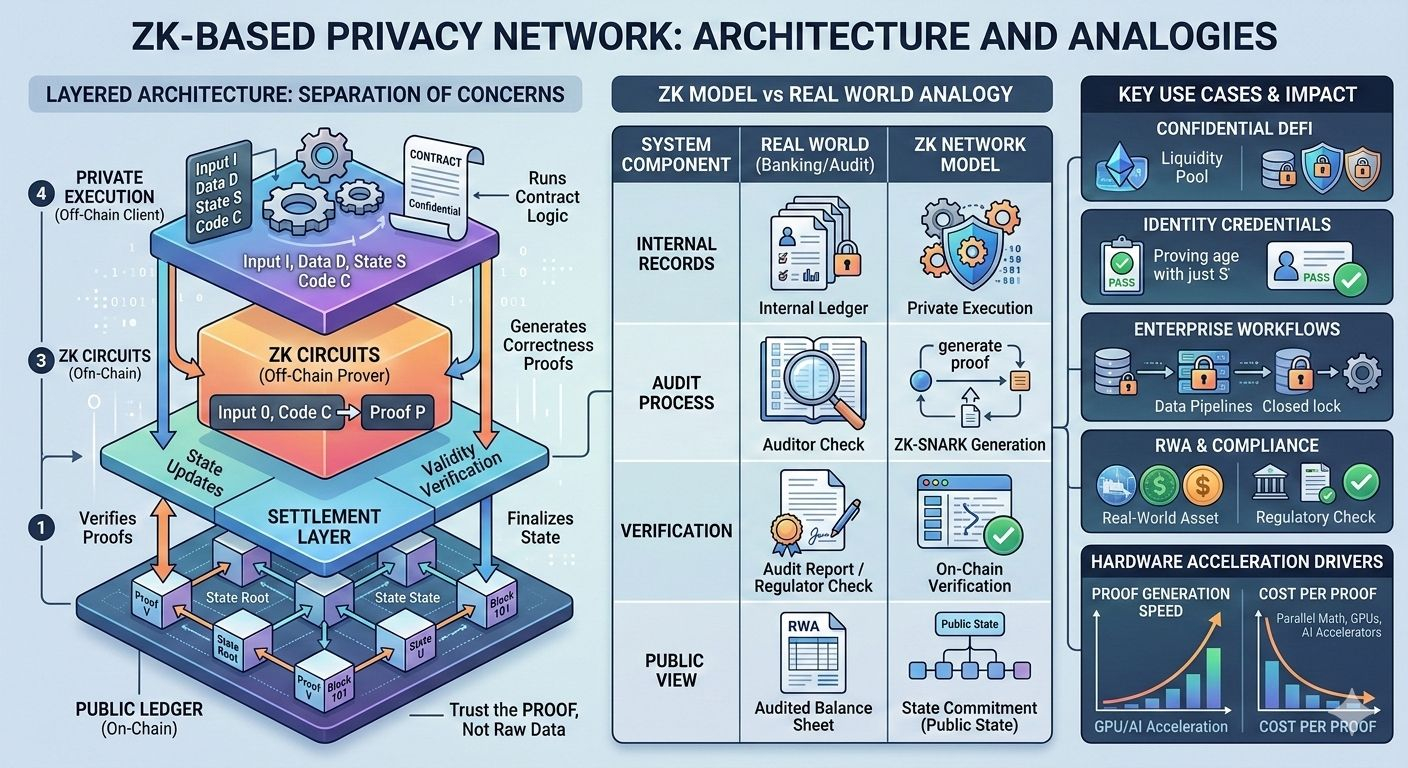
The system splits into layers instead of forcing everything into one place:
Layer Role
Public ledger Verifies proofs
Private execution Runs contract logic
ZK circuits Generate correctness proofs
Settlement layer Finalizes state
So the network doesn’t trust raw data anymore.
It trusts the proof that the data was processed correctly.
On paper that sounds like a detail.
In practice, that’s a completely different execution model.
And yeah, this is where things start getting interesting.
ZK circuits replace raw execution and that changes how contracts even work
Normally a chain runs your transaction in public. Everyone sees it.
Midnight flips that.
The contract runs privately, then a ZK circuit produces a proof that basically says:
> I ran this code, and the result checks out.
No inputs revealed.
No internal state revealed.
Just validity.
Flow is straightforward, but the implications aren’t:
1. Contract runs off-chain
2. Circuit generates proof
3. Proof goes to the network
4. Network verifies proof
5. State root updates
That’s it.
Nothing sensitive leaks, but the chain still stays verifiable.
People don’t talk about this enough, but this only works today because hardware finally caught up.
Ten years ago? This design would’ve been unusable. Way too slow.
Now? Totally different story.
Hardware changed the rules not crypto, not theory, hardware
Honestly, zero-knowledge didn’t suddenly become popular because people got smarter.
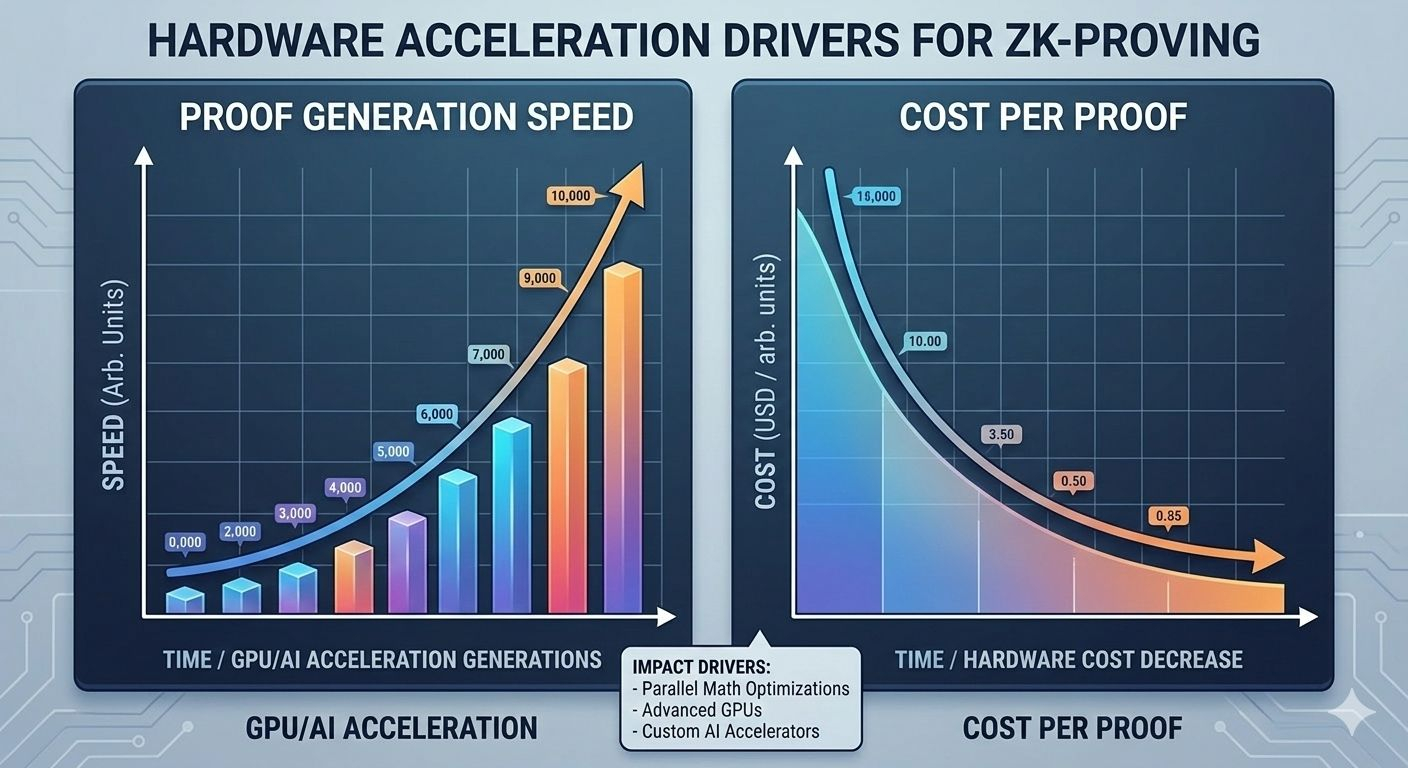
It became popular because GPUs got ridiculously fast.
Same thing that pushed AI forward.
Proof generation loves parallel math.
GPUs love parallel math.
You don’t need a whitepaper to see where that leads.
Right now ZK proving rides on the same trends pushing AI:
Hardware trend Why it matters
GPUs Parallel proof generation
AI accelerators Faster field arithmetic
Cloud clusters Distributed proving
WASM runtimes Portable execution
Instead of fighting compute limits, Midnight rides the same wave everyone else rides.
That’s the part I think a lot of people miss.
Privacy didn’t become realistic because blockchains improved.
It became realistic because compute got cheap.
Big difference.
Think about finance nobody shows the full ledger
Here’s the analogy that makes this click for most people.
Banks don’t show you every internal transaction.
They show audited statements.
Auditors check the details.
You trust the audit.
Same pattern here.
Real world ZK model
Audit report Proof
Internal ledger Private execution
Regulator check On-chain verification
Balance sheet State commitment
You don’t need the raw data.
You need proof the raw data is correct.
Blockchains spent years assuming everyone needed to see everything.
Turns out, most real systems don’t work like that at all.
Why older privacy designs kept breaking stuff
I’ll be honest, we’ve tried this before. Many times.
And every time something broke.
Full encryption → no composability
Mixers → no programmability
Shielded pools → hard to integrate
Privacy rollups → trust assumptions everywhere
Most teams tried to bolt privacy onto public chains.
That approach almost always turns messy.
Midnight flips the order:
Privacy first.
Verification second.
Sounds obvious now, but building from scratch is harder than patching old designs, so most teams never did it.
And patches always come back to haunt you.
Always.
Not everything needs privacy but the stuff that does really does
People love saying every app needs privacy.
No it doesn’t.
NFTs don’t care.
Memecoins definitely don’t care.
Public trading sometimes benefits from transparency.
But some use cases just don’t work without selective disclosure:
Confidential DeFi positions
Identity credentials
Enterprise workflows
AI inference results
Tokenized real-world assets
Compliance-safe transactions
These need a weird mix:
Private data
Public verification
Deterministic execution
Auditability
Normal chains struggle here.
Proof-based execution fits naturally.
That’s why this design actually matters.
Where this could go intent, proofs, and less manual transactions
Here’s the part people don’t talk about yet.
ZK isn’t only about hiding data.
It changes how users interact with the chain.
Instead of sending transactions, you send intent.
Swap at best price.
Prove I’m eligible.
Execute this trade under these rules.
Run this model privately.
The network figures out the execution.
Then it proves the result.
If this keeps going, blockchains stop looking like ledgers.
They start looking like compute networks with verification layers.
And honestly… that feels closer to where everything is heading anyway.
Not louder chains.
Smarter ones.
@MidnightNetwork #night $NIGHT
